Field: Technology
Why the Right Side of Your Brain Runs the Left Side of Your Body
Published | Technical Staff
Visualization
The intricate dance of neuronal connections that govern the interplay between our brain and body has long been a subject of fascination and inquiry. A fundamental tenet of neuroscience teaches us that the right hemisphere of the brain orchestrates movements and processes information from the left side of the body, while the left hemisphere does the converse. This seemingly paradoxical crossing of neural pathways has provoked speculation and investigation for centuries, with scholars attempting to illuminate the mechanisms behind this contralateral organization.
In a recent hypothesis articulated by Martin W. Wessendorf and Daniel Delie Wang from the University of Minnesota, the crossed arrangement of the mammalian cortex may not be a result of selective adaptation but instead a historical artifact stemming from evolutionary processes. A hallmark of their argument lies in the evolutionary significance of vision, positing that the mammalian cortex inherited this wiring as part of its phylogenetic lineage.
“Our research indicates that the organization of the mammalian central nervous system, particularly in the context of motor control, has deep evolutionary roots,” remarked Wessendorf and Wang in their publication in *Frontiers in Neuroanatomy*. The fiber pathways that govern motor commands from the cortex to the spinal motoneurons are intricately linked to the process by which sensory input is processed. For instance, the right motor cortex is responsible for directing motoneurons that govern movements in the left limbs, while the left cerebral cortex predominantly receives sensory neuronal input from the left side of the external environment, a phenomenon described in the sophisticated neural circuitry of the vertebrate brain.
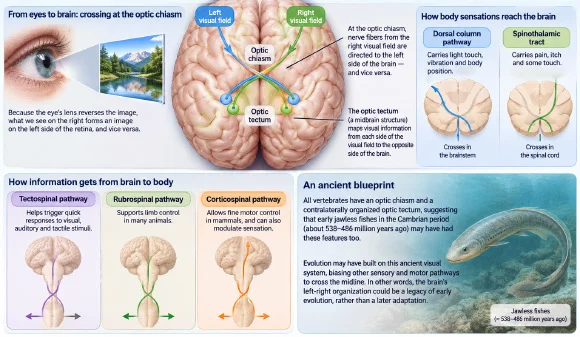
The authors meticulously reviewed an extensive body of comparative studies that spanned multiple vertebrate classes, including fish, amphibians, reptiles, birds, and mammals, to delineate patterns of shared neural traits. Central to their findings is the assertion that vision represents one of the earliest systems to exhibit a crossed configuration. Every vertebrate species examined, extending from primitive lampreys to sophisticated humans, possesses an optic chiasm – a critical structure where the visual fibers originating in each visual field cross over to be processed in the contralateral optic tectum, which occupies a vital midbrain role in coordinating sensory input and motor responses.
Drawing from evolutionary analyses, Wessendorf and Wang contend that the last common ancestor of vertebrates likely exhibited both an optic chiasm and contralateral visual processing pathways. Other categories of crossed neural circuits arose in later evolutionary phases. The touch and nociceptive pathways to the thalamus, the tectospinal tract, and the rubrospinal tract emerged in the last common ancestor of tetrapods, suggesting that even as species diversified into more complex forms, fundamental wiring patterns remained remarkably consistent.
The researchers introduce the corticospinal tract as a unique construct of mammals, although a parallel projection has been documented in certain avian species. Herein lies the crux of their hypothesis: the arrangement of the optic tectum, by virtue of receiving multiple sensory inputs and broadcasting motor commands, inadvertently set a precedent for the organization of subsequent sensory and motor systems that would emerge in mammals. With mammals first appearing approximately 165 million years ago, the crossing of major neuronal pathways had already been entrenched in the evolutionary narrative.
Such a crossed organization, while not an outright necessity, would have offered a pragmatic advantage in neuronal architecture, sparing the organism from the potential ‘wiring costs’ associated with maintaining energy-intensive uncrossed systems – where either excess connections or circuit revisions would have been required. The complexities entailed in rewiring the brain to accommodate an uncrossed neocortex would likely have engendered decreased functional efficiency and heightened metabolic demands.
Yet, variability exists within the corticospinal tract across species. Evidence indicates that in certain animals – including goats and elephants – this tract remains bilateral, contrasting with the predominantly uncrossed configurations found in hedgehogs and moles. Wessendorf and Wang interpret this variability as indicative of a lack of strong selective pressure favoring a uniform crossed organization across all mammalian species.
In their exploration, the authors meticulously dissect six prevailing hypotheses that attempt to rationalize the contralateral organization of the brain. Some notions allude to structural benefits, injury resilience, enhanced navigation towards goals, or ancestral anatomical blueprints. Each hypothesis, however, reveals certain inadequacies upon scrutiny. For instance, a theoretical framework postulating that crossing is essential for preserving spatial maps hinges on the erroneous assumption that all mapped pathways must exhibit crossing, which is patently untrue.
While Wessendorf and Wang tread with caution, categorizing their proposal as a hypothesis open to empirical scrutiny, they present several testable predictions that could further substantiate their arguments. Investigations into Cambrian fossils of early vertebrates might reveal the presence of an optic tectum and chiasm. Studies on the anatomical configurations of cranial tracts in crocodilians and diverse bird species can yield insights into the prevalence of crossed telencephalic pathways. Moreover, analyses of the functional efficiencies of crossed versus uncrossed wiring could provide robust evidence for or against their claims.
“Evolution is fundamentally conservative and builds upon existing structures,” the researchers elucidate, drawing attention to the notion that the organizational principles governing the visual system, particularly the optic tectum, may have set foundational standards for the development of subsequent sensory and motor pathways in the evolutionary timeline.
They assert that the contralateral organization of the neurological frameworks did not arise purely as an adaptive solution, but rather as a product of evolutionary engineering that optimized existing resources and circuitry. In doing so, Wessendorf and Wang propose a compelling narrative that reshapes our understanding of the evolutionary origins of brain organization—a reminder that the complex machinery of the central nervous system is as much a product of historical contingency as it is of natural selection.