Field: Technology
Why Mathematicians Both Revere and Fear the Riemann Hypothesis
Published | Technical Staff
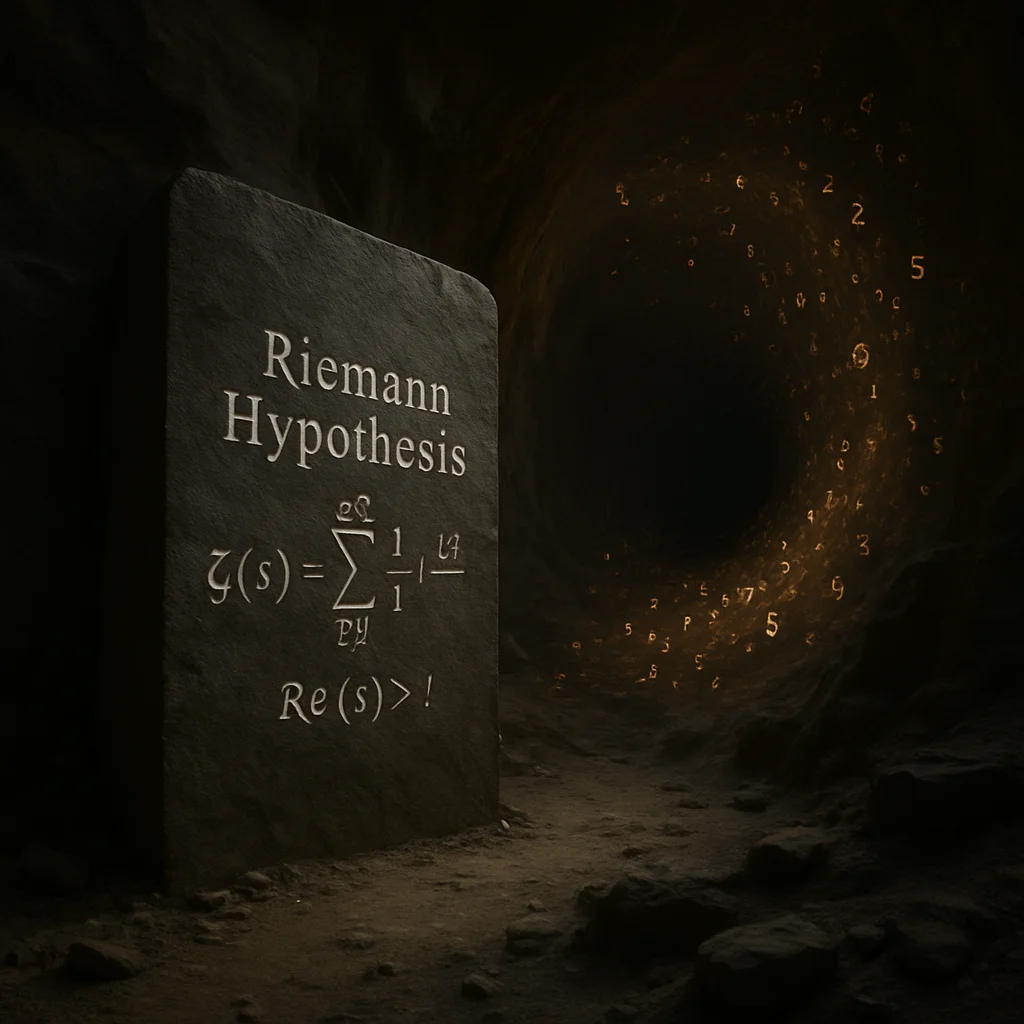
Visualization
In the rarefied world of pure mathematics, the Riemann hypothesis stands as both an apex of unsolved mystery and a monolith of intellectual intimidation. Though festooned with a million-dollar prize from the Clay Mathematics Institute — a challenge enshrined among the seven Millennium Problems — the hypothesis finds itself at the periphery of active research, shrouded in both reverence and wary resignation. Its formidable reputation is matched only by its profound implications: a proof would cascade through mathematics, altering fields from cryptography to quantum physics.
Consider a scene at a 2024 Harvard University workshop where the future of mathematical proof — particularly the integration of artificial intelligence — was under earnest discussion. Amid the collegial exchange, a question surfaced: would it matter if an AI, rather than a human, finally proved the Riemann hypothesis? MIT number theorist Andrew Sutherland articulated an unease that mirrored the collective anxiety among mathematicians: “An AI that can prove the Riemann hypothesis is not one I’d want to meet. If that happens, mathematicians having jobs will be the least of our problems.” The unease is rooted less in professional obsolescence than in the chasm separating human mathematical intuition and the daunting abstraction that the hypothesis presents.
Yet the enigma of the Riemann hypothesis is not merely historical happenstance or mathematical vanity. Its gravitational pull lies in its direct bearing on the distribution of prime numbers, the elemental units of arithmetic. Prime numbers, those positive integers divisible only by one and themselves, underpin the structure of the integers; their unpredictable appearance along the number line has been an obsession since antiquity. Euclid’s proof, circa 300 B.C.E., established the infinitude of primes, yet their positional distribution — the spacing among these arithmetic atoms — remained persistently mysterious.
Mathematicians spanning millennia have searched for patterns amidst this apparent numerical chaos. The Enlightenment saw the construction of exhaustive tables cataloging primes and their factorizations. In the late 18th century, prodigy Carl Friedrich Gauss began to discern a faint order. Venturing into observational mathematics, he noted the diminishing density of primes as one moves along the number line: for instance, there are 25 primes between 0 and 100, but only 16 between 1,000 and 1,100. Gauss conjectured a relationship governing this phenomenon, codifying it in the form of the Prime Number Theorem (later rigorously proven): the number of primes less than some large number \( x \) approximates \( \frac{x}{\log x} \), where \( \log \) denotes the natural logarithm. This statistical regularity, however, begged a deeper analytic explanation.
The germ of that explanation emerged in 1859 through the work of Bernhard Riemann, a former theology student captivated by the spectral nature of primes. Riemann introduced a mathematical apparatus, the now-eponymous zeta function:
\[
\zeta(s) = \sum_{n=1}^{\infty}\frac{1}{n^s}
\]
where the input \( s \) is a complex number — that is, a number of the form \( s = \sigma + it \), with \( \sigma \) and \( t \) real and \( i = \sqrt{-1} \) the imaginary unit. Initially, this infinite sum converges (yields meaningful values) only for \(\sigma > 1\), but Riemann’s exceptional insight was to extend, via analytic continuation, the domain of the zeta function over the entire complex plane save for a simple pole at \( s = 1 \).
The prime numbers, it turns out, are intimately encoded in the zeros of the zeta function, that is, the complex solutions to \( \zeta(s) = 0 \). Riemann’s revolutionary conjecture — the heart of the hypothesis — claims that all "nontrivial" zeros (those not at the obvious negative even integers) lie precisely along the so-called critical line, where the real part \( \sigma \) equals \( \frac{1}{2} \). Formally, the Riemann hypothesis asserts that:
\[
\zeta\left(\frac{1}{2}+it\right) = 0
\]
for infinitely many values of \( t \), and that all such nontrivial zeros have real part \( \frac{1}{2} \).
Why should this matter? The spectral placement of these zeros governs the fluctuation in the count of primes up to a given magnitude. Through the explicit formulae in analytic number theory, the location of zeta zeros tightly constrains the error terms in prime-counting functions. In practical terms: a proof would render the distribution of primes as asymptotically regular as possible, revolutionizing fields that rely on their unpredictability — most notably cryptography, where the difficulty of prime factorization underpins encrypted communications.
Yet, despite this mathematical and practical allure — not to mention the pecuniary incentive — the Riemann hypothesis remains largely untouched by contemporary researchers. Even among number theorists, there is a palpable reluctance to engage directly. As Rutgers University’s Alex Kontorovich acknowledges, “The basic status is: nothing is happening, and I don’t really expect anything to happen.” Oxford’s James Maynard admits, “I don’t spend too much of my day really thinking about it. I just don’t really have any good idea of how to get started.”
The reluctance reflects the hypothesis’s forbidding technical landscape. The machinery of complex analysis, analytic continuation, and the intricate behavior of the zeta function have only become more elaborate over the decades. While computational advances have pushed the verification of the hypothesis’s prediction—confirming, for instance, that billions of nontrivial zeros do indeed lie on the critical line—such numerical evidence, however impressive, cannot substitute for the inviolable certainty of proof.
The deeper truth is that the Riemann hypothesis is not merely a difficult problem; it is a condensation of two centuries of mathematical culture. It is the keystone of a great arch, connecting arithmetic, complex analysis, probability, and mathematical physics. It influences quantum chaos, random matrix theory, and even the energy levels in heavy nuclei. Its resolution — if one can even imagine such an outcome—would not simply solve an old riddle about primes; it would redraw the map of mathematics.
No wonder, then, that even in an age animated by artificial intelligence and algorithmic ambition, the Riemann hypothesis remains an object of awe, not direct attack. For now, it sits in splendid, daunting isolation, awaiting either a revolution in mathematical ideas—or the advent of a superintelligence that Sutherland and his colleagues contemplate with both hope and unease. Until then, the primes—and the zeta function that shadows them—continue to whisper their secrets just beyond the reach of human reason.