Field: Technology
White Dwarf’s Radio Pulses Reveal Storms on Its Sun-Like Companion
Published | Technical Staff
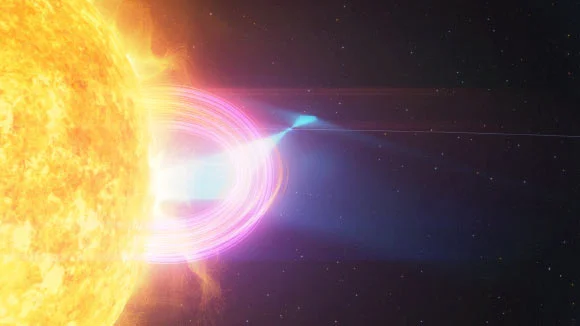
Visualization
In an unprecedented discovery, astronomers from the Curtin University node at the International Centre for Radio Astronomy Research (ICRAR) have identified a white dwarf, designated as GPM J071507-114153, which emits radio pulses every 7.9 minutes while orbiting a G-type star akin to our Sun. This marks a pivotal moment in the study of long-period transients (LPTs), a class of astronomical objects characterized by their fluctuating radio emissions over timescales ranging from minutes to hours. The current finding adds to the mere dozen known instances of such phenomena since the first LPT was cataloged in 2021 by the same research team.
The binary system's nomenclature hints at a combination of a low-mass white dwarf and a Sun-like star, presenting an intriguing platform within which dynamic astrophysical interactions can be scrutinized. A critical aspect of this research is the confirmation that the pulsar-like emissions emanate not merely from the stellar duo's interactions but specifically from the white dwarf itself. Dr. Sam McSweeney, a leading figure in this study, remarked on the clarity of the observed signals, stating that they were robust enough to illustrate the white dwarf's distinct orbital movements around its companion star. This observation provides compelling evidence that the radio pulses originate from a region proximate to the white dwarf, representing a significant advancement in our understanding of such celestial bodies.
Through meticulous processing of over 100 hours of radio data at the Pawsey Supercomputing Research Centre, the researchers were able to unveil previously undetected stellar flares on the G-type companion, akin to those that produce spectacular auroras on Earth. These flares are indicative of the star’s magnetic activity, demonstrating the diverse range of phenomena exhibited by solar-type stars in binary configurations. Furthermore, the investigation revealed a phenomenon known as a stellar prominence, which consists of large loops of plasma that erupt from the surface of stars. This prominence appears to have eclipsed the white dwarf, further elucidating the intricate dance of celestial bodies in this binary system.
Dr. Natasha Hurley-Walker, another prominent astronomer involved in the publication, underscored the significance of their findings by highlighting the power of radio wavelengths in allowing researchers to observe stellar activity occurring over 5,000 light-years away. This capability not only enhances our comprehension of the white dwarf's environment but also sheds light on the mechanisms underlying radio emissions in binary systems.
The research was encapsulated in a paper published in *Nature Astronomy*, where the authors provided insights into the magnetic fields and stellar dynamics involved in this intriguing system. By unveiling the behavior and characteristics of GPM J071507-114153, scientists are afforded a rare glimpse into the complexities of star formation, evolution, and the interactions that occur when differing stellar masses coexist. The findings hold promise for future investigations into the robustness of long-period transient phenomena and the role they play in the broader context of galactic evolution.
As researchers continue to probe the cosmos for such enigmas, the study of GPM J071507-114153 exemplifies the confluence of advanced technology and astrophysical inquiry, revealing the nuances of celestial mechanics that inform our understanding of the universe.