Field: Technology
Webb Unveils the Dynamic Stellar Nursery of N159
Published | Technical Staff
Visualization
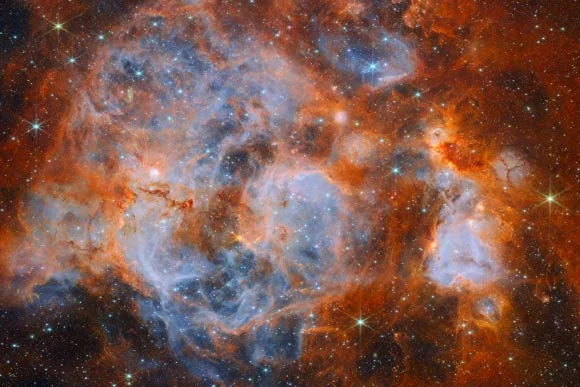
The illustrious depths of the cosmos have been further illuminated by observations from the James Webb Space Telescope (JWST), a culmination of efforts from NASA, ESA, and CSA. Recently, astronomers received a transformative view of N159, one of the most prolific H II regions nestled within the Large Magellanic Cloud—our Milky Way's satellite galaxy that resides approximately 161,000 light-years away and extends over 230 light-years in expansiveness.
The N159 complex is a youthful entity in galactic terms, having formed less than 3 million years ago. Within this stellar nursery, thousands of nascent stars are evolving under conditions dictated by the interplay of gravity and thermodynamics. Dr. Nolan Habel of NASA’s Jet Propulsion Laboratory, along with his seasoned colleagues, has elucidated the processes governing star formation in these extraordinary environments. As they elucidate, the saga begins with the gravitational collapse of massive molecular clouds predominantly composed of cold hydrogen gas. This collapse initiates thermonuclear reactions, birthing new stars that are often massive, hot, and capable of emitting powerful ultraviolet radiation which subsequently ionizes the surrounding gas.
HII regions, characterized by their ionized hydrogen, serve as grand indicators of ongoing star formation. The resultant ionized gas not only radiates light but also forms the brilliant emission nebulae observable in high-resolution images from JWST. Utilizing the Near-Infrared Camera (NIRCam), the telescope’s imagery exposes the exquisite structures sculpted by the intense stellar winds and energetic radiation from these luminous stellar bodies.
Pale blue segments of N159 represent zones of ionized hydrogen, their iridescence contrasting sharply with orange-tinted areas rich in polycyclic aromatic hydrocarbons—carbon-based molecules known for their chemical complexity and contribution to interstellar medium processes. Adding a further layer of structure, dark red filaments of cool molecular hydrogen traverse the scene, densely packed features that perform a critical shielding function for nascent stars against the harsh bombardment of radiation and stellar winds from their more massive counterparts. Within these intricate filaments, the infant stars endeavor to forge their identities, partially cloaked yet visible as specks of light against the backdrop of dynamic gas structures.
These stupendous observational capabilities allowed researchers to differentiate between young stellar objects still encased in their formative cloud structures and those further along in development. Notably, the N159 complex harbors exceptionally faint stars with masses less than one-tenth of that of our Sun, suggesting a rich tapestry of stellar evolution in varying stages.
Spatial analysis within N159 revealed an intriguing asymmetry: the western segment of the complex exhibited a significantly higher density of young stellar objects compared to its eastern counterpart. This disparity intimates that star formation in the western region is still in the nascent stages, a tantalizing prospect for astronomers eager to understand the chronology of stellar evolution. The researchers posited that N159 presents a unique opportunity to scrutinize the sequential dynamics of star formation within collapsing molecular clouds, akin to a cosmic time capsule revealing simultaneous generations of star development.
With their findings shared on the arXiv.org preprint server on September 22, 2026, the work by Habel and collaborators not only augments our understanding of star formation dynamics but also redefines our comprehension of stellar nurseries within the greater cosmic arena. N159 stands not just as a site of stellar birth, but as a testament to the relentless and beautiful processes that govern the fabric of the universe itself.