Field: Technology
Webb Unveils a Hidden Population of Low-Mass Stars, Redefining the Early Universe's Galactic Mass
Published | Technical Staff
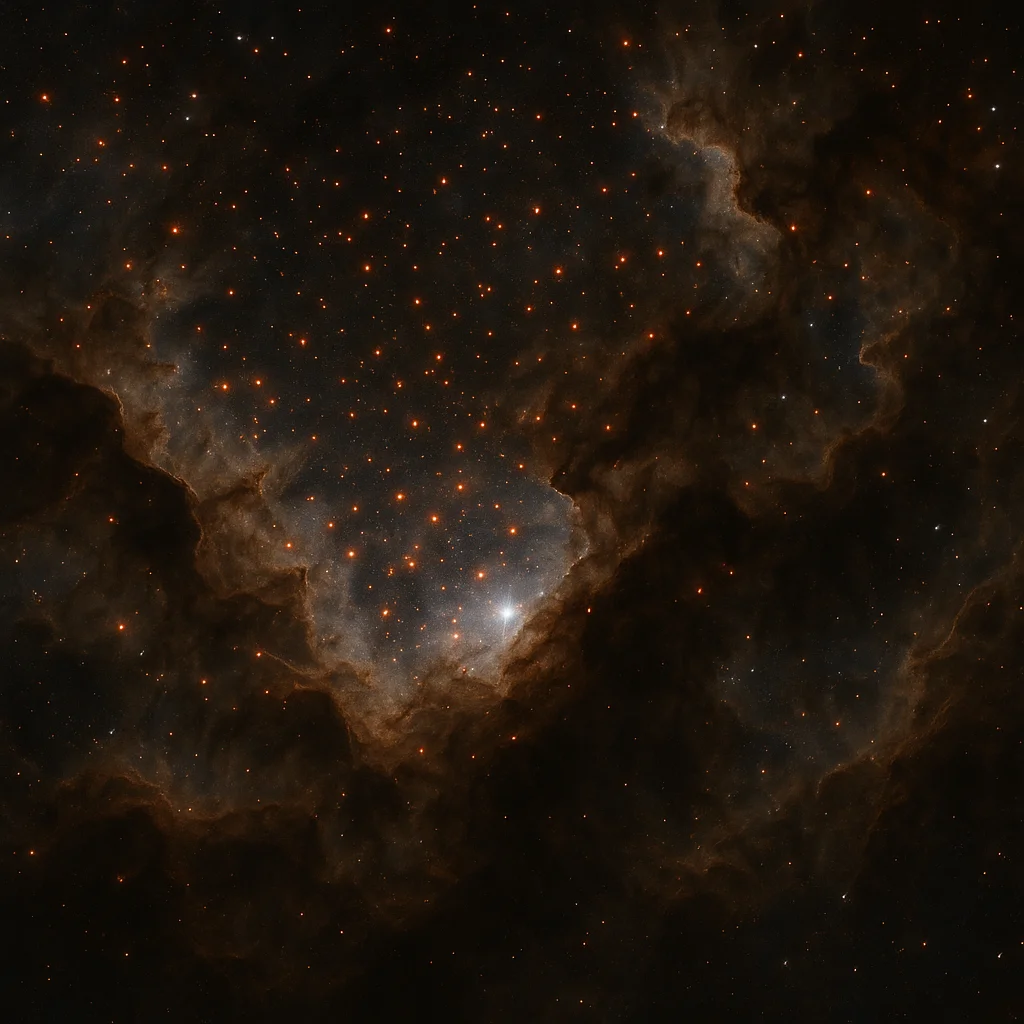
Visualization
The earliest chapters of cosmic history have once again been rewritten, as the James Webb Space Telescope (JWST) penetrates the shrouded depths of ancient galaxies to reveal a profusion of faint, low-mass stars previously lost in the glare of their more luminous compatriots. In a landmark study published in *Nature Astronomy* by Cheng et al., the team’s analysis of nine massive, quiescent galaxies—systems that had ceased star formation billions of years ago—demonstrates that these galaxies harbor up to four times more stellar mass than conventional estimates suggested, fundamentally altering our perception of matter assembly in the infant cosmos.
Historically, the Initial Mass Function (IMF)—the statistical distribution governing the birth masses of stars within a newly formed population—has been assumed to be largely invariant across space and time. This Salpeter-like or Chabrier-like IMF dictates a relative scarcity of low-mass stars, calibrated against observations in the local Universe. Stellar population synthesis models, primarily informed by optical and near-infrared photometry and limited low-redshift galaxy spectra, further entrenched this paradigm. However, leveraging the unrivaled spectral acuity and sensitivity of JWST’s instruments, Dr. Chloe Cheng and collaborators meticulously dissected the stellar content of galaxies that flourished in epochs less than a few billion years after the Big Bang.
Their approach incorporated medium-resolution spectra taken by JWST’s Near Infrared Spectrograph (NIRSpec), allowing the isolation of subtle absorption features—such as Na I and Wing-Ford bands—which are exquisitely sensitive to the temperature and surface gravity characteristics intrinsic to low-mass, low-luminosity stars (typically M-dwarfs with masses < 0.5 M_⊙). By fitting these spectra with advanced stellar population models that permit a variable, so-called “bottom-heavy” IMF, the investigators uncovered a startling result: existing mass-to-light (M/L) ratios, predicated on a standard IMF, had been systematically underestimated.
The data reveal that the stellar mass (M_*) of these compact galaxies is underestimated by factors of three to four when assuming a canonical IMF. Mathematically, if the traditional M/L ratio yields \( M_* = (M/L)_{\rm canonical} \times L \), where \( L \) is the bolometric luminosity, the study shows the true mass is closer to \( M_* = (3-4) \times (M/L)_{\rm canonical} \times L \). The implication is profound: the cumulative stellar mass density of the early Universe may be vastly greater than previously projected, forcing a recalibration of cosmic star formation rates and galactic assembly histories.
Dr. Joel Leja of Penn State, a co-author, emphasizes the radical nature of these findings: “These galaxies are different in a way that is really challenging to understand. They’re more massive than we expected—three or four times more massive.” Cheng likens the observational challenge to discerning houses hidden among skyscrapers: “The brightest stars are the skyscrapers, while low-mass stars—far more numerous—are like the houses obscured between them.” JWST’s unique combination of resolution and sensitivity was indispensable; as Leiden’s Martje Slob notes, “We needed not only a telescope capable of magnifying very distant galaxies, but also spectra of exceptional quality and new analysis techniques to reliably detect these subtle signatures.”
That seemingly innocuous “bottom-heavy” IMF not only redefines the global stellar mass budget but also has ramifications for exoplanet demographics. Low-mass stars are fertile grounds for planetary systems; thus, the early occurrence rate of planets across the universe may be much higher than previously theorized. “If more low-mass stars formed in the early cosmos, then so did more planets,” adds Professor Mariska Kriek of Leiden Observatory.
The findings challenge the universality of the IMF, demanding new theoretical frameworks for star and galaxy formation in extreme environments. Furthermore, the rapid assembly of such massive, mature galaxies mere gigayears after the Big Bang intensifies the enigma of hierarchical structure formation, as it implies that star formation rates and the efficiency of baryonic collapse into stars were far higher than anticipated.
The bottom-heavy IMF scenario, quantitatively captured by a steeper logarithmic slope \( \alpha \) in the IMF functional form \( \xi(m) \propto m^{-\alpha} \), where the observed values of \( \alpha > 2.35 \) (Salpeter) tip the scales toward dwarf-rich populations, stands in stark defiance of the previously held universality postulate.
With these revelations, JWST has not only illuminated faint stars in distant galaxies but also cast a new light on the fundamental processes shaping the Universe’s stellar and planetary archipelago. The deeper one peers into the cosmic past, the more the Universe’s complexity and capacity for surprise become manifest, inviting a new era of inquiry into the hidden mass shaping cosmological evolution.
Historically, the Initial Mass Function (IMF)—the statistical distribution governing the birth masses of stars within a newly formed population—has been assumed to be largely invariant across space and time. This Salpeter-like or Chabrier-like IMF dictates a relative scarcity of low-mass stars, calibrated against observations in the local Universe. Stellar population synthesis models, primarily informed by optical and near-infrared photometry and limited low-redshift galaxy spectra, further entrenched this paradigm. However, leveraging the unrivaled spectral acuity and sensitivity of JWST’s instruments, Dr. Chloe Cheng and collaborators meticulously dissected the stellar content of galaxies that flourished in epochs less than a few billion years after the Big Bang.
Their approach incorporated medium-resolution spectra taken by JWST’s Near Infrared Spectrograph (NIRSpec), allowing the isolation of subtle absorption features—such as Na I and Wing-Ford bands—which are exquisitely sensitive to the temperature and surface gravity characteristics intrinsic to low-mass, low-luminosity stars (typically M-dwarfs with masses < 0.5 M_⊙). By fitting these spectra with advanced stellar population models that permit a variable, so-called “bottom-heavy” IMF, the investigators uncovered a startling result: existing mass-to-light (M/L) ratios, predicated on a standard IMF, had been systematically underestimated.
The data reveal that the stellar mass (M_*) of these compact galaxies is underestimated by factors of three to four when assuming a canonical IMF. Mathematically, if the traditional M/L ratio yields \( M_* = (M/L)_{\rm canonical} \times L \), where \( L \) is the bolometric luminosity, the study shows the true mass is closer to \( M_* = (3-4) \times (M/L)_{\rm canonical} \times L \). The implication is profound: the cumulative stellar mass density of the early Universe may be vastly greater than previously projected, forcing a recalibration of cosmic star formation rates and galactic assembly histories.
Dr. Joel Leja of Penn State, a co-author, emphasizes the radical nature of these findings: “These galaxies are different in a way that is really challenging to understand. They’re more massive than we expected—three or four times more massive.” Cheng likens the observational challenge to discerning houses hidden among skyscrapers: “The brightest stars are the skyscrapers, while low-mass stars—far more numerous—are like the houses obscured between them.” JWST’s unique combination of resolution and sensitivity was indispensable; as Leiden’s Martje Slob notes, “We needed not only a telescope capable of magnifying very distant galaxies, but also spectra of exceptional quality and new analysis techniques to reliably detect these subtle signatures.”
That seemingly innocuous “bottom-heavy” IMF not only redefines the global stellar mass budget but also has ramifications for exoplanet demographics. Low-mass stars are fertile grounds for planetary systems; thus, the early occurrence rate of planets across the universe may be much higher than previously theorized. “If more low-mass stars formed in the early cosmos, then so did more planets,” adds Professor Mariska Kriek of Leiden Observatory.
The findings challenge the universality of the IMF, demanding new theoretical frameworks for star and galaxy formation in extreme environments. Furthermore, the rapid assembly of such massive, mature galaxies mere gigayears after the Big Bang intensifies the enigma of hierarchical structure formation, as it implies that star formation rates and the efficiency of baryonic collapse into stars were far higher than anticipated.
The bottom-heavy IMF scenario, quantitatively captured by a steeper logarithmic slope \( \alpha \) in the IMF functional form \( \xi(m) \propto m^{-\alpha} \), where the observed values of \( \alpha > 2.35 \) (Salpeter) tip the scales toward dwarf-rich populations, stands in stark defiance of the previously held universality postulate.
With these revelations, JWST has not only illuminated faint stars in distant galaxies but also cast a new light on the fundamental processes shaping the Universe’s stellar and planetary archipelago. The deeper one peers into the cosmic past, the more the Universe’s complexity and capacity for surprise become manifest, inviting a new era of inquiry into the hidden mass shaping cosmological evolution.