Field: Technology
Webb Illuminates Black Hole Feeding Ritual in Giant Elliptical Galaxy NGC 4696
Published | Technical Staff
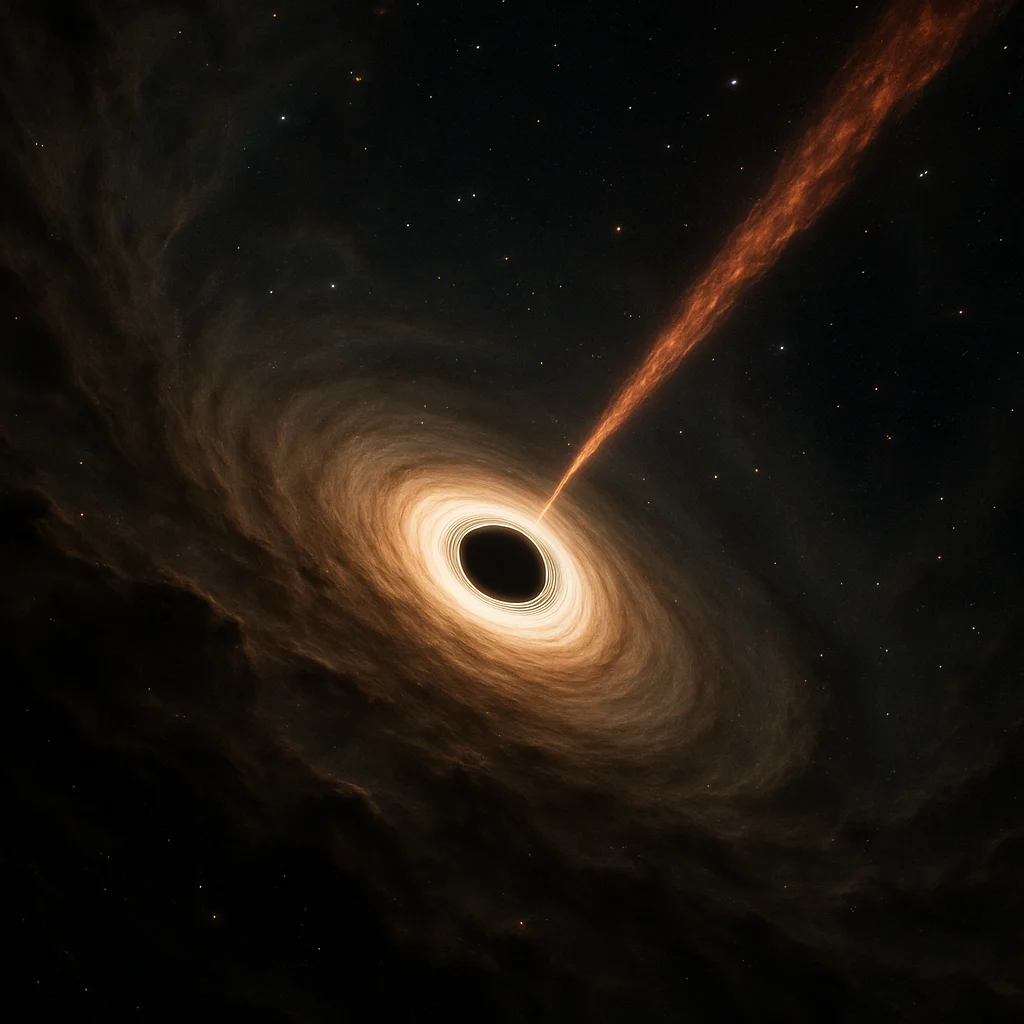
Visualization
An unprecedented observational campaign with the James Webb Space Telescope (JWST) has resolved a decades-old astrophysical enigma: the mass accretion mechanism by which supermassive black holes in giant elliptical galaxies sustain their growth, amid destructive feedback from their own relativistic jets. At the heart of this advance is NGC 4696, the dominant galaxy in the Centaurus Cluster, whose colossal mass and proximity—116 million light-years—make it an exquisite laboratory for investigating galaxy-scale feedback and regulation.
NGC 4696, spanning nearly 30,000 light-years, harbors a central supermassive black hole enveloped by intricate gas dynamics. Prior to JWST, the prevailing paradigm held that active galactic nuclei (AGN) in such environments exert prodigious mechanical and radiative feedback. Once triggered, these AGN can accelerate and heat surrounding interstellar and intracluster medium, quenching star formation and, in theory, cutting off their own accretion supply—an apparent paradox for continued black hole growth. This self-limiting mechanism seemed to contradict the presence of exceptionally massive black holes, often reaching 10^9–10^10 solar masses.
Webb’s NIRSpec (Near-Infrared Spectrograph) instrument, utilizing an integration time approaching eight hours, produced spectroscopically resolved maps of NGC 4696’s nucleus at an angular resolution corresponding to ~30 light-years—substantially finer than previous facilities. The JWST’s infrared sensitivity pierced through dust-obscured regions to reveal both morphology and kinematics of the circumnuclear gas. The diagnostic emission-line imaging revealed a prominent S-shaped structure, which dynamical modeling has confirmed is, in fact, a massive, rotating disk extending roughly 800 light-years across, kinetically dominated by gas rotating at velocities up to 600 km/s.
Crucially, the investigation detected large-scale filamentary accretion structures physically connected to this nuclear disk. These filaments, some only a few hundred light-years in cross-section but extending thousands of light-years into the host galaxy, serve as funnel-like pathways for cooled interstellar gas to traverse from the galaxy’s hot atmosphere into the very sphere of influence of the black hole. Emission-line spectral diagnostics (such as those from [Fe II], Paα, and molecular hydrogen lines) indicate multiphase gas with stratified temperatures and densities, consistent with a cooling flow scenario.
The full feedback-accretion cycle, illuminated by these data, is elegantly self-regulating: AGN-driven jets inject energy and entropy into the surrounding medium, forestalling catastrophic cooling on global scales (mechanical heating rates are on the order of 10^44 erg/s). Nevertheless, thermal instabilities localize in regions where the cooling time t_cool drops below several times the free-fall time t_ff, producing conditions conducive to multiphase condensation. The resulting filaments lose angular momentum, mediated in part by magnetic field draping and associated magnetorotational instability (MRI), and ultimately deliver cold gas to the vicinity of the black hole. This process is quantitatively consistent with the "chaotic cold accretion" (CCA) framework, in which stochastic infall regulates both black hole growth rates and the larger galaxy’s star formation rate.
State-of-the-art magnetohydrodynamical (MHD) simulations, constrained and parameterized with JWST-derived boundary conditions, replicate the observed filament morphology and kinematics. Velocity gradients, turbulence levels, and filament geometry predicted by these simulations resonate with the Webb observations, bolstering confidence in the CCA model. The simulations further confirm the role of magnetic fields (B ≈ 10–100 μG) in channeling material inward, retarding angular momentum transfer, and ultimately modulating the accretion disk growth.
“It’s remarkable,” comments Dr. Mark Voit of Michigan State University, “to see empirical evidence of magnetic fields shepherding cold gas into direct accretion flows, precisely as our theoretical models have long postulated.”
Thus, NGC 4696 now stands as an archetype for understanding self-regulated AGN feeding cycles in giant ellipticals. As the research team—led by Julie Hlavacek-Larrondo and colleagues—prepares full publication in The Astrophysical Journal Letters, the direct linkage between kiloparsec-scale multiphase filaments and sub-kiloparsec-scale circumnuclear disks crystallizes. Multimodal accretion, aided by magnetic and hydrodynamical processes, forms the backbone of black hole growth even in the face of immense feedback. The Webb era, armed with technical prowess in the infrared, is moving astrophysical black hole theory from speculation to demonstrable, empirical phase space.
The observationally confirmed cycle in NGC 4696 eloquently demonstrates that, far from stifling their own growth, AGNs set the stage for their own feeding—a cosmic dance of heating, cooling, and magnetic choreography, enacted on scales spanning parsecs to tens of kiloparsecs.