Field: Technology
Webb Discovers Dust-Rich Water Ice in Interstellar Comet 3I/ATLAS
Published | Technical Staff
Visualization
Recent observations from the James Webb Space Telescope (JWST) have unveiled compelling insights about the interstellar comet 3I/ATLAS, a celestial traveler believed to have originated from regions surrounding distant stars. Astronomers, led by Dr. Silvia Protopapa of the Southwest Research Institute, have found that the water ice within this comet is interspersed with dark, rocky materials, forming a mixture that deviates significantly from the compositions of icy bodies originating within our own Solar System.
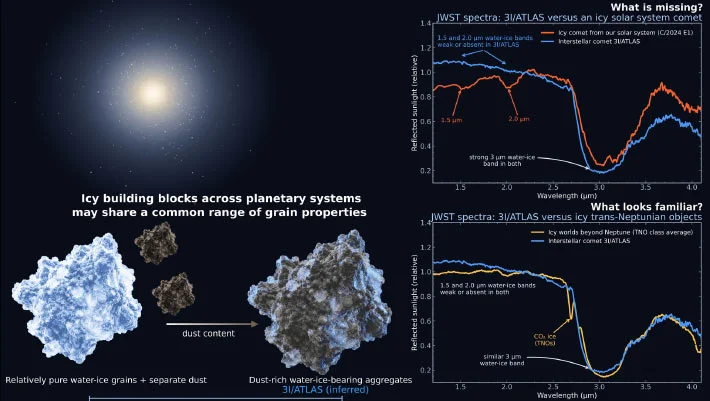
The team employed the Near-Infrared Spectrograph (NIRSpec) aboard JWST to analyze 3I/ATLAS across three distinct dates: August 6, December 22, 2025, and April 1, 2026, strategically timed to coincide with the comet's perihelion—its closest approach to the Sun—on October 29, 2025. Through this temporal lens, the researchers acquired spectra that revealed the presence of a strong water-ice absorption band, particularly pronounced near the 3-micron wavelength, while simultaneously detecting gas emissions of water, carbon dioxide, and carbon monoxide. In stark contrast to typical icy comets, 3I/ATLAS exhibited a pronounced absence of absorptions near the 1.5 and 2.0-micron regions.
The differences in spectral characteristics led the research team to postulate that the ice grains within 3I/ATLAS are of a fundamentally unique composition, resembling the spectra of icy celestial bodies located beyond Neptune, rather than the familiar ice observed in solar system comets. Preliminary modeling indicates these grains are composed predominantly of water ice amalgamated with refractory materials, with sizes on the order of just a few micrometers. This distinctive composition not only distinguishes 3I/ATLAS from its solar system counterparts but provides insight into the conditions prevailing in its region of formation. As Dr. Protopapa articulated, the nature of the grains "holds clues to the conditions where the comet was born."
The intricacies of the spectral data reveal more than just the icy makeup of 3I/ATLAS; they hint at the presence of a second population of larger, micron-sized ice-rich grains noted during the April 2026 observation. This raises a critical question: are these spectral changes the result of differential heating by the Sun or indicative of material being exposed as the comet's surface erodes? The ambiguity surrounding these observations presents an exciting frontier for ongoing research, as Dr. Michael Kelley from the University of Maryland points out, acknowledging that clarifying these dynamics is among their collective goals.
Additionally, the research compares 3I/ATLAS to a variety of other comets and trans-Neptunian objects, proposing that icy planetesimals formed in disparate star systems could possess a continuum of ice grain properties. This continuum ranges from nearly pure ice compositions to those highly infused with refractory materials. Notably, 3I/ATLAS appears to be skewed towards the more refractory-rich end of the spectrum. As Dr. Protopapa notes, this implies that what was initially perceived as an anomaly might not be so unusual in the broader cosmological context: "When we placed it alongside distant icy worlds in our own Solar System, it no longer looked out of place."
Moreover, if these grain properties are substantiated through further research, they could suggest an early establishment of water ice forms within planet-forming disks, potentially preserved within the icy bodies birthed in such environments. The implications of this work resonate strongly within the context of planetary formation theories, offering a potential bridge between the chemical compositions of precursor materials across the Universe.
The findings have been documented in detail in the forthcoming issue of the Astrophysical Journal Letters, and as they permeate through the scientific community, they are likely to stimulate further explorations of interstellar comets and the formative conditions of planetary material in the cosmos. The initial observations of 3I/ATLAS not only enhance our understanding of this singular comet but also illuminate the enigmatic processes that govern the genesis of celestial bodies across the galaxy.