Field: Technology
Water Molecules and Silicate Dust Thrive in the Volatile Shadow of the Milky Way’s Supermassive Black Hole
Published | Technical Staff
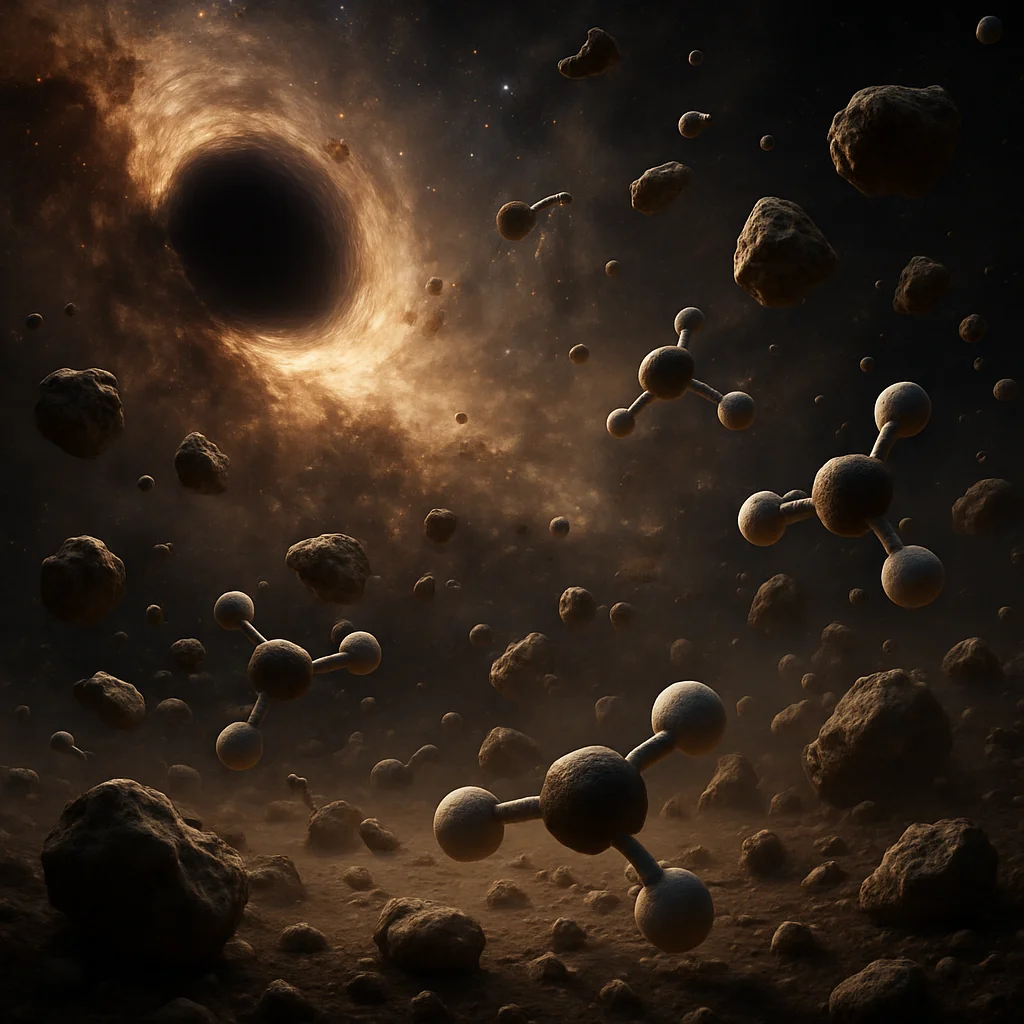
Visualization
Within the heart of the Milky Way, the region dominated by the gravitational monolith of Sagittarius A*—a supermassive black hole with a mass over four million solar masses—one would expect only the most robust forms of matter to endure the milieu's severe radiation fields, intense stellar winds, and tidal forces. Yet, a new investigation led by Dr. Florian Peißker and colleagues, utilizing the unprecedented sensitivity and spatial resolution of the James Webb Space Telescope’s (JWST) Mid-Infrared Instrument (MIRI), has upended expectations. The team reports the ongoing synthesis of silicate dust and the survival of water molecules in the extended envelope of a giant star, IRS 3, orbiting a mere 0.55 light-years from Sagittarius A*’s accretion disk—an environment that tests the very limits of molecular and particulate resilience.
IRS 3 itself is a behemoth: an oxygen-rich, asymptotic giant branch (AGB) star, estimated to be 72 million years in age and possessing nearly six solar masses. As it exhausts its nuclear reserves, IRS 3 has entered its terminal evolutionary phase, exhibiting intense mass-loss that manifests as concentric, optically-thick shells of dust and gas. These are the very exhalations from which future planetary systems may condense—but conventional wisdom has long held that such delicate structures cannot survive the ferocious UV and X-ray onslaught as near as a parsec from a galaxy’s central black hole.
The Webb observations, recorded through a continuous mid-infrared spectrum obtained by MIRI’s Medium-Resolution Spectrometer (MRS), have delivered the most comprehensive spectral data for IRS 3 to date—a feat unattainable with prior ground-based instrumentation, such as the earlier VLT/NACO observations. The spectrum reveals pronounced absorption bands at wavelengths characteristic of silicate-based dust, specifically at approximately 9.7 μm and 18 μm—features which are unequivocally associated with Si–O vibrational modes and only manifest in oxygen-rich stellar chemistries. This spectral fingerprint conclusively rules out earlier hypotheses that IRS 3 might be a carbon-rich object.
Further bolstering the significance of the finding, the team identified clear signatures of water vapor (H₂O) in the same circumstellar envelope. The molecular absorption lines in the mid-infrared, which are routinely obliterated by dissociative photons in high-radiation environments, persisted in the Webb spectra. Their survival indicates not only active water formation in the outflow, but also that the dust envelope attains sufficient optical depth to attenuate the pervasive high-energy emissions from Sagittarius A* and its cluster of massive, radiation-intensive neighbors.
To dissect the intricate temperature gradients and compositional variations of the envelope, the group employed the Hyperion radiation transfer code, simulating over 100,000 model permutations to reproduce the observed SED (Spectral Energy Distribution). The best-fitting model describes IRS 3 as radiating with L ≈ 6 × 10⁴ L_☉, its circumstellar shell stratified into layers distinguished by chemical gradients: an inner regime dominated by refractory aluminum oxides, whose proximity to the stellar photosphere allows survival at T > 1400 K, with a gradual transition outward to silicate-rich grains at distances where the temperature drops by approximately 1,000 K. Crucially, the temperature and density gradients modeled suggest regions within the envelope where H₂O molecules can persist, shielded from ambient UV and X-rays by both the dust and column density of gas.
The ramifications of this discovery extend far beyond the local context of IRS 3. That water and planet-forming minerals can assemble and endure within one light-year of a galactic central black hole provides a blueprint for chemical evolution under the most adversarial astrophysical conditions. This challenges longstanding assumptions embedded in models of galactic nuclei and implies a surprising robustness of astrochemical processes even where molecular lifetimes should, by most calculations, be fleeting.
“These results demonstrate not only the formidable power of JWST to illuminate hidden processes in extreme environments,” comments Dr. Peißker, “but also the adaptability of stellar mass-loss and dust chemistry under conditions that previously seemed prohibitive for complex molecule survival.” Dr. Macarena Garcia Marin of the European Space Agency echoes this, emphasizing that collecting continuous mid-infrared spectra for a star this close to a galactic center constitutes a milestone: “For the first time, we have direct observational proof of ongoing dust and water production in the very heart of the Milky Way.”
The implications are clear: even in the galaxy’s most relentless crucible, the cosmos finds a way to recycle, enriching the interstellar medium with the requisite ingredients for planet and, potentially, life formation—reminding us that astrophysical violence and creative chemistry are anything but mutually exclusive.
IRS 3 itself is a behemoth: an oxygen-rich, asymptotic giant branch (AGB) star, estimated to be 72 million years in age and possessing nearly six solar masses. As it exhausts its nuclear reserves, IRS 3 has entered its terminal evolutionary phase, exhibiting intense mass-loss that manifests as concentric, optically-thick shells of dust and gas. These are the very exhalations from which future planetary systems may condense—but conventional wisdom has long held that such delicate structures cannot survive the ferocious UV and X-ray onslaught as near as a parsec from a galaxy’s central black hole.
The Webb observations, recorded through a continuous mid-infrared spectrum obtained by MIRI’s Medium-Resolution Spectrometer (MRS), have delivered the most comprehensive spectral data for IRS 3 to date—a feat unattainable with prior ground-based instrumentation, such as the earlier VLT/NACO observations. The spectrum reveals pronounced absorption bands at wavelengths characteristic of silicate-based dust, specifically at approximately 9.7 μm and 18 μm—features which are unequivocally associated with Si–O vibrational modes and only manifest in oxygen-rich stellar chemistries. This spectral fingerprint conclusively rules out earlier hypotheses that IRS 3 might be a carbon-rich object.
Further bolstering the significance of the finding, the team identified clear signatures of water vapor (H₂O) in the same circumstellar envelope. The molecular absorption lines in the mid-infrared, which are routinely obliterated by dissociative photons in high-radiation environments, persisted in the Webb spectra. Their survival indicates not only active water formation in the outflow, but also that the dust envelope attains sufficient optical depth to attenuate the pervasive high-energy emissions from Sagittarius A* and its cluster of massive, radiation-intensive neighbors.
To dissect the intricate temperature gradients and compositional variations of the envelope, the group employed the Hyperion radiation transfer code, simulating over 100,000 model permutations to reproduce the observed SED (Spectral Energy Distribution). The best-fitting model describes IRS 3 as radiating with L ≈ 6 × 10⁴ L_☉, its circumstellar shell stratified into layers distinguished by chemical gradients: an inner regime dominated by refractory aluminum oxides, whose proximity to the stellar photosphere allows survival at T > 1400 K, with a gradual transition outward to silicate-rich grains at distances where the temperature drops by approximately 1,000 K. Crucially, the temperature and density gradients modeled suggest regions within the envelope where H₂O molecules can persist, shielded from ambient UV and X-rays by both the dust and column density of gas.
The ramifications of this discovery extend far beyond the local context of IRS 3. That water and planet-forming minerals can assemble and endure within one light-year of a galactic central black hole provides a blueprint for chemical evolution under the most adversarial astrophysical conditions. This challenges longstanding assumptions embedded in models of galactic nuclei and implies a surprising robustness of astrochemical processes even where molecular lifetimes should, by most calculations, be fleeting.
“These results demonstrate not only the formidable power of JWST to illuminate hidden processes in extreme environments,” comments Dr. Peißker, “but also the adaptability of stellar mass-loss and dust chemistry under conditions that previously seemed prohibitive for complex molecule survival.” Dr. Macarena Garcia Marin of the European Space Agency echoes this, emphasizing that collecting continuous mid-infrared spectra for a star this close to a galactic center constitutes a milestone: “For the first time, we have direct observational proof of ongoing dust and water production in the very heart of the Milky Way.”
The implications are clear: even in the galaxy’s most relentless crucible, the cosmos finds a way to recycle, enriching the interstellar medium with the requisite ingredients for planet and, potentially, life formation—reminding us that astrophysical violence and creative chemistry are anything but mutually exclusive.