Field: Technology
Wandering Behemoth: Astronomers Detect a Supermassive Black Hole Adrift on the Galactic Fringe
Published | Technical Staff
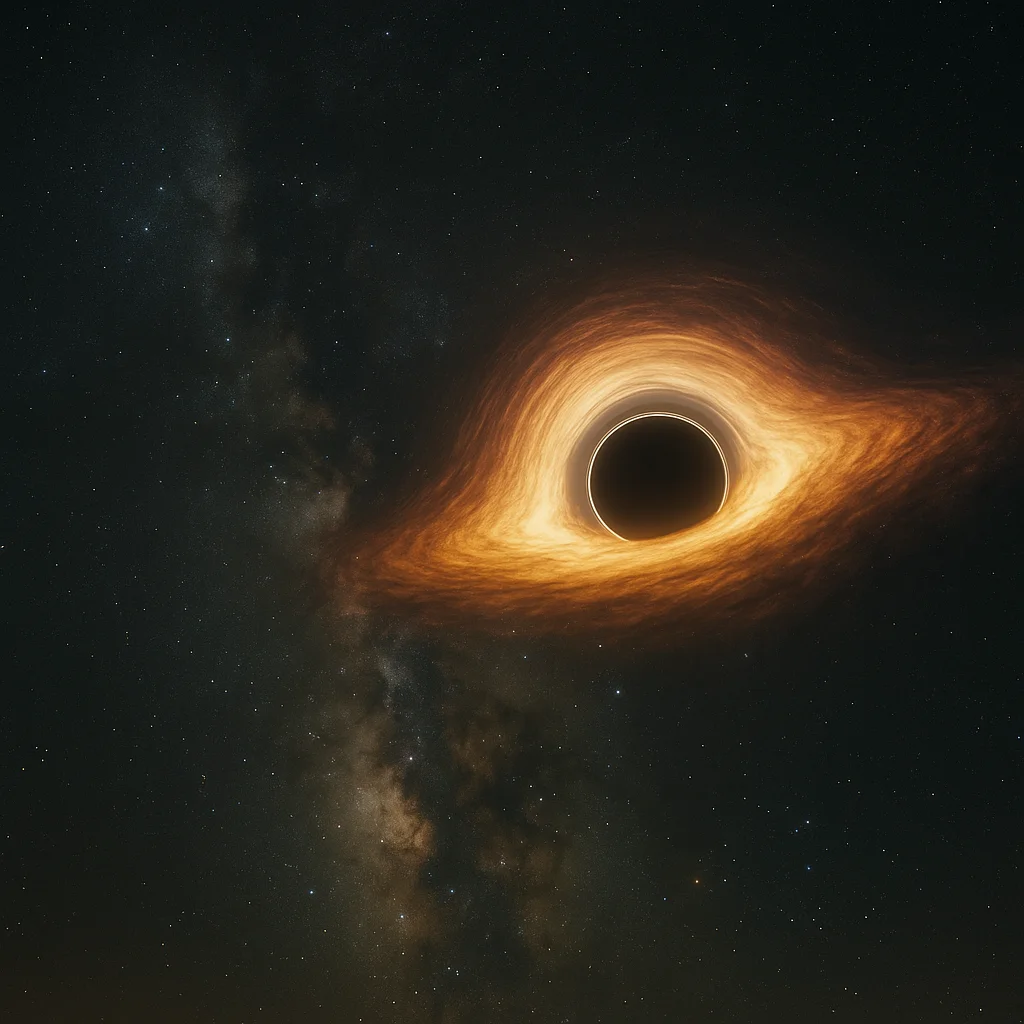
Visualization
When a lone black hole feasts on an unsuspecting star, it can briefly outshine an entire galaxy. Such monumental episodes, termed tidal disruption events (TDEs), are rare celestial beacons; astronomers typically expect them to originate from the crowded centers of massive galaxies, where gravitational titans reside. Yet a recent detection has overturned this expectation—unveiling a dormant supermassive black hole haunting the outskirts of WISEA J014656.04-152214.7, a galaxy sprawled 750 million light-years away in the constellation Cetus.
The event that exposed this black hole, designated TDE 2025abcr, unfolded some 30,000 light-years from the galactic center—a position that starkly diverges from the canonical paradigm of central black holes. The precision of this localization depended on transient optical surveys conducted by the Zwicky Transient Facility (ZTF), whose two telescopes systematically canvass the Northern sky from Palomar Observatory, revisiting each region every two days. Operating at this scale, ZTF records hundreds of thousands of temporal fluctuations in stellar brightness nightly; the dataset is so immense that human scrutiny is infeasible. Instead, the researchers deployed an artificial intelligence algorithm trained to recognize the photometric signature of tidal disruption: a rapid, characteristic rise in luminosity followed by an exponential decay, a pattern modeled as \( L(t) \sim (t - t_{D})^{-5/3} \) in accordance with predictions from tidal dynamics.
Statistically, TDEs occur with mean rates on the order of \( R_{TDE} \sim 10^{-5} \) per galaxy per year, or roughly once per 100,000 years for a typical galaxy. The overwhelming majority of cataloged TDEs over the preceding decade are anchored to galactic nuclei, consistent with the theoretical expectation that supermassive black holes (\( M_{BH} \geq 10^6 M_{\odot} \)) dominate these dense environs. The newly observed TDE, however, stands in stark contrast—its luminous beacon emerged from a site bereft of any visible stellar population or classical galactic structure.
The mass estimate of this black hole is particularly striking: spectroscopic modeling of the TDE’s afterglow constrains the culprit’s mass to a scale comparable to Sagittarius A*, the supermassive black hole at our Galaxy’s heart (\( M_{BH} \sim 4 \times 10^6 M_{\odot} \)). Its physical displacement from the galactic disk rules out dynamical friction as a plausible mechanism for rapid migration to the outskirts. Instead, its presence supports long-standing theoretical scenarios in which hierarchical galaxy mergers can exile supermassive black holes from their natal cores.
Two principal pathways dominate theoretical discourse regarding the formation of such orphaned giants. The first invokes the process of galactic cannibalism: in this scenario, a more massive galaxy accretes a smaller companion, gradually stripping away its stellar envelope via tidal forces, until only the dense nuclear black hole remains. Over cosmic timescales, the stellar debris disperses, potentially leaving the remnant black hole gravitationally untethered in the galactic periphery.
Alternatively, the three-body interaction model posits that a single galaxy may host a binary supermassive black hole at its core, the result of past mergers. When a third massive intruder arrives—possibly from yet another merger—the system devolves into complex resonant interactions. Conservation of energy and angular momentum in such a non-hierarchical triple system can dynamically eject the least massive black hole, a mechanism analogous to the slingshot phenomena seen in planetary scattering. Numerical simulations predict ejection velocities up to several hundreds of kilometers per second, sufficient to displace a black hole by tens of kiloparsecs over a gigayear timescale.
The observed TDE 2025abcr imparts crucial empirical weight to these theoretical constructs. Its solitary light-echo, lingering in a region devoid of any detectable host galaxy, underscores the reality that supermassive black holes may frequently roam the outskirts of galaxies, invisible until a fortuitous stellar encounter ignites their dormant accretion disk for a cosmic moment.
The detection also underscores the efficacy of modern time-domain astronomy, in which phenomena as transient as TDEs—virtually imperceptible against the static backdrop of galactic structure—are captured by algorithmic filters capable of parsing petabytes of data for signals with precisely the expected temporal evolution. As forthcoming surveys, such as those from the Vera C. Rubin Observatory, extend the reach and cadence of such searches, the census of wandering black holes is expected to grow. Each discovery will act as a probe of galactic assembly, hierarchical merging, and the population statistics of dormant black holes beyond galactic centers.
As Dr. Suvi Gezari of the University of Maryland articulated, "Until now, we’ve started with the assumption that supermassive black holes reside in the centers of massive galaxies." This new evidence challenges that dogma, compelling astronomers to reevaluate fundamental assumptions about the dark, dynamic lives of galaxies and their central engines. Whether orphaned by galactic consumption or cast out in a gravitational ballet, these supermassive black holes are no longer theoretical phantoms at the fringes—but emergent actors in the cosmic story of structure formation and evolution.
The deeper science lies ahead. Continued monitoring of TDE 2025abcr, and the search for its kin, will illuminate not only the frequency of wandering black holes but the intertwined fates of galaxies and the monsters they harbor. The findings, published in *The Astrophysical Journal Letters* (Stein et al. 2026, doi: 10.3847/2041-8213/ae77f3), point to a Universe where galactic centers cannot claim exclusive dominion over supermassive black holes—and where the fringes, too, are haunted by invisible giants.