Field: Technology
Vera Rubin Observatory Spots Possible New Dwarf Planet beyond Pluto
Published | Technical Staff
Visualization
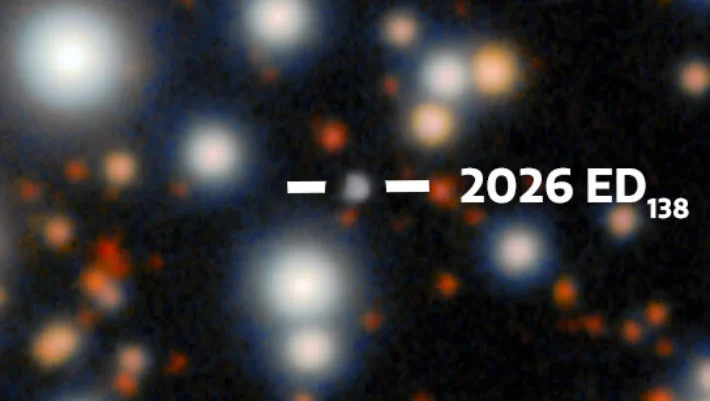
In a significant leap forward for planetary astronomy, researchers utilizing the advanced capabilities of the NSF-DOE Vera C. Rubin Observatory have identified a compelling candidate for a new dwarf planet in the distant realms of our Solar System. Designated as 2026 ED138, this large icy body resides beyond Pluto, broadening our understanding of the celestial entities that populate the outer Solar System. Although its status remains provisional, the implications of this discovery are profound, considering its possible classification alongside the likes of Pluto, Ceres, Eris, Haumea, and Makemake.
At an estimated size ranging from 600 to 1,500 kilometers, or approximately 373 to 932 miles in diameter, 2026 ED138 presents intriguing characteristics determined via photometric analysis of its brightness, measured distance, and presumed reflectivity. A critical requirement for dwarf planet classification is that such massive objects should achieve hydrostatic equilibrium, a state where their self-gravity compels them into a near-spherical shape. The potential confirmation of ED138's dwarf planet status hinges on upcoming infrared observations, which will clarify its dimensions and physical properties.
Dr. Mario Jurić, Rubin's solar system lead scientist from the University of Washington, elucidated the transformative capabilities of the observatory in discovering and pre-covering celestial objects. The Rubin Observatory combines exceptional speed, depth, and precision — attributes that revolutionize how astronomers navigate the cosmos. Each identified object can now be traced back through historical images, many taken months or even decades earlier, as researchers hunt for information hidden amidst the multitude of stars that pepper our visible sky.
The orbital dynamics of 2026 ED138 situate it approximately 46 astronomical units from the Sun, placing it firmly within the category of trans-Neptunian objects (TNOs), while Pluto orbits at an average distance of about 40 AU. Notably, this candidate's orbit exhibits a tilt of nearly 25 degrees relative to the ecliptic plane, identifying it as a 'hot-classical' Kuiper Belt object. Such classifications suggest that ED138 has likely experienced gravitational interactions with Neptune that have altered its trajectory over eons.
The discovery, however, owes itself to the Rubin Observatory's capacity to perform systematic sky surveys. The facility's design allows for repeated scans of the southern hemisphere, enabling the identification of faint cosmic entities previously obscured by the dense stellar backdrop of the Milky Way's plane. Dr. Edward Ajhar, NSF program director for the Rubin Observatory, emphasized the tool's unmatched effectiveness in revealing a plethora of astrophysical phenomena, not limited to dark energy investigations but also extending to the exploration of nascent planetary bodies.
The promising capture of 2026 ED138 will not only augment our inventory of dwarf planets but also exemplify the future of astronomical observation. The Rubin Observatory's ongoing mission is to persistently image the entirety of the southern sky for an uninterrupted ten-year span, which is anticipated to unveil additional celestial objects that remain hidden in the depths of space — elusive entities that may have evaded earlier surveys.
As further analysis unfolds and infrared observations commence, scientists eagerly await the confirmation of ED138's status. If validated as a dwarf planet, 2026 ED138 would indeed enrich the concise roster of these enigmatic worlds, contributing to our evolving narrative of the Solar System's composition and formation. Each discovery has the potential to reshuffle our understanding of the cosmos, revealing new layers of complexity in our celestial neighborhood while situating Rubin Observatory as a cornerstone of modern astronomical research.