Field: Technology
Uranus and Neptune's Bizarre Magnetic Fields May Finally Be Explained
Published | Technical Staff
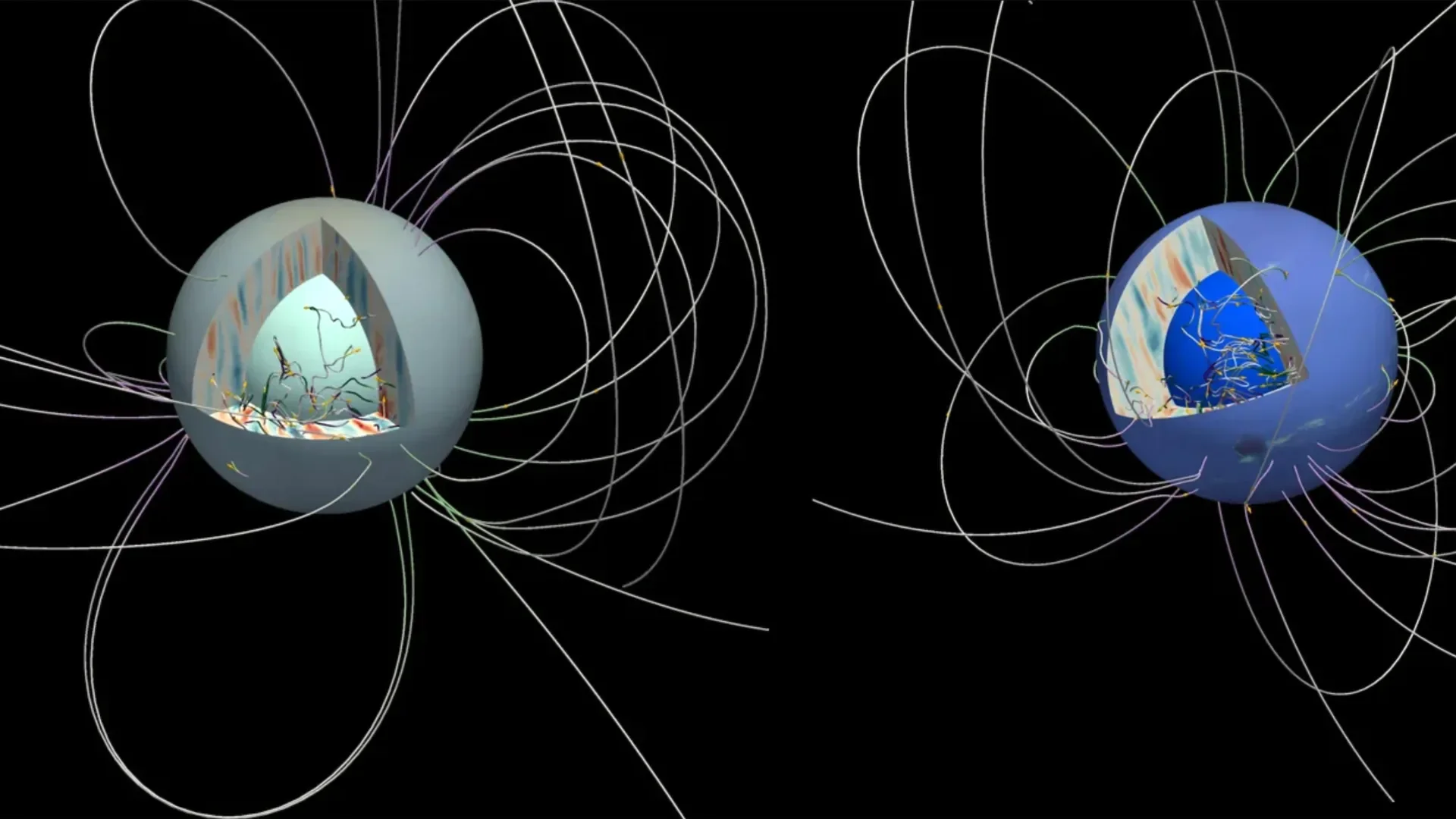
Visualization
Since the Voyager 2 spacecraft provided humanity's first close-up views of Uranus and Neptune in the 1980s, scientists have grappled with the conundrum posed by the magnetic fields of these icy behemoths. Unlike Earth’s comparatively orderly geomagnetic field, which is closely aligned to its axial tilt of approximately 11 degrees, Uranus and Neptune exhibit magnetic dipoles that are not only severely tilted—59 degrees and 47 degrees, respectively—but also display a chaotic arrangement that challenges conventional planetary dynamo theory.
New research emerging from the University of Texas at Austin posits that extreme conditions residing deep within the interiors of these ice giants could account for their enigmatic magnetic properties. The study, co-authored by scientists from renowned institutions including the University of California, Los Angeles, Imperial College London, and Northumbria University, introduces a suite of advanced computer simulations that explore how varying electrical conductivity within these planets may lead to anomalous dynamo behavior.
In the heart of both Uranus and Neptune lie high-pressure environments where temperatures reach critical thresholds, leading to unique alterations in material states. As the study's lead author Chi Yan articulates, these extreme conditions facilitate the dissociation of water molecules into ions, generating regions of increasingly high electrical conductivity as a function of depth. Under the fundamental principles of magnetohydrodynamics, this conductance can drastically modify the manner in which the magnetic field is generated, indicating a dynamic and possibly unstable magnetic environment.
To assess these hypotheses, the research team harnessed computer modeling that incorporates various plausible internal structures and conductive properties. The models speculated on how circulating fluids within Uranus and Neptune, affected by temperature gradients and external magnetic influences, interacted over extensive temporal scales. The findings suggest a correlation between escalating electrical conductivities and the peculiar magnetic fields manifested at the planetary surfaces, hinting at a more complex interplay of physics than previously understood.
One of the most striking revelations from these simulations is the projected volatility of the magnetic fields of Uranus and Neptune. Unlike Earth, where magnetic poles drift merely by about a single degree over half a century, the simulations indicate that the ice giants may experience magnetic pole shifts of tens of degrees within mere decades. This temporal variability of magnetic orientation could imply that the magnetospheres of Uranus and Neptune, as observed by Voyager 2, may no longer be representative of their current states.
In tandem with theoretical simulations, observational campaigns utilizing the James Webb Space Telescope (JWST) promise to validate these findings. The JWST’s infrared observations of Uranus and Neptune, particularly of their auroras—luminescent displays generated by the interaction of solar particles with the planets' atmospheres—are highly indicative of the underlying magnetic dynamics. These auroral phenomena serve as valuable proxies for assessing fluctuations in the magnetic fields, with scientists keenly analyzing the shapes and patterns formed.
Tom Stallard, a prominent researcher at Northumbria University, emphasizes that the auroras and other ionospheric features harbor crucial clues about the magnetic restructuring that may have occurred since Voyager 2's 1980s flybys. The ionosphere, filled with charged particles, is directly influenced by the planets' enigmatic magnetic activities and thus presents a wellspring of potential insights into ongoing dynamo processes.
In summary, while the simulations underscore a significant leap in understanding the complex magnetic schemas of Uranus and Neptune, researchers concur that unraveling the enigma of these distant giants' interiors will ultimately require direct exploration by future spacecraft missions. Until such endeavors are realized, the combined forces of advanced simulation techniques and high-resolution astronomical observations from powerful telescopes stand to provide unprecedented clarity, illuminating one of the solar system's most captivating and perplexing magnetic mysteries. As investigations continue, the nature of Uranus and Neptune's magnetic realms may finally come into focus, inviting a reevaluation of long-held assumptions about the behavior of planetary bodies in the vast cosmos.