Field: Technology
Unveiling a Jurassic Giant: Discovery of a New Sauropod Species in Argentina Advances Our Understanding of Dinosaur Evolution
Published May 12, 2026 | Technical Staff
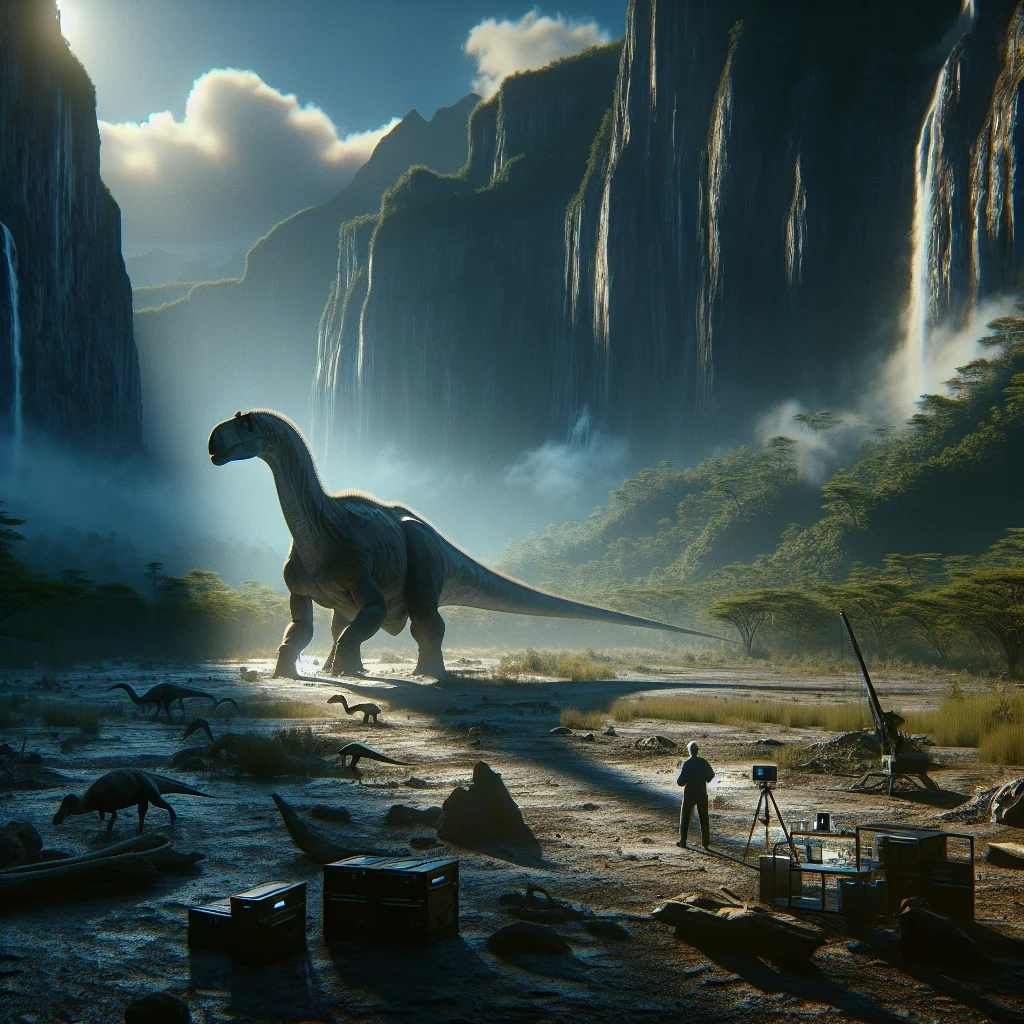
AI-Generated Visualization
A groundbreaking fossil unearth discovery on an isolated ranch in Argentina has caught the attention of the scientific community, marking the recognition of a new genus and species of macronarian sauropod dinosaur. The species, named Bicharracosaurus dionidei, which roamed the Earth during the Late Jurassic epoch approximately 157 million years ago, offers new insights into the evolutionary narrative of gargantuan herbivores on the southern supercontinent Gondwana.
The fossil evidence, a collection of spinal, rib, and hip fragments, was unearthed in the Cañadón Calcáreo Formation, a geological site characterized by its wealth of Jurassic-era deposits nestled in the central to northern sectors of Chubut province. This discovery was facilitated by a local farmer, Dionide Mesa, who alerted paleontologists to the find in March 2001. The striking length of this colossal creature, estimated to be around 20 meters (65 feet), underscores the significant physical attributes typical of sauropod dinosaurs.
Sauropods, particularly renowned for their elongated necks and tails, form one of the principal lineages within the dinosaur clade, notable for their size and herbivorous lifestyle. Within the broader taxonomic umbrella of Sauropoda, Bicharracosaurus dionidei has been classified within Macronaria, a subgroup that includes some of the largest-known terrestrial animals. Notably, the newly discovered species also exhibits anatomical features reminiscent of Diplodocidae, indicating a fascinating blend of traits that contribute to its unique placement in the dinosaur lineage.
The research leading to this classification involved rigorous phylogenetic analysis employing two different datasets to ascertain the evolutionary relationships of Bicharracosaurus dionidei. These analyses predominantly support the positioning of this new species within the Macronaria, and intriguingly, some phylogenetic signals hint at a closer affinity with Brachiosauridae, a prominent macronarian lineage.
This revelation is punctuated by the implications it holds for understanding the geographic and evolutionary dispersal of sauropods. Until the discovery of Bicharracosaurus dionidei, significant insights into the Jurassic period's sauropod diversity were primarily derived from fossil records located in the Northern Hemisphere, notably North America and Europe, and a singular noteworthy site in Tanzania. Thus, the findings from the Argentine site offer crucial comparative data that is vital for revising and expanding our understanding of sauropod evolution, particularly in Gondwana.
The implications of these findings are far-reaching, influencing not just taxonomic classifications but also our understanding of the environmental and ecological dynamics of the Jurassic period. The convergence of traits from different sauropod subgroups in Bicharracosaurus dionidei suggests a more intricate evolutionary web within Neosauropoda than previously understood. As outlined in the study conducted by Alexandra Reutter and her team from the Ludwig-Maximilians-Universität München, published in PeerJ, this new species sets the stage for further exploratory works into the murky depths of sauropod ancestry and their survival adaptations during a dynamic era of Earth’s biological history.
By continuing to piece together these puzzle elements, paleontologists and evolutionary biologists can hope to construct a more cohesive picture of the majestic reign of sauropods on ancient Earth, enhancing our comprehension of life's past marvels and the processes that shaped their existence.
The fossil evidence, a collection of spinal, rib, and hip fragments, was unearthed in the Cañadón Calcáreo Formation, a geological site characterized by its wealth of Jurassic-era deposits nestled in the central to northern sectors of Chubut province. This discovery was facilitated by a local farmer, Dionide Mesa, who alerted paleontologists to the find in March 2001. The striking length of this colossal creature, estimated to be around 20 meters (65 feet), underscores the significant physical attributes typical of sauropod dinosaurs.
Sauropods, particularly renowned for their elongated necks and tails, form one of the principal lineages within the dinosaur clade, notable for their size and herbivorous lifestyle. Within the broader taxonomic umbrella of Sauropoda, Bicharracosaurus dionidei has been classified within Macronaria, a subgroup that includes some of the largest-known terrestrial animals. Notably, the newly discovered species also exhibits anatomical features reminiscent of Diplodocidae, indicating a fascinating blend of traits that contribute to its unique placement in the dinosaur lineage.
The research leading to this classification involved rigorous phylogenetic analysis employing two different datasets to ascertain the evolutionary relationships of Bicharracosaurus dionidei. These analyses predominantly support the positioning of this new species within the Macronaria, and intriguingly, some phylogenetic signals hint at a closer affinity with Brachiosauridae, a prominent macronarian lineage.
This revelation is punctuated by the implications it holds for understanding the geographic and evolutionary dispersal of sauropods. Until the discovery of Bicharracosaurus dionidei, significant insights into the Jurassic period's sauropod diversity were primarily derived from fossil records located in the Northern Hemisphere, notably North America and Europe, and a singular noteworthy site in Tanzania. Thus, the findings from the Argentine site offer crucial comparative data that is vital for revising and expanding our understanding of sauropod evolution, particularly in Gondwana.
The implications of these findings are far-reaching, influencing not just taxonomic classifications but also our understanding of the environmental and ecological dynamics of the Jurassic period. The convergence of traits from different sauropod subgroups in Bicharracosaurus dionidei suggests a more intricate evolutionary web within Neosauropoda than previously understood. As outlined in the study conducted by Alexandra Reutter and her team from the Ludwig-Maximilians-Universität München, published in PeerJ, this new species sets the stage for further exploratory works into the murky depths of sauropod ancestry and their survival adaptations during a dynamic era of Earth’s biological history.
By continuing to piece together these puzzle elements, paleontologists and evolutionary biologists can hope to construct a more cohesive picture of the majestic reign of sauropods on ancient Earth, enhancing our comprehension of life's past marvels and the processes that shaped their existence.