Field: Technology
Unraveling the Enigma: Physicist Challenges Standard Cosmology with a Novel Universe Expansion Theory
Published | Technical Staff
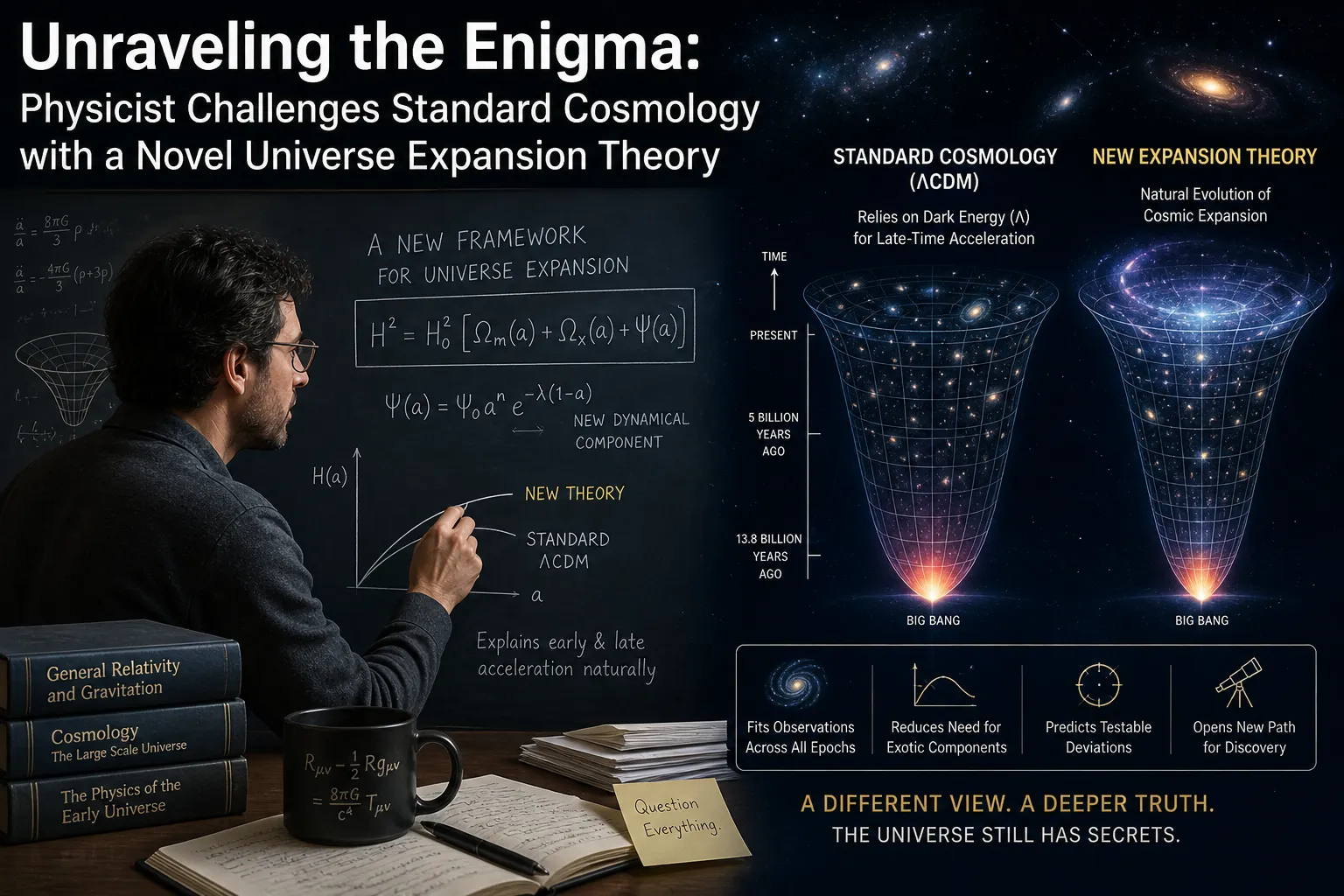
Visualization
The cosmos has consistently bestowed as many questions as stars in its endless murk, notably touching upon the very essence of its expansive nature. Traditional cosmological theories heavily rely on the concept of dark energy, a hypothetical force inferred from the observed acceleration in the universe's expansion. Identified by two pivotal projects in 1998—the Supernova Cosmology Project and the High-Z Supernova Search Team—this expansion presented a significant conundrum. It stretched the fabric of existing physics theories to their limits, indicative of underlying forces at play beyond our current understanding. Renowned theoretical cosmologist Katie Mack encapsulates this cosmic mystery aptly, highlighting the enigmatic nature of dark energy: a force unseen, unknown, and perplexing to justify within the extant theoretical frameworks.
In an intriguing shift from conventional theories that rely on dark energy, a physicist at the University of Alabama in Huntsville, Richard Lieu, introduces a compelling alternative that potentially sidesteps the need for both dark energy and the traditional Big Bang narrative. Published in the journal *Classical and Quantum Gravity*, Lieu's theory brings to the forefront the concept of multiple singularities—distinct points in time where conditions of density and temperature reach infinite scales—that sporadically emerge and dissolve within the fabric of spacetime. These transient temporal singularities, according to Lieu, could sporadically release bursts of energy and matter, significant enough to influence the cosmological scale expansion observed over decades.
This innovative approach subtly revives elements from the steady-state theory, a once-prominent model contending the Big Bang theory between the 1940s and 1960s, suggesting a continuous creation of matter to maintain constant density as the universe expands. However, Lieu's model addresses one of the steady-state's crucial flaws: the violation of the conservation of mass-energy laws. Unlike the steady-state theory, Lieu proposes a framework wherein the sudden appearances and disappearances of matter and energy do not contravene these fundamental conservation laws. This nuance is crucial, framing his postulation within current physical law compliance, and it pivots away from the traditional conservation-issue ridden models.
Despite the elegance and potential of Lieu’s model to streamline the understanding of universal dynamics, it currently stands without empirical support—a predicament not unique in the realms of advanced theoretical physics. The much-anticipated Nancy Grace Roman Space Telescope, slated for launch in 2027, could provide critical observational data to scrutinize and perhaps validate competing theories, including that which Lieu proposes.
The advent of theories such as Lieu’s underscores a vibrant tapestry of exploration and reinterpretation in cosmology, challenging the ontological and methodological foundations laid by dark energy-centric paradigms. As astronomers and theoretical physicists peer deeper into the universe’s arcane expanses, the quest for understanding its expansion—whether through dark energy, transient singularities, or otherwise—remains a cornerstone of contemporary cosmological research and philosophical inquiry. This dynamic frontier continues to evolve, sculpted by the dual chisels of empirical observation and creative theoretical musings, each essential in piercing the cosmic veils.