Field: Technology
Tyrannosaurus rex Scavenging Confirmed by Forensic Analysis of Duck-Billed Dinosaur Bones in Cretaceous Wyoming
Published | Technical Staff
Visualization
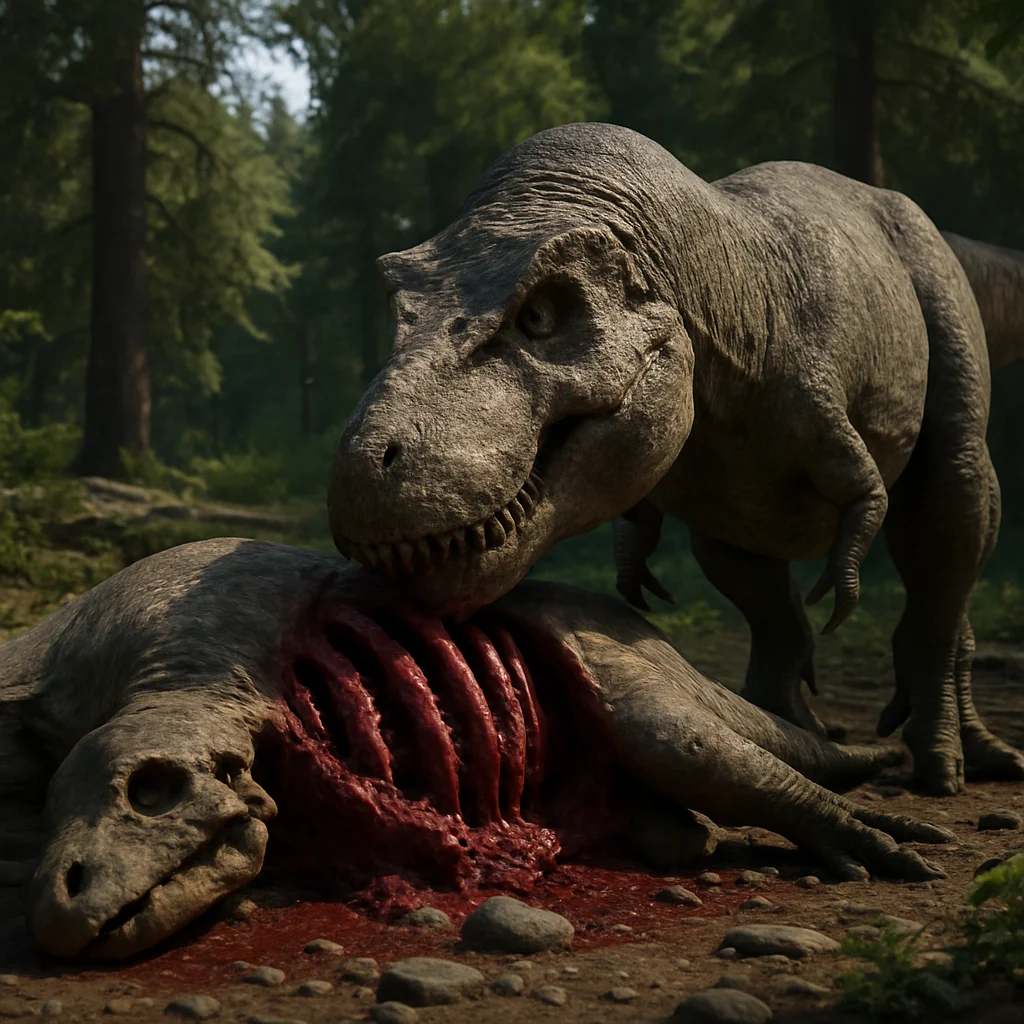
Paleobiological detective work at a Late Cretaceous bonebed in northeastern Wyoming has illuminated the dietary habits of the most iconic apex predator of the Mesozoic. In a meticulous analysis published in PLoS ONE, Bethania Siviero and colleagues at Loma Linda University challenge and refine conventional approaches to interpreting trace fossils, uncovering rare, unambiguous physical evidence that Tyrannosaurus rex scavenged the carcasses of Edmontosaurus annectens—a large, hadrosaurid herbivore that once dominated the ancient floodplains of western North America.
The site, a densely fossiliferous lens within the Maastrichtian-age Lance Formation near Hanson Ranch Station, has yielded 3,013 catalogued skeletal elements from systematic excavations conducted between 1997 and 2017. This exceptional assemblage overwhelmingly comprises Edmontosaurus annectens, providing an unparalleled dataset for taphonomic study. Yet within this trove of prehistoric bone, only a narrow subset—just thirteen specimens—presented candidate bite marks, a sobering reminder of the rarity with which clear evidence of behavioral interactions is preserved in the terrestrial fossil record.
Interrogating the origin of these perforating lesions required a nuanced application of modern paleontological forensics. The research team subjected each candidate specimen to high-resolution computed tomography (CT), enabling microanatomical scrutiny of ambiguous features. Of the original thirteen, one was revealed as a morphological artifact rather than a trace of macropredation. The remaining twelve bones—comprising ribs, vertebral centra, a radius, and an ulna—demonstrated patterns of bone modification consistent with bona fide tooth traces.
Crucial to the study was the taxonomic assignment of these traces. The researchers identified four instances of ichnotaxa Knethichnus parallelum and Linichnus serratus—morphotypes characterized, respectively, by parallel striations (indicative of serrated theropod teeth, where striae width and pitch can be expressed as a function of tooth denticle spacing and drag angle) and elongate, V-shaped gouges with serrated impression margins. Utilizing known dental morphometrics from the Lance Formation’s suite of predators, the team analyzed trace spacing (mean ≈ 8–10 mm) and width (mean ≈ 7 mm) in context with the dentary morphology of T. rex. The geometry and distribution of the marks preclude attribution to contemporaneous smaller theropods, such as Nanotyrannus lancensis, whose more gracile cranial architecture and finer dentition would have produced markedly different ichnosignatures.
Further, osteological context held interpretive weight: the majority of bite-marked specimens showed no histological evidence of periosteal reaction or bone remodeling—hallmarks of premortem injury and attempted healing. Instead, the absence of inflammatory bone growth (such as woven bone texture or periosteal callus) signaled perimortem or postmortem modification, strengthening the argument that these injuries represent scavenging, not active predation.
Siviero et al. go beyond mere behavioral inference. Recognizing the pervasive confusion born of ambiguous diagnostic criteria, the team leveraged their dataset to propose refined standards for tooth mark attribution, emphasizing the necessity of anatomical, taphonomic, and ichnological synergy. Their approach addresses shortcomings in prior literature, where non-trace bone features—such as vascular pits or pathological fenestrae—have sometimes been misidentified as evidence of trophic interactions, confounding our understanding of Cretaceous paleoecology.
In sum, this forensic investigation reaffirms the opportunistic proclivities of T. rex, positioning it as both fearsome predator and efficient scavenger within the terminal Cretaceous food web of Laramidia. The Wyoming dataset not only captures a rare snapshot of carrion consumption but also recalibrates the methodological compass guiding the search for prehistoric evidence of complex behavioral interactions. As frameworks for differentiation between bite marks and pseudopathologies evolve, so too will our capacity to reconstruct, bone by bone, the vanished dynamics of ancient ecosystems.