Field: Technology
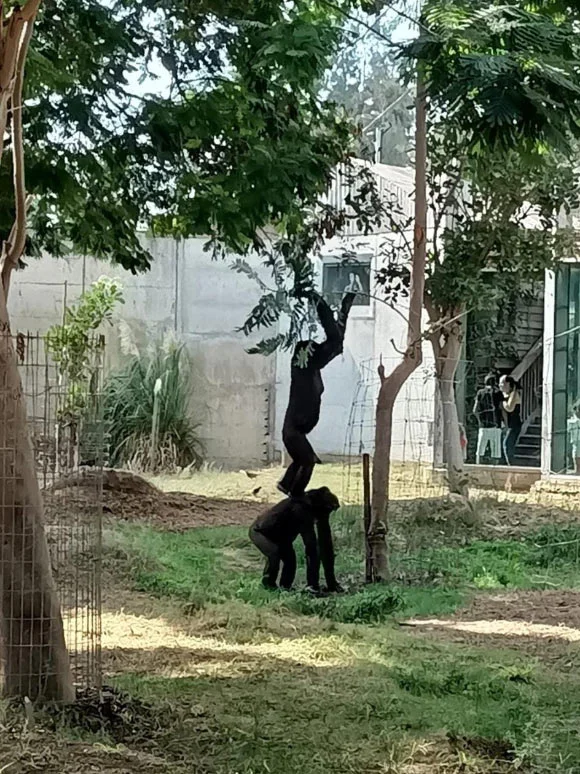
Two Gorillas Cooperate to Reach Food, Using Each Other as Ladder
Published | Technical Staff
Visualization
In a striking display of cognitive sophistication, two female western lowland gorillas, Amelia and Lisha, located at the Ramat Gan Safari in Israel, demonstrated an intricate form of cooperation that challenges traditional perceptions of animal intelligence. This remarkable interaction was meticulously documented by researchers from Tel Aviv University, who observed the half-sisters engaging in a problem-solving strategy that involved one gorilla literally using the other as a ladder to access unreachable food.
The intricacy of their cooperative behavior unfolded when an enticing leafy branch dangled tantalizingly at a height of approximately 4.5 meters (15 feet), presenting a challenge that neither gorilla could surmount alone. Amelia, the dominant individual, assumed a pivotal role by climbing onto Lisha's back, who stabilized herself on all fours to facilitate this unconventional ascent. The innovative approach was necessitated by an electric barrier that thwarted their ability to simply scale the tree trunk, illustrating how environmental constraints can catalyze adaptive problem-solving behaviors.
Professor Israel Hershkovitz, a key contributor to the study, emphasized the significance of their findings by asserting that such instances of cooperation are particularly noteworthy given the gorillas' otherwise limited social proximity. “Our observations reveal how two gorillas can join forces and assume complementary roles to solve a problem that neither can solve on her own,” he noted. This raises intriguing questions regarding social dynamics and cognitive abilities within nonhuman primate species, where the expected paradigm is one of competition rather than collaboration.
The researchers documented these cooperative efforts across multiple observations in 2021, 2024, and 2025, capturing the same sequence of events each time. The consistency of their behavior leads to a deeper understanding of gorilla social structure and individual roles within collaborative tasks. In one instance highlighted in a video recorded in 2025, Lisha displayed an engaging approach as she willingly positioned herself for Amelia, with no apparent signs of coercion or overt direction from the dominant female. This voluntary participation marks a significant contrast to behaviors seen in species where individuals are utilized chiefly as instruments for personal gain, reinforcing the theory that true cooperation involves mutual engagement toward an aligned goal.
“The fascinating part is that Lisha did more than merely serve as a ‘step’ for Amelia,” remarked Michael Levitzky, the lead author of the study. “She appeared to participate actively and willingly in solving the problem.” This refined observation has crucial implications for interpreting animal behavior, particularly in understanding how gorillas and possibly other great apes may exhibit advanced cognitive processes previously underestimated by the scientific community.
Historically, great apes have been viewed through a lens that often downplays their cognitive capacities, presenting a misconception in light of emerging evidence. As Levitzky pointed out, “For years, gorillas were considered less cognitively sophisticated than other great apes.” Yet, with accumulating observations of such complex social interactions, researchers are gradually reshaping comprehendings of their social intelligence. This burgeoning field of study not only encapsulates the rich lives of these magnificent creatures but also provides profound insights into the evolutionary roots of cooperation and social behavior, domains that have vast ramifications for understanding human social dynamics as well.
The researchers called for further inquiry into these social structures, proposing that future studies, especially those employing systematic documentation and audio recording, could significantly enhance our understanding of inter-gorilla coordination strategies. Capturing the nuances of their communication and cooperation may illuminate comparisons and contrasts to early human social behaviors, crafting a narrative that echoes across species boundaries.
Published on October 26, 2026, in the journal Primates, the findings by Levitzky and Hershkovitz encapsulate this fascinating cooperative engagement between two western lowland gorillas, challenging preconceived notions about intelligence in the animal kingdom while providing a potential framework for investigating the evolution of complex social behaviors both now and in prehistory. As the research progresses, the implications of their study serve as a reminder that the richness of animal intelligence is more nuanced than previously understood, prompting a reconsideration of how we define cooperation, agency, and cognition across the animal spectrum.