Field: Technology
Treble Clef Radio Glow Reveals Galaxy Cluster Hiding behind Milky Way
Published | Technical Staff
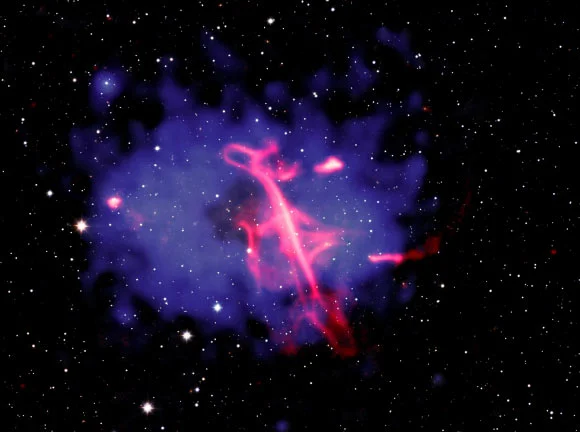
Visualization
In a remarkable convergence of astrophysics and celestial geometry, researchers have uncovered an enigmatic radio source, VLSS J0318.9+5755, nestled behind the Milky Way's obscuring dust disk. This peculiar, treble clef-shaped configuration is not merely an aesthetic anomaly but rather the remnants of a rich astrophysical narrative involving an ancient black hole outburst occurring deep within a massive colliding galaxy cluster. The discovery was spearheaded by Dr. Andrea Botteon and colleagues at the Italian National Institute for Astrophysics (INAF), who meticulously excavated data from the LOFAR Two-Meter Sky Survey alongside other state-of-the-art observational tools.
Previous studies dating back to the 1960s initially flagged this mysterious object, with early hypotheses hinting at its pulsar-like behavior due to its proximity to the Galactic plane. However, a significant leap forward occurred with a tentative link to a galaxy cluster established in a 2004 investigation. Yet, the full implications of this source remained largely unexplored until now, when a suite of observational data combined to form a coherent picture.
Harnessing the capabilities of the Giant Metrewave Radio Telescope (GMRT), meticulous data from the LOFAR's low-frequency survey, and X-ray metrics from NASA's Chandra X-ray Observatory and the SRG/eROSITA telescope, the research team has robustly confirmed that a colossal galaxy cluster is indeed residing behind VLSS J0318.9+5755. This cluster, estimated to be approximately 1.5 billion light-years distant, serves as the backdrop to an expansive structure that stretches over 2.5 million light-years, composed intricately of thin, delicate filaments.
The spectral signature of the Treble Clef is particularly intriguing, characterized by a steep decline at higher frequencies, indicative of its classification as a "radio phoenix." This term denotes the ancient and dimmed plasma that has been given a second lease on life, likely as a result of gas dynamically stirred by the interactions inherent in galaxy cluster collisions. The estimated age of this plasma—ranging between 190 to 200 million years—provides a timeline that aligns with the dynamic processes of cosmic evolution.
The research posits a two-stage genesis for the Treble Clef. Initially, an explosive outburst from a supermassive black hole at the center of the array of interacting galaxy clusters unleashed streams of charged particles and magnetic fields, propelling them outward at velocities approaching the speed of light. This cataclysm produced a robust burst of radio waves, which over time diminished as the energy of the particles decayed. The subsequent merger of the two galaxy clusters acted as a cosmic catalyst, compressing and rejuvenating the particles, consequently inducing a resurgence of radio frequency emissions. This cycle of cosmic formation and reinvigoration is reminiscent of sonic booms that emanate from supersonic aircraft, with shock waves facilitating this rejuvenation of sidelined plasma.
Dr. Botteon's team plans to disseminate their findings in the forthcoming issue of Astronomy & Astrophysics, solidifying the Treble Clef's position as a pivotal study in understanding the complex interplay between black hole jet activity and the intricate symphony of structure formation within the universe. As we probe deeper into the fabric of cosmic evolution, discoveries such as these will continue to unveil the mysteries that lie beyond our immediate celestial backyard, bridging the distance between mere observation and profound understanding of the universe's grand narrative.