Field: Technology
Tianwen-2’s Rendezvous with Kamoʻoalewa: China Explores Earth’s Quasi-Satellite after Epic One-Billion-Kilometer Voyage
Published | Technical Staff
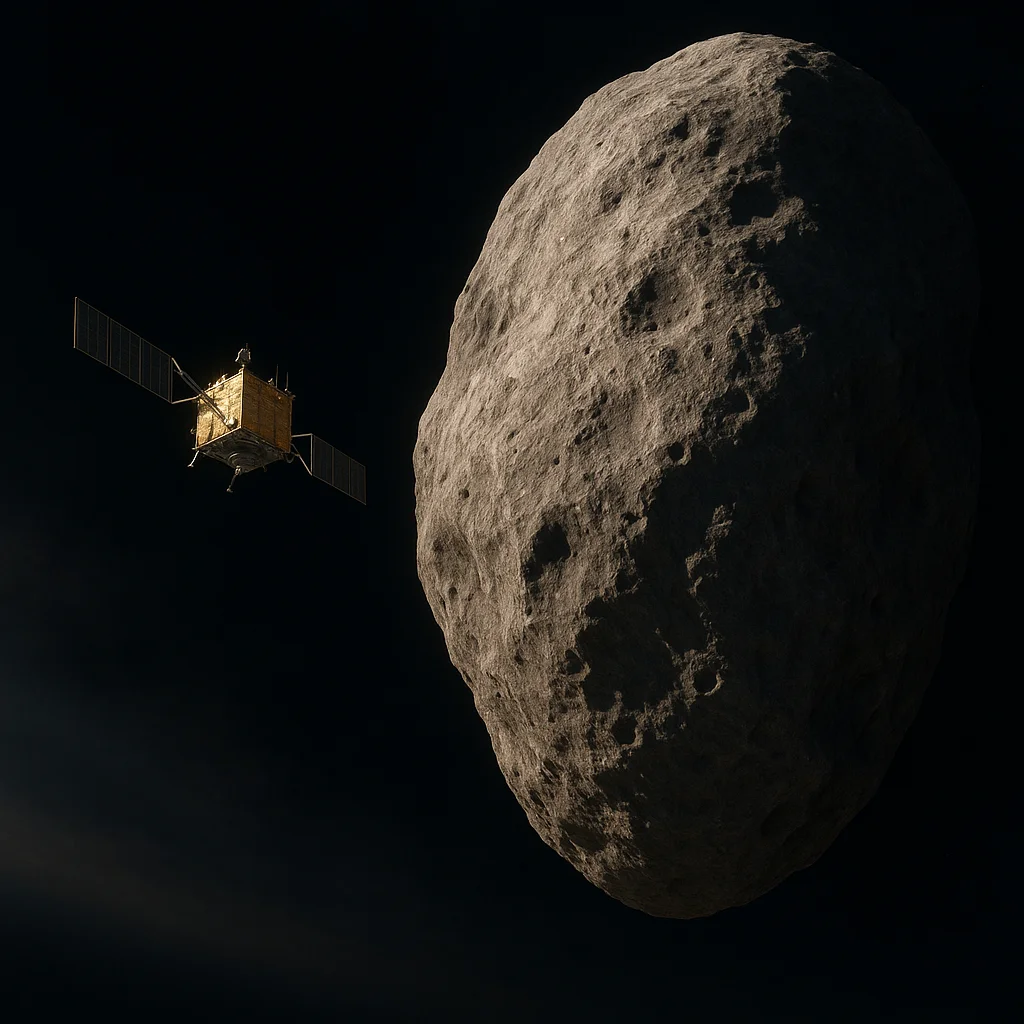
Visualization
When China’s Tianwen-2 spacecraft closed to within 20 kilometers of asteroid 2016 HO3 on July 2, 2026, it marked a pivotal moment in the annals of planetary exploration. This near-Earth asteroid, also known by its Hawaiian name Kamoʻoalewa—“oscillating celestial fragment”—has captivated the attention of dynamicists and planetary scientists since its discovery by the Pan-STARRS telescope on April 27, 2016. Uniquely, 2016 HO3 is one of only seven Earth quasi-satellites ever identified, occupying a co-orbital configuration that offers an exceptional laboratory for the study of small body dynamics, planetary formation scenarios, and the mechanisms underlying quasi-satellite stability.
Orbiting the Sun with a period \( P \approx 1 \) year and residing at a heliocentric semi-major axis nearly identical to that of Earth, 2016 HO3 executes a complex horseshoe-like path relative to our planet. Its orbit maintains a stable geocentric distance oscillating between 0.1 and 0.3 astronomical units, never venturing more than about 45 million kilometers from Earth—a stability unprecedented among known quasi-satellites. According to simulations, this configuration began roughly a century ago and is projected to remain dynamically coherent for about 300 years, providing a persistent and accessible target for detailed in situ investigation.
The physical characterization of 2016 HO3—estimated at merely 30 meters in diameter—remains tantalizingly incomplete, making it one of the solar system’s most enigmatic debris fragments. Hypotheses concerning its origin abound: it could be a primordial near-Earth object, a product of gravitational capture, or perhaps even an ejecta fragment from a colossal lunar impact event. By probing 2016 HO3’s mineralogy, structure, and isotopic disequilibria, Tianwen-2 aims to resolve questions central to the evolutionary history of planetary debris in Earth’s vicinity.
Launched on May 29, 2025, atop a Long March 3B/G2 rocket from Xichang, Tianwen-2 encapsulates the next phase of the China National Space Administration’s Tianwen Project—a four-mission odyssey targeting major enigmas throughout the inner and outer solar system. Following the successful orbital insertion and sample return by Tianwen-1 at Mars, Tianwen-2’s technical blueprint is equally ambitious: in addition to close-quarters observation and sample acquisition from 2016 HO3, the mission is set to subsequently intercept and study the active asteroid/comet 311P, a main-belt body renowned for its sustained mass loss and complex dynamics.
Traversing over a billion kilometers in a 400-day interplanetary arc required a sequence of meticulously orchestrated maneuvers. After spotting the asteroid on June 6, 2026, Tianwen-2 performed a critical “capture control” at a standoff of 30,000 kilometers, matching its velocity with the target and entering a co-orbital flight path on June 7. By June 19, the probe had further arrested its approach to 2,000 kilometers. Throughout this sequence, the mission team employed real-time optical navigation to refine the asteroid ephemeris, collapsing positional uncertainties from hundreds of kilometers—typical of purely Earth-based astrometry—to within just a few kilometers, a prerequisite for precision targeting of such a diminutive, fast-moving objective.
With the spacecraft now stationed within 20 kilometers of Kamoʻoalewa, the science phase can fully engage. Instrumentation suites are tasked with resolving the asteroid’s irregular topography, quantifying regolith properties, and conducting spectrometric analysis to decode surface composition. Subsurface sounding will probe the interior density distribution, hunting for clues to formative processes or post-formation modifications such as tidal fracturing or impact gardening.
Should Tianwen-2’s sample return phase proceed as engineered, it would represent the first recovery of material from an Earth quasi-satellite—a relic potentially carrying the isotopic and mineralogical fingerprints of the early solar system, a local dynamical environment, or, evocatively, the Moon itself. The prospect of unraveling the origins and dynamical evolution of these rare co-orbital companions stands to redefine theorists’ understanding of near-Earth asteroid populations and enrich our planetary defense and resource utilization strategies.
As the Tianwen Project continues its expansion toward Mars sample return (Tianwen-3) and Jovian system reconnaissance (Tianwen-4), Tianwen-2’s odyssey at Kamoʻoalewa is set to become a touchstone for multi-target, technologically sophisticated small body exploration. The mission’s ongoing operations at the solar system’s most stable Earth quasi-satellite promise to illuminate an arena of celestial mechanics and planetary genesis that, until now, has remained largely theoretical.