Field: Technology
Three giant black holes discovered in a galaxy from the dawn of time
Published | Technical Staff
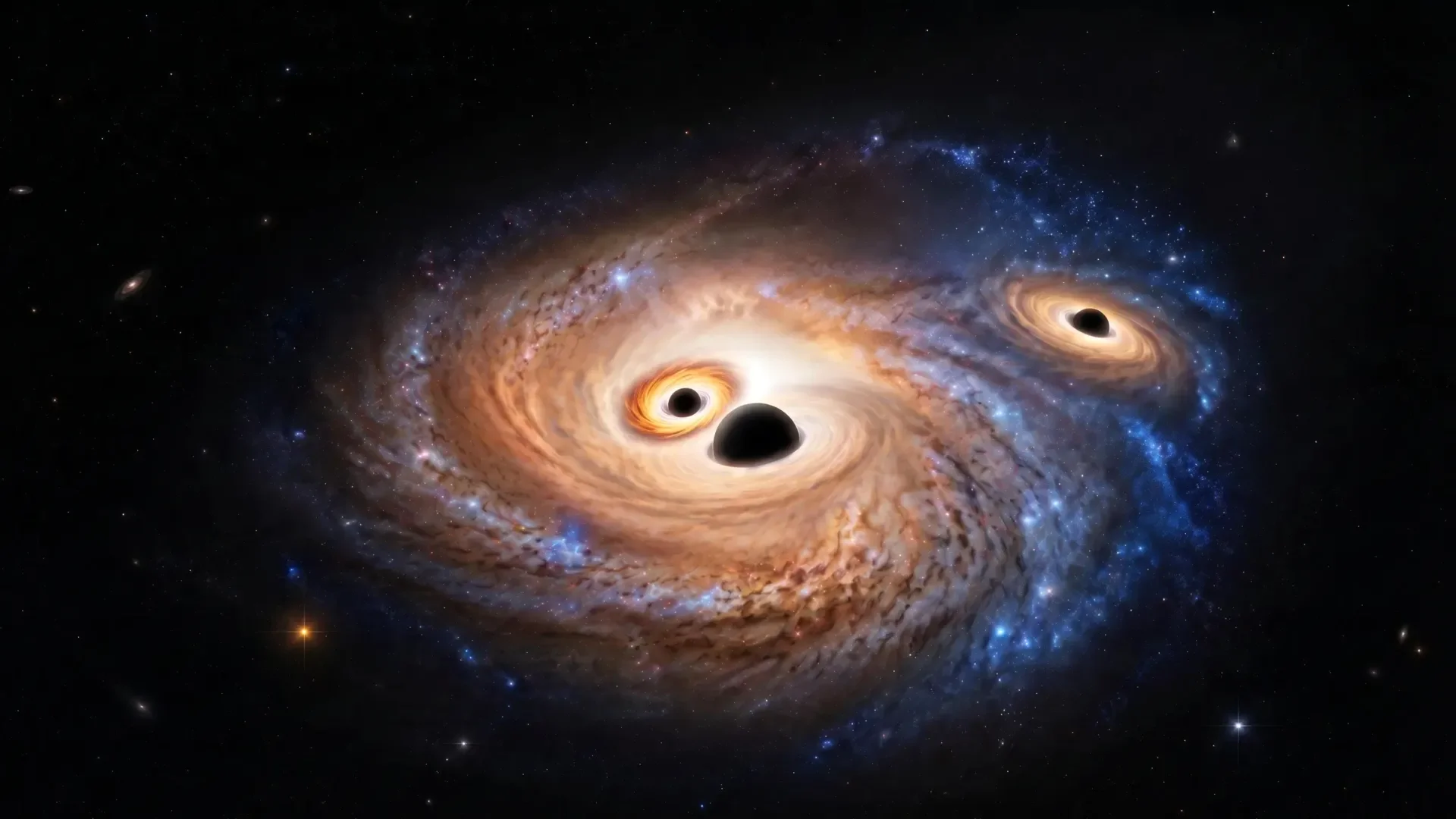
Visualization
In a remarkable revelation that augments our understanding of the nascent universe, a coalition of astronomers led by the Max Planck Institute for Extraterrestrial Physics (MPE) has unveiled the existence of three actively feeding supermassive black holes nestled within a single galaxy, identified as J0148-4214. This distant cosmic entity, resplendent with the echoes of a young universe, lies over 12.5 billion light-years away and provides a historical snapshot from only 1.2 billion years post-Big Bang. The implications of this discovery transcend mere identification of celestial objects; they illuminate the mechanisms underpinning the formation and growth of black holes during the universe's infancy.
The research team employed advanced observational technologies, notably the James Webb Space Telescope (JWST), particularly leveraging its Near Infrared Spectrograph (NIRSpec) in integral field spectroscopy mode. The significance of this technique lies in its capacity to disentangle the light signatures emitted from multiple sources within the galaxy, revealing intricately overlapping spectral patterns that point to the presence of three distinct black holes. This analysis yielded a redshift measurement of z=5.02 for J0148-4214, positioning the galaxy temporally and spatially in an epoch of aggressive star formation and black hole growth.
At the heart of this galaxy resides a duo of black holes situated merely 620 light-years apart. Projections indicate that these gravitational giants, with masses approximating 80 million and 600,000 solar masses respectively, will eventually coalesce, merging through a complex dance dictated by galactic dynamics. Such mergers not only advance the size of individual black holes, but they also hold the promise of capturing the gravitational wave signals that future observatories are keenly poised to detect.
The third black hole, significantly more remote and approximately 5,500 light-years from the central pair, presents an intriguing enigma. With a mass of approximately 2 million solar masses, it diverges sharply from its neighbors, demonstrating a dramatically different growth trajectory. While the supermassive black hole at the center eclipses others in sheer mass, it is the smaller black hole, devouring material at a frenetic pace, that piques scientific curiosity. This auxiliary black hole’s accretion rate, which surpasses conventional limits predicted by the Eddington formula, an equation defining the balance between gravitational and radiation forces acting on a black hole, implicates unusual processes in early cosmos.
When examining the black holes’ accretion and growth, it becomes essential to consider the dynamics imposed by their surroundings. Gas and dust from the galaxy's interstellar medium spiral into these gravitational behemoths, forming accretion disks that illuminate the dark voids of space with brilliant emissions due to the intense friction and heat generated as matter descends into the singularities. Such interaction elucidates the pioneering stages of structure formation in the universe and provides insights into the pathways that led to the genesis of some of the largest black holes we observe today.
The discovery of multiple black holes within J0148-4214 highlights the processes of galactic merger and black hole growth prevalent in the youthful universe. The epoch during which this galaxy formed was marked by rapid cosmological evolution, where interactions among primordial structures occurred at a staggering rate. As galaxies collided and merged, their central black holes also drew closer, a phenomenon that is hypothesized to trigger further black hole mergers—events predicted to have not only augmented the mass of these entities but also shaped the gravitational landscape of future galaxies.
Profoundly, the amalgamation of these findings underscores the capability of JWST to unveil the hidden complexities of early cosmic environments. The precise identification of spectral signatures through spectro-astrometry, which carefully tracks the minute displacements of hydrogen emission lines from these bustling neighborhoods of black hole activity, represents a monumental leap in our astronomical toolkit. This level of detail in spectroscopic analysis is pivotal to discerning the intricate interplay of black holes within diverse galactic assemblies, suggesting that many more such systems likely persist undetected across the expanse of the universe.
In unraveling the tales of J0148-4214, astronomers embark on a journey toward understanding the genesis and evolution of the universe's most massive structures. The elucidation of the conditions facilitating intense black hole growth at such early epochs will provide crucial context for the broader comprehension of cosmic history, ultimately guiding future explorations into the gravitational phenomena that continue to confront our understanding of physics in extreme environments. As the universe steadily discloses its secrets, the narrative of these three black holes stands as a testament to the ongoing quest for knowledge, urging scientists to delve deeper into the mysteries of creation itself.