Field: Technology
The Universe’s First Rocky Planets: New Simulations Point to Cosmic Dawn Origins
Published | Technical Staff
Visualization
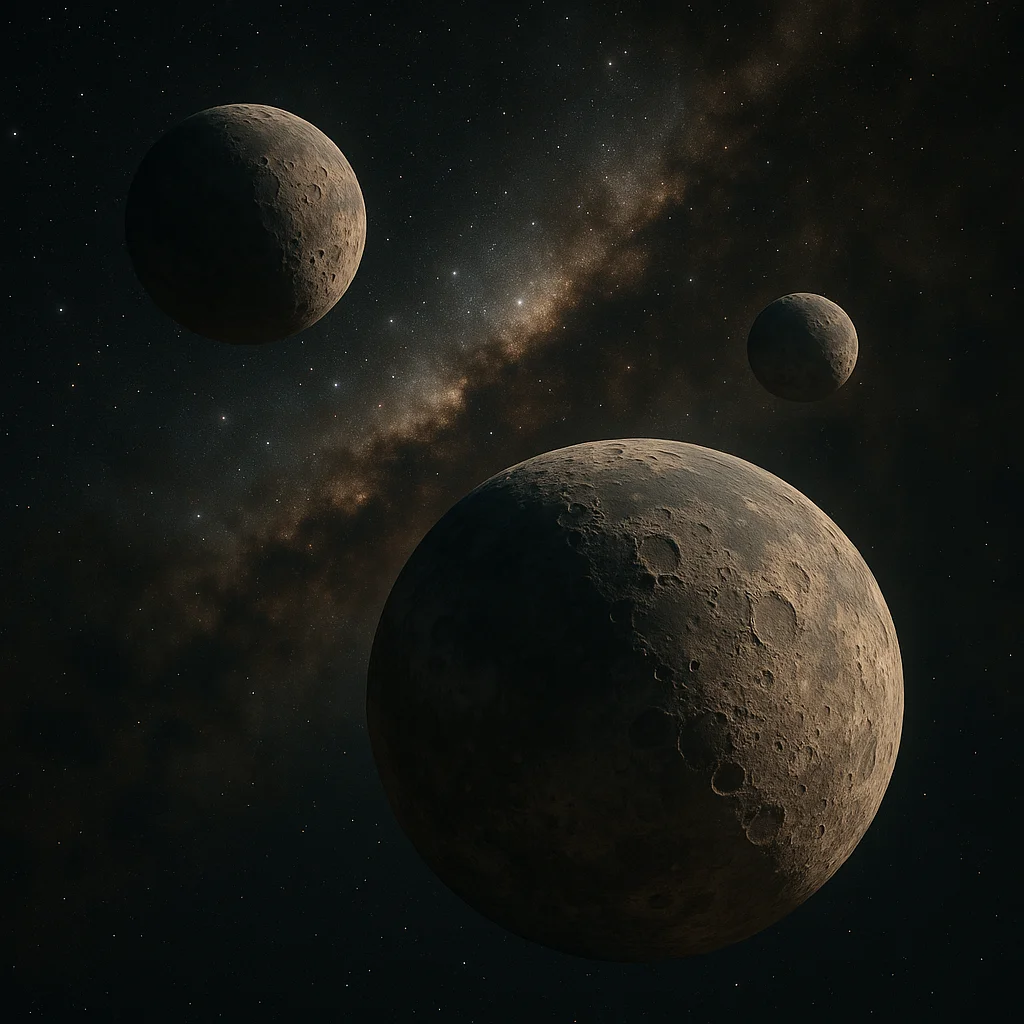
Astrophysics has long grappled with the origins of rocky, water-bearing planets, traditionally positioning their emergence several billion years after the Big Bang. But pioneering simulations now suggest terrestrial planets may have started assembling a mere 100 million years after the Universe’s inception—an era previously thought too primitive for such complex chemistry and planetary construction.
At the heart of this paradigm shift lie the violent deaths of the Universe’s first stars, dubbed Population III (Pop III). These stars, theorized to be massive—often exceeding 100 solar masses—were pristine, composed almost exclusively of hydrogen and helium forged in the Big Bang. Their life cycles, measured in millions rather than billions of years, ended in supernovae whose titanic energies fabricated heavy elements like carbon (C), oxygen (O), and iron (Fe) through nucleosynthetic processes.
Of particular interest is the subset of Pop III supernovae categorized as pair-instability supernovae. Triggered when the thermonuclear core of an ultra-massive star produces electron-positron pairs, these explosions are so cataclysmic that they can disperse upwards of 100 M☉ (solar masses) of heavy elements in a single detonation, profoundly enriching the surrounding proto-galactic medium. The distribution and eventual gravitational collapse of these element-laden clouds set the stage for the genesis of second-generation stars and, crucially, their attendant protoplanetary disks.
Utilizing advanced cosmological simulation frameworks—incorporating hydrodynamics, non-equilibrium chemistry networks, and gravity—researchers led by Dr. Daniel Whalen at the University of Portsmouth have traced how such supernova ejecta can seed nearby molecular clouds with metallicities (Z) sufficient to mimic those in the solar neighborhood. Their models reveal that, even at redshifts z ≈ 30, dense molecular clouds can compact and cool efficiently via C and O fine structure line emission, ultimately forming discs around emerging Population II (Pop II) stars.
One particularly illustrative simulation follows the collapse of an enriched gas cloud into a disk encircling a low-mass (M* ≈ 0.7 M☉) protostar—a system compositionally and architecturally analogous to our own solar nebula. Within this early disk, dust grains and planetesimals accreted rapidly, accumulating as much as ~3–5 M⊕ (Earth masses) of solids at radial distances comparable to Earth’s orbit (1 AU) from the nascent star.
Unexpected, however, was the predicted abundance of water (H₂O) in this protoplanetary environment. The simulations estimate that the disk's water inventory was only an order of magnitude less than that of the protosolar nebula—which yielded Earth’s oceans billions of years later. Coupled with solid planetesimal masses in the terrestrial regime, such a profile implies that mechanisms for volatile delivery and hydration of rocky planets were operational far earlier in cosmic history than previously postulated.
Dr. Whalen emphasizes the profound implications: “If these planet-forming disks already contained substantial water, the chemical and physical preconditions for habitability may have arisen in the Universe’s first 100 million years—a near-instant in cosmic terms.”
This assertion challenges a central tenet of cosmic chemical evolution: that sufficient metallicity (customarily, Z > 0.1 Z☉) is a prerequisite for efficient rocky planet formation. By demonstrating that Pop III supernovae could locally boost metallicities and volatile abundances well above Galactic averages for that epoch, the research suggests planetesimal accretion and even early ocean worlds were not merely theoretical possibilities, but potentially common outcomes in populated regions following the first supernovae.
While observational confirmation awaits the next generation of telescopes—capable of probing the reionization epoch with sufficient resolution—the implications are enormous. The genesis of terrestrial, perhaps even habitable, planets may not have required the protracted “cosmic chemical maturation” once thought necessary. Instead, worlds reminiscent of Earth could have sparkled into existence at the cosmic dawn, raising fundamental questions about the antiquity and pervasiveness of potentially habitable environments in the observable universe.
The full account of these findings will appear in the Astrophysical Letters Journal, signaling a new era in the quest to decipher the origins of planetary systems and the conditions under which life itself might emerge.
At the heart of this paradigm shift lie the violent deaths of the Universe’s first stars, dubbed Population III (Pop III). These stars, theorized to be massive—often exceeding 100 solar masses—were pristine, composed almost exclusively of hydrogen and helium forged in the Big Bang. Their life cycles, measured in millions rather than billions of years, ended in supernovae whose titanic energies fabricated heavy elements like carbon (C), oxygen (O), and iron (Fe) through nucleosynthetic processes.
Of particular interest is the subset of Pop III supernovae categorized as pair-instability supernovae. Triggered when the thermonuclear core of an ultra-massive star produces electron-positron pairs, these explosions are so cataclysmic that they can disperse upwards of 100 M☉ (solar masses) of heavy elements in a single detonation, profoundly enriching the surrounding proto-galactic medium. The distribution and eventual gravitational collapse of these element-laden clouds set the stage for the genesis of second-generation stars and, crucially, their attendant protoplanetary disks.
Utilizing advanced cosmological simulation frameworks—incorporating hydrodynamics, non-equilibrium chemistry networks, and gravity—researchers led by Dr. Daniel Whalen at the University of Portsmouth have traced how such supernova ejecta can seed nearby molecular clouds with metallicities (Z) sufficient to mimic those in the solar neighborhood. Their models reveal that, even at redshifts z ≈ 30, dense molecular clouds can compact and cool efficiently via C and O fine structure line emission, ultimately forming discs around emerging Population II (Pop II) stars.
One particularly illustrative simulation follows the collapse of an enriched gas cloud into a disk encircling a low-mass (M* ≈ 0.7 M☉) protostar—a system compositionally and architecturally analogous to our own solar nebula. Within this early disk, dust grains and planetesimals accreted rapidly, accumulating as much as ~3–5 M⊕ (Earth masses) of solids at radial distances comparable to Earth’s orbit (1 AU) from the nascent star.
Unexpected, however, was the predicted abundance of water (H₂O) in this protoplanetary environment. The simulations estimate that the disk's water inventory was only an order of magnitude less than that of the protosolar nebula—which yielded Earth’s oceans billions of years later. Coupled with solid planetesimal masses in the terrestrial regime, such a profile implies that mechanisms for volatile delivery and hydration of rocky planets were operational far earlier in cosmic history than previously postulated.
Dr. Whalen emphasizes the profound implications: “If these planet-forming disks already contained substantial water, the chemical and physical preconditions for habitability may have arisen in the Universe’s first 100 million years—a near-instant in cosmic terms.”
This assertion challenges a central tenet of cosmic chemical evolution: that sufficient metallicity (customarily, Z > 0.1 Z☉) is a prerequisite for efficient rocky planet formation. By demonstrating that Pop III supernovae could locally boost metallicities and volatile abundances well above Galactic averages for that epoch, the research suggests planetesimal accretion and even early ocean worlds were not merely theoretical possibilities, but potentially common outcomes in populated regions following the first supernovae.
While observational confirmation awaits the next generation of telescopes—capable of probing the reionization epoch with sufficient resolution—the implications are enormous. The genesis of terrestrial, perhaps even habitable, planets may not have required the protracted “cosmic chemical maturation” once thought necessary. Instead, worlds reminiscent of Earth could have sparkled into existence at the cosmic dawn, raising fundamental questions about the antiquity and pervasiveness of potentially habitable environments in the observable universe.
The full account of these findings will appear in the Astrophysical Letters Journal, signaling a new era in the quest to decipher the origins of planetary systems and the conditions under which life itself might emerge.