Field: Technology
The Asteroid that Wiped Out the Dinosaurs: A Closer Look at Crocodile Survival
Published | Technical Staff
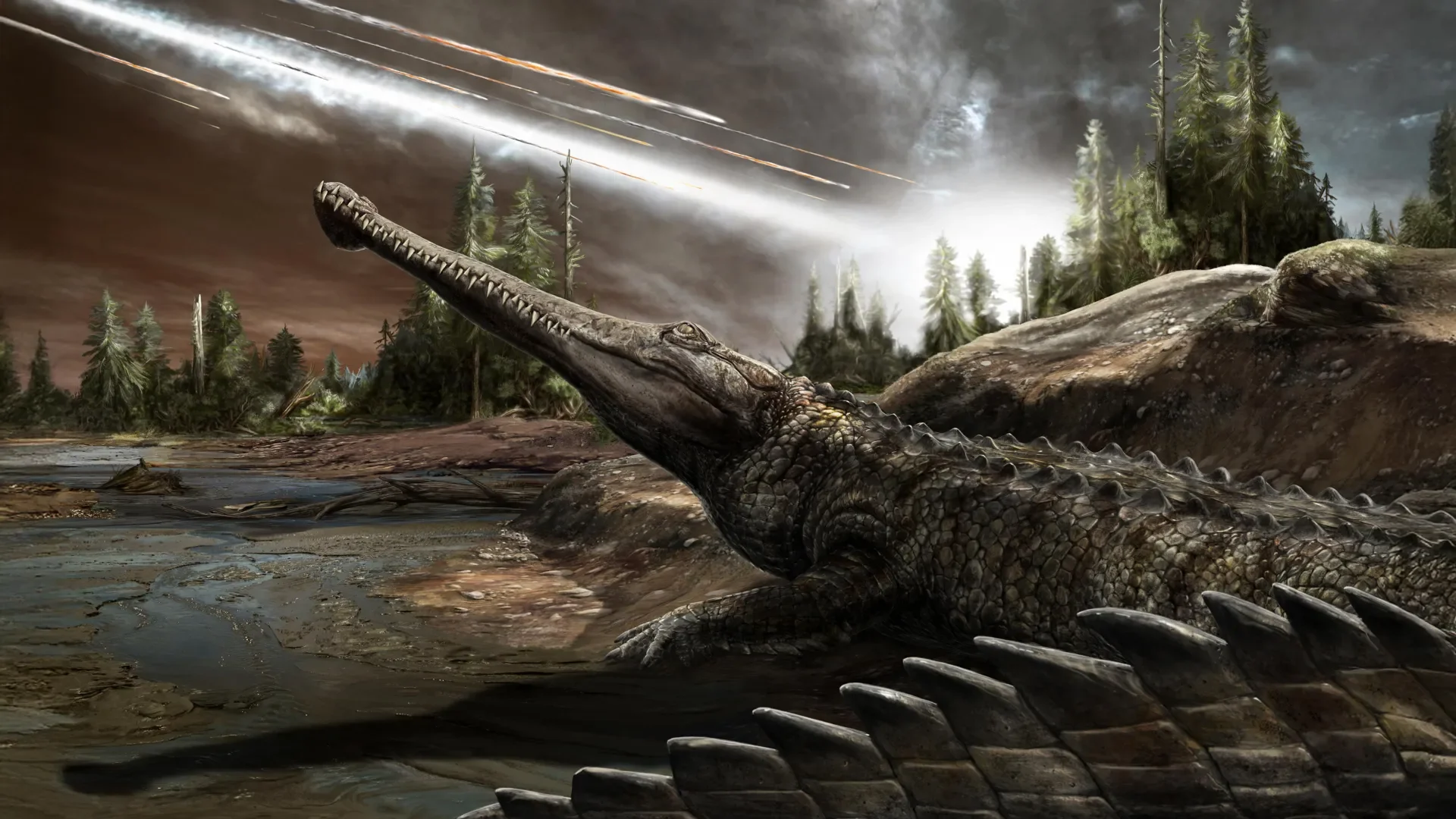
Visualization
The extinction event that occurred 66 million years ago, catalyzed by the colossal Chicxulub impact, is etched into the annals of Earth's history as a moment of catastrophic ecological upheaval. While this celestial collision precipitated the demise of approximately 75% of terrestrial species, including non-avian dinosaurs, a group of reptiles that emerged around the same time as those formidable giants demonstrated an unparalleled capacity for survival: crocodiles. Recent research led by University College London offers profound insights into the obscure advantages that enabled these ancient archosaurs to endure where others perished.
At the heart of the investigation is the realization that crocodiles and their ancient relatives, collectively referred to as pseudosuchians, have long exhibited a proclivity for warm climates. This affinity, the study contends, may have been instrumental in guiding the survival of certain crocodilian populations through the severe environmental disruptions that followed the asteroid impact. Over the course of 250 million years of evolutionary history, these reptiles displayed remarkable adaptability, tracing the contours of temperature shifts by expanding their geographical ranges during warmer epochs and retreating towards the equator as climates cooled.
The research team meticulously analyzed over 7,000 fossil specimens alongside extensive records from 400 extant and extinct species. Leveraging advanced computational models, they reconstructed the changing climate and geographical landscapes spanning 245 million years. Among the significant findings is the assertion that tropical and subtropical regions retained habitable conditions for crocodilian ancestors even as environments for many dinosaurs grew increasingly inhospitable. Only under extreme climate scenarios did these potential refuges dissipate entirely. By employing climate simulations that predicted environmental conditions in the aftermath of the Chicxulub event, the researchers discovered that equatorial areas may have remained warm enough, fostering the survival of these persistent reptiles while many larger terrestrial species succumbed.
Lead author Dr. Alfio Alessandro Chiarenza elucidated the disparities in the extinction event's impact, asserting, "The asteroid did not make the whole planet equally hostile to every group." The research dismisses notions that the event universally rendered Earth uninhabitable, emphasizing how creatures adapted to warmer regions endured while others faltered.
A critical aspect of this investigation hinged on the paleoclimate data that elucidate the relationship between climate fluctuations and crocodile survival. By integrating fossil findings with evolutionary genealogies, the researchers elucidated the facets of ancient climate that governed crocodilian distribution throughout history. In eras such as the early Eocene, around 50 million years ago, global temperatures soared approximately 10°C above contemporary averages, with even polar regions devoid of permanent ice. This warmer world, devoid of harsh climatic extremes, allowed crocodile relatives to thrive in high latitudes across continents like North America and Europe, a remarkable feat accentuating their adaptability.
Yet, the resilience of these reptiles is punctuated by two notable exceptions in their evolutionary journey. During the Cretaceous Thermal Maximum, around 94 million years ago, certain branches of the crocodile lineage developed the capacity to withstand conditions hotter than those favored by their broader lineage. Meanwhile, during a prolonged cooling period around 34 million years ago, specific extant cousins adapted to drier climates, illustrating an intriguing resilience to diverse environmental pressures.
Post-impact simulations revealed hot equatorial regions consistently retained conditions conducive to the survival of crocodilian ancestors, while adverse climate shifts—initially characterized by diminished sunlight from dust debris—failed to eliminate all potential habitats for these reptiles. Only severe reductions in sunlight, beyond 15%, rendered equatorial niches unsuitable, a scenario now deemed increasingly unlikely. The interplay of atmospheric carbon dioxide spikes and other environmental perturbations observed in the model indicated that many crocodilian refuges remained viable as dinosaur habitats diminished.
Nonetheless, the evolutionary success of crocodiles during this tumultuous period cannot solely be attributed to climate tolerance. Their relatively modest body sizes, aquatic adaptations, flexible feeding strategies, and low metabolic demands as ectothermic organisms likely coalesced to enhance their odds of survival. Such energy efficiency meant they relied less on the abundance of resources than endothermic species competing for limited food during periods of ecological strife.
Yet amidst these revelations lies a cautionary note for modern-day crocodilians, confronting an era of anthropogenic climate change. With a history marked by adept geographic and climatic adaptability, questions arise concerning their coping strategies in response to the encroaching climate crisis. Could the very traits that empowered their survival in the face of mass extinction now preclude their resilience in the contemporary world, as environments shift at unprecedented rates?
The survival of crocodiles after the demarcating asteroid impact signifies more than simple endurance; it underscores a complex tapestry of ecological relationships and evolutionary pathways where temperature preferences dictated trajectories of life and death. As we decipher the past and confront our current challenges, the story of these ancient reptiles serves as a poignant reminder of the intricate balance between nature and survival, and the unpredictability that shapes the future of our planet's biodiversity.