Field: Technology
Tectonic Imprints Reveal Charon’s Rotational Secrets and Thermal Past
Published | Technical Staff
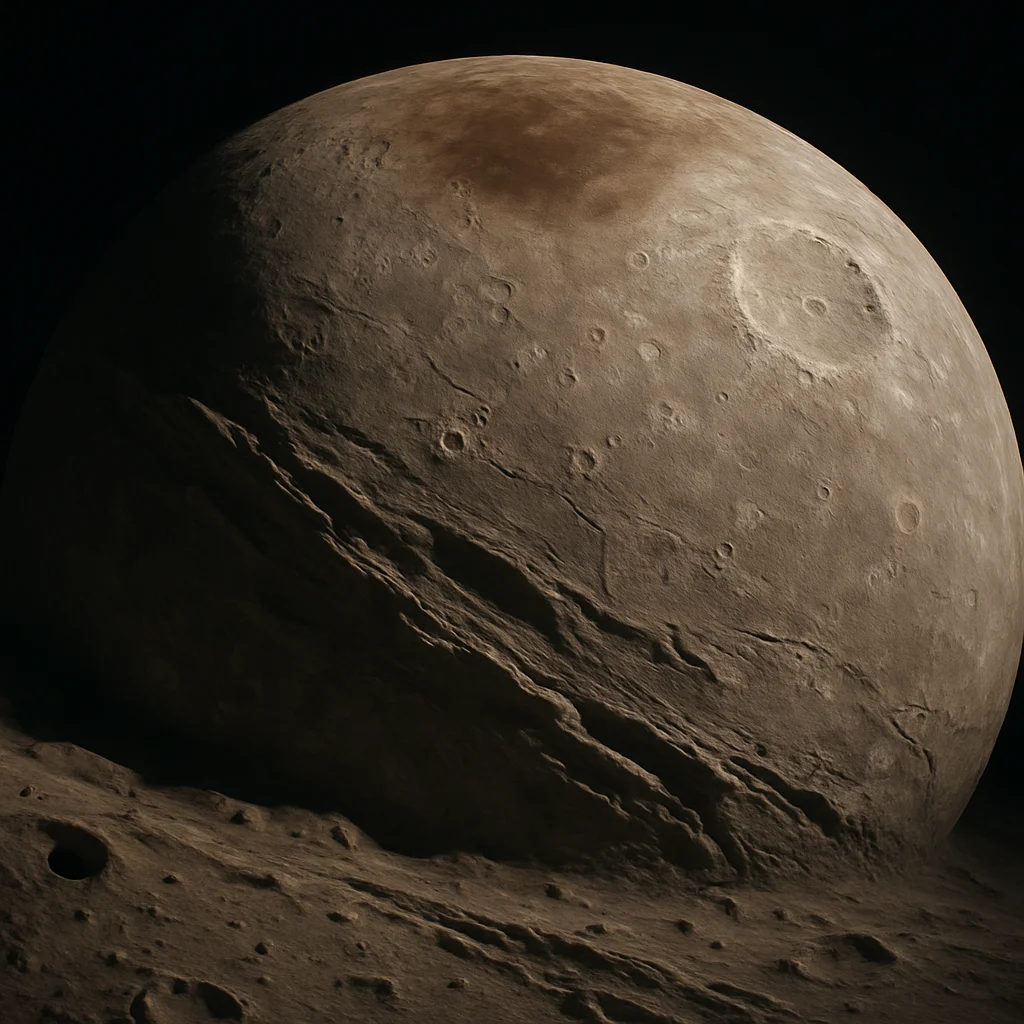
Visualization
In the cold, distant reaches of the Kuiper Belt, Pluto and its enigmatic satellite Charon enact a celestial dance locked for eons by gravitational embrace. But recent research, published in *Nature Communications* (Chen et al., 2026), offers a provocative revision to the presumed equilibrium of this planetary pairing: Charon’s spin may not be wholly stilled. Instead, evidence suggests rotational deceleration—"despinning"—is subtly recorded in the tectonic fabric of its ancient surface.
High-resolution imaging from the New Horizons mission in 2015 set the stage for this revelation. Charon’s terrain, geologically pristine and largely undisturbed since its formation nearly four billion years ago, offers researchers an unparalleled archive—a cartographic fossil record of planetary dynamics. Central to this new analysis is Oz Terra, a northern hemisphere province defined by rugged mountain fabrics stretching across 200 kilometers, whose orientations and morphologies are diagnostic of powerful interior and rotational processes.
Traditionally, icy satellites undergo rotational evolution dictated by Newtonian tidal torques, with dissipation channels governed by their internal rheologies. This despinning phenomenon is theoretically modeled via differential equations balancing tidal dissipation (parameterized by the tidal quality factor Q and the Love number k₂) against the mechanical inertia of the satellite:
\[
\frac{d\omega}{dt} = -\frac{3k_2GM_p^2R^5}{Qa^6I}\omega
\]
where \( \omega \) is the satellite's angular velocity, \( M_p \) the mass of the primary (here, Pluto), \( a \) the semi-major axis, and \( I \) the moment of inertia of Charon. Over billions of years, such tidal stresses are expected to bring the system into a doubly synchronous state—the current 153.3-hour period matching the Charon-Pluto orbital revolution. However, the absence of clear surface manifestations of this evolutionary trajectory has long challenged observers.
Dr. Hanzhang Chen and colleagues addressed this conundrum by interrogating the geometry of tectonic ridges and fault lines of Oz Terra through spectral analysis and geophysical modeling. The most arresting finding: the ridges exhibit persistent slope asymmetries and structural alignments indicative of compressional, rather than extensional, tectonics. While much of Charon’s surface chronicles ancient global extension events associated with cryovolcanism, these features bespeak shortening of the crust consistent with longitudinal contraction.
By constructing finite element models of the ice lithosphere, Chen et al. deduced that at the epoch of ridge formation, Charon’s outer shell was at least 30–36 km thick, conferring a substantially rigid, cold response to stress. Calculations show a circumferential contraction of nearly 1% near the equator, a strain sufficient to nucleate thrust faults and fold ridges. By correlating these tectonic markers to rotational deceleration, the team inferred an initial rotational period of approximately 14.3 hours—an order of magnitude faster than current.
Such a rapid primordial rotation is consistent with the aftermath of a giant impact origin, invoking a “cold start” scenario in which Charon formed with a thick, icy crust that suppressed early internal convection and cryovolcanic resurfacing. The progressive loss of angular momentum, via tidal interactions with Pluto, drove secular changes in planetary shape and stress fields. These, in turn, were imprinted as contractional ridges that predate later extension and cryovolcanism—offering a stratigraphic sequence for Charon’s tectonic evolution.
Notably, this evolutionary narrative demands the interplay of thermal, orbital, and mechanical parameters—highlighting the complex coevolution of despinning and global contraction. The notion that Charon's early, rapidly spinning state is recorded not only in orbital dynamics but directly in tectonic topoforms adds a rare layer of empirical depth to models of icy satellite evolution.
Beyond Charon itself, these findings recalibrate interpretations of icy satellites on a system-wide scale. The synthesis articulated by Chen and colleagues provides a template for decoding the cryptic tectonic signatures of objects far beyond the reach of landed missions, offering an indirect yet profound window onto the deep-time thermal and rotational evolution of the Solar System’s most remote worlds.