Field: Technology
Stonehenge's Altar Stone: A Geological Mystery Remains Unsolved
Published | Technical Staff
Visualization
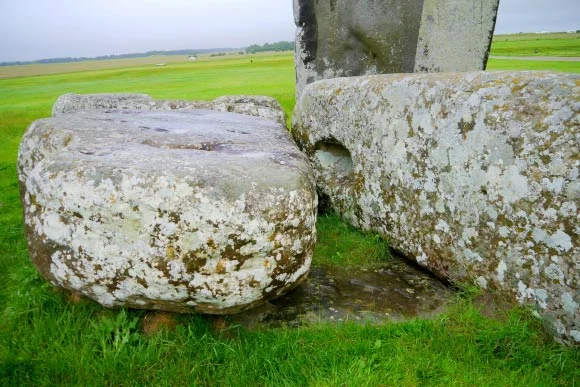
The Altar Stone, a 4.9-meter sandstone monolith weighing approximately 6 tons, rests in a compromised position at Stonehenge, primarily concealed under the weight of two fallen sarsen stones. For much of its scholarly history, the origins of this enigmatic artifact have been attributed to the regions of West Wales, an assumption that had prevailed for nearly a century. However, recent studies and a nuanced interpretation of geological evidence have begun to unravel the complexities behind its provenance and nature.
In 2020, researchers significantly challenged the West Wales hypothesis by proposing that the Altar Stone instead originated from the Orcadian Basin in northeastern Scotland. This geographic shift posited a remarkable transport distance of over 700 kilometers, an implication that deepened the intrigue surrounding Stonehenge's construction and the cultural significance of its materials. The research, spearheaded by Professor Duncan Pirrie from the University of South Wales, aims to refine these assumptions with a multidimensional approach that encompasses mineralogical, petrographical, and isotopic analyses.
At this pivotal juncture in research, Pirrie and his colleagues acknowledge the findings put forth by earlier teams, notably the study led by Curtin University researcher Anthony Clarke in 2024, which confirmed a Laurentian origin for the mineralogy of the Altar Stone. However, their recent investigations reveal complexities that suggest the definitive source of the stone is still under scrutiny. Notably, their study does not entirely negate the hypothesis of a Scottish origin but rather emphasizes the limitations of relying on age data as a standalone metric.
Utilizing a robust suite of analytical techniques, including portable X-ray fluorescence spectrometry, Pirrie's team sought to paint a clearer geological portrait of the Altar Stone. Their investigation centered on eight museum fragments linked to the stone alongside localized field measurements of the excavated areas of the monument. The results revealed a distinct assemblage of minerals, including high levels of baryte—a barium sulfate mineral that serves as a cementing agent for the sandstone’s grains and correlates with unusually elevated barium readings.
Moreover, the presence of chrome spinel—a heavy mineral rarely found in rocks from the Old Red Sandstone formations prevalent across much of the Orcadian Basin—adds yet another layer of intrigue. The mixed-layer illite/smectite clays display an approximate 20% component of expandable layers, in stark contrast to samples from Caithness and Orkney, which exhibit values below 10%. This observation implies that the Altar Stone has been subjected to minimal thermal alteration, ruling out many potential source areas in Scotland.
The geological narrative becomes further compelling with the identification of tosudite, a rare clay mineral present within the Altar Stone, alongside a ripple-laminated structure indicative of deposition in a fluvial environment. This unique texture, combined with observations revealing that its calcite cement likely formed under conditions of burial rather than surface exposure, provides critical geological context that precludes regions like the Southern Uplands of Scotland from contention; low-grade metamorphism typical of that area is conspicuously absent from the Altar Stone’s profile.
Prevailing hypotheses regarding alternative sources—encompassing the broader Anglo-Welsh Basin and various regions of southern and central Britain—continue to be systematically dismantled, as isotopic characterizations reveal that while the old red sandstone presents a closer match, significant gaps in strontium isotopic data leave open questions regarding the stone's geological lineage.
As the investigation deepens, it becomes clear that refining the geographical search is as integral to uncovering the stone's provenance as identifying new potential sources. Each eliminated candidate helps to focus attention on regions more likely to yield positive outcomes in the quest for the Altar Stone's origins. The implications for our understanding of prehistoric stone transport and construction practices at Stonehenge are profound; to trace the Altar Stone’s source means unraveling a narrative that extends back thousands of years into the tapestry of human civilization.
Ultimately, as Professor Richard Bevins of Aberystwyth University notes, the growing body of evidence propels researchers closer to a resolution amidst one of archaeology's most enduring enigmas. Each analytical step undertaken in this geological detective story not only sheds light on the Altar Stone but also expands our appreciation of the ancestral connections woven into the very fabric of this iconic monument. Together with the academic community, researchers are nearing the cusp of discovery, seeking to narrate how this singular stone journeyed to the heart of Stonehenge and the people who revered it in a time long faded from memory.