Field: Technology
Stochastic Sirens: Harnessing the Gravitational-Wave Background to Pin Down the Hubble Constant
Published | Technical Staff
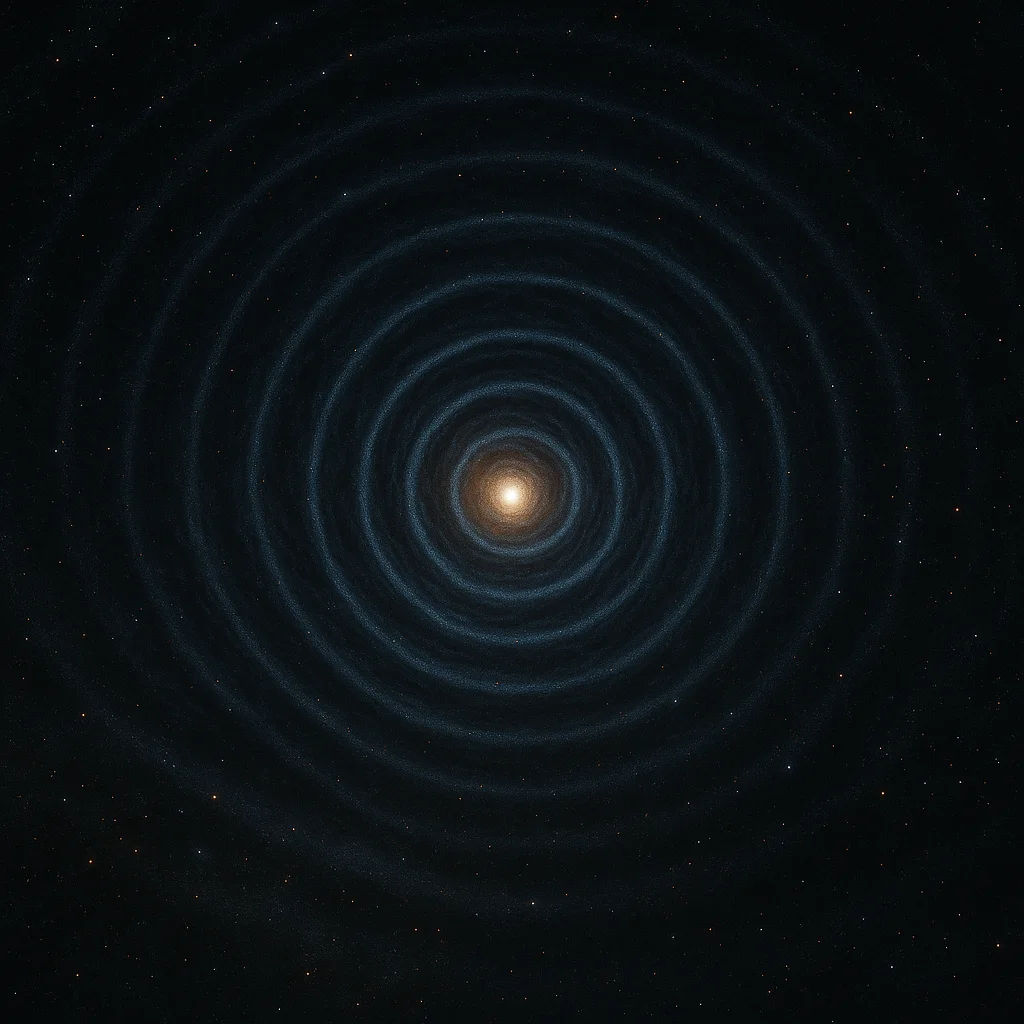
Visualization
A quiet revolution is underway in cosmology, led by an international team of astrophysicists who are turning to an unexpected source to refine our grasp of the universe’s expansion rate: the stochastic hum of gravitational waves. Traditionally, the Hubble constant (H₀)—the proportionality factor relating recession velocity to cosmic distance in Hubble's law (v = H₀d)—has been measured via electromagnetic signals: standard candles like Cepheid variables and Type Ia supernovae, or observations of the Cosmic Microwave Background (CMB). These pillars of observational cosmology have yielded values of H₀ that stubbornly disagree, fueling a persistent “Hubble tension” whose resolution could profoundly reshape fundamental physics.
Now, Professor Nicolás Yunes of the University of Illinois and collaborators propose the “stochastic siren” method, a technique poised to sidestep the systematic uncertainties of classical probes by exploiting the universe’s own gravitational-wave background (GWB). This composite signal arises from the superposition of countless distant and unresolved binary black hole mergers—each one sending minuscule but coherent ripples throughout spacetime.
Unlike “standard sirens”—a method relying on individually detected gravitational wave events and their host galaxies to calibrate cosmic distances—the stochastic siren framework does not require the pinpointing of any single event. Instead, it operates statistically, using the measured auto-correlation properties and amplitude of the GWB to infer both the volumetric merger rate and the characteristic distance scale set by H₀. The observed energy density spectrum Ω_gw(f) of the GWB, as measured by detectors like LIGO, Virgo, and the future Einstein Telescope, encodes crucial information about the universe’s rate of expansion. Ω_gw(f) is proportional to the population-averaged chirp mass and the merger rate density integrated over redshift, both of which trace cosmological parameters.
The essence of the method is elegantly simple: gravitational waves propagate through spacetime unimpeded by dust or intervening matter, and their amplitude scales inversely with luminosity distance (h ∝ 1/d_L). This property renders them cosmic messengers immune to several confounding factors that plague electromagnetic observations. By disentangling the statistical properties of the GWB, Yunes and colleagues extract constraints on H₀ directly from the universe’s most energetic and most ancient collisions.
Bryce Cousins, graduate student and lead author, emphasizes the strength of their approach: “By observing individual black hole collisions, we estimate their occurrence rate across cosmic history. But the vast majority of mergers remain undetectable as individual events, instead building up the persistent background signal. Our method leverages this unresolved population—what we call the gravitational-wave background—to provide novel constraints on the Hubble constant.”
Their analysis predicts that as the sensitivity of terrestrial gravitational-wave observatories scales upward in the next decade, detection of the GWB at signal-to-noise ratios (SNR) sufficient for cosmological inference lies within reach, likely within the next six years. Even prior to a confident detection, progressive improvements on GWB upper limits incrementally sharpen the constraints on H₀, formalized through hierarchical Bayesian modeling. The team’s simulations forecast meaningful bounds on H₀ that are independent of both the local distance ladder and the CMB, providing a critical third axis on the cosmological parameter plane.
The significance is underscored by Daniel Holz of the University of Chicago, who notes: “We show that the background gravitational-wave hum from merging black holes in far-flung galaxies encodes information not just about how fast the universe is expanding, but about its age and composition as well—a wholly new avenue for probing cosmological models.” As sensitivity thresholds fall and observation runs lengthen, the stochastic siren method is poised to become a cornerstone in efforts to resolve the Hubble tension—and, by extension, to test the underpinnings of ΛCDM and its alternatives.
As outlined in their forthcoming paper in Physical Review Letters, Cousins et al. highlight that while gravitational-wave astronomy is still in its infancy, its ability to access cosmic distances and rates via a fundamentally independent channel heralds a new epoch for cosmology: one in which the fabric of spacetime itself becomes the ultimate calibrator. With each successive improvement in detector sensitivity—and each additional year of observational data—the stochastic siren is expected to evolve from a promising theoretical proposal into a foundational tool for precision cosmology, significantly enhancing our pursuit of the universe’s most fundamental constants.
In essence, the stochastic siren method not only redefines how we listen to the universe but also deepens our understanding of its origins, fate, and the very laws governing its evolution. The quiet background hum of merging black holes may soon become the gold standard in our quest to resolve one of cosmology’s most profound mysteries.