Field: Technology
Smithsonian scientists just recreated the first 2 billion years of the Universe
Published | Technical Staff
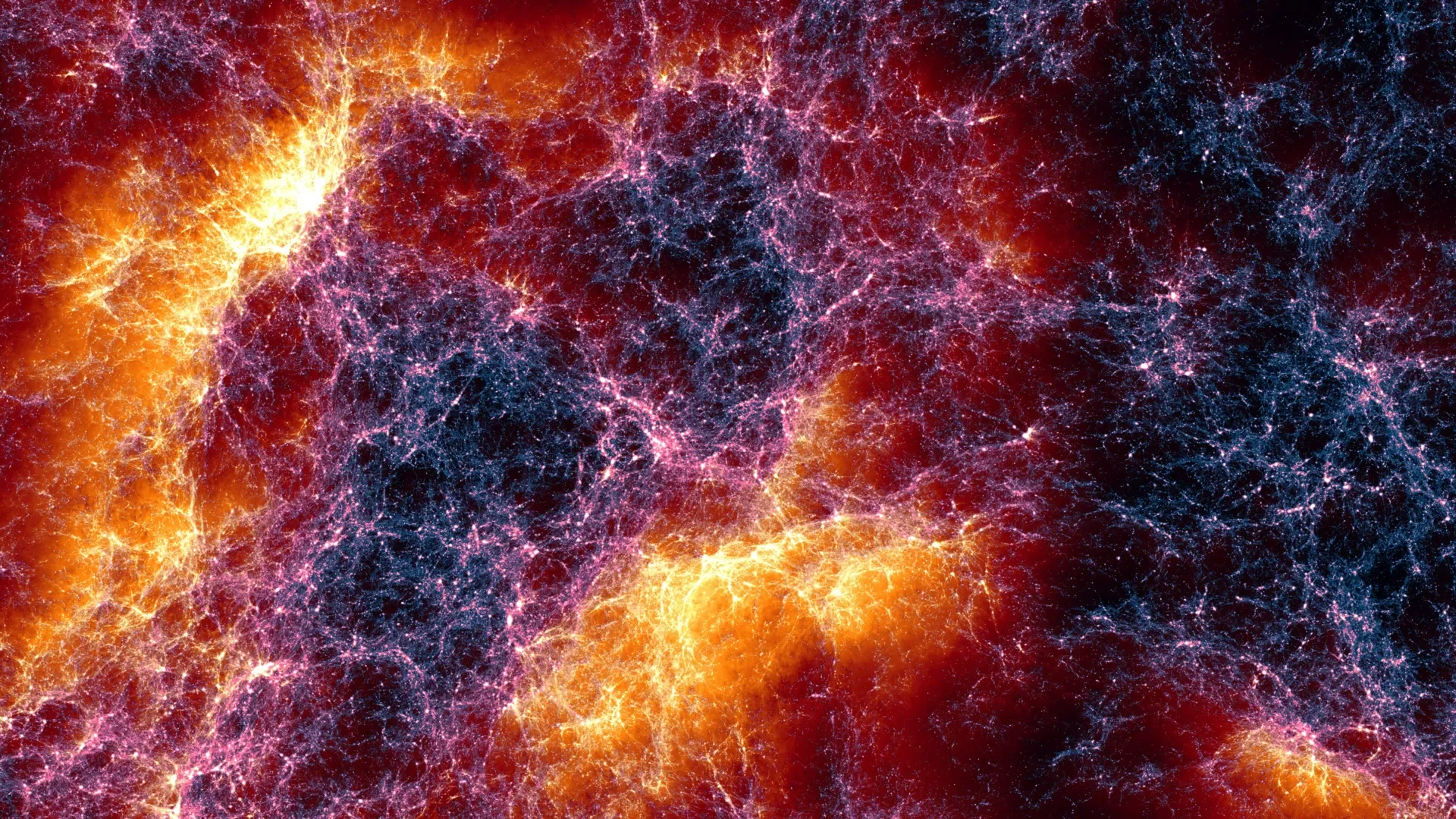
Visualization
In an epoch-defining scientific achievement, researchers at the Center for Astrophysics | Harvard & Smithsonian have executed one of the most extensive and intricate simulations of the infancy of the universe, aptly christened Lumina. This sophisticated computational initiative offers an unprecedented reimagining of the cosmos for the initial 2 billion years following the Big Bang, revealing the complex interactions of dark matter, gas, and radiation that culminated in the formation of the earliest astronomical structures, including stars, galaxies, and black holes.
At the heart of Lumina lies a powerful computational framework capable of simulating substantial cosmic volumes with extraordinary detail. Specifically, the model encompasses a cubic expanse approximating 1.5 billion light-years on each side, significantly expanding the simulation's scope beyond prior efforts. The model’s capacity to represent such vast regions while meticulously delineating individual galaxies positions it as a pivotal resource for contemporary astrophysics. This approach captures the intricate and often perplexing processes accompanying cosmic evolution as the universe transitioned from a hot, dense state to the rich tapestry of structures observed today.
Utilizing advanced radiation hydrodynamics, Lumina employs cutting-edge computing resources, primarily harnessing a staggering array of over 15,000 graphics processing units on the Frontier supercomputer, one of the world’s preeminent computational systems housed at Oak Ridge National Laboratory. This formidable arrangement lends itself to the calculation of the myriad interactions between gas, dark matter, and electromagnetic radiation throughout the formative era. The intricate equations governing these interactions can be modeled holistically—taking into account radiation pressure, cooling processes, and gravitational dynamics—allowing for a coherent examination of how these forces sculpted the universe.
A significant innovation within Lumina’s framework is its treatment of helium reionization, which is not merely modeled in isolation but is dynamically integrated with the cosmic environment. This process is vital; as the universe evolved, radiation from nascent stars and galaxies emitted energetic photons capable of stripping electrons from helium atoms, thereby altering galactic and intergalactic landscapes. This nuanced representation enables researchers to probe the symbiosis between galactic evolution, the radiation emitted during star formation, and the heterogeneous gas filling the cosmos.
Lead author Oliver Zier emphasized the significance of Lumina in the context of recent observational breakthroughs facilitated by state-of-the-art astronomical instruments, such as the James Webb Space Telescope (JWST) and the Nancy Roman Space Telescope. These observatories are ushering in an era rife with new discoveries, particularly concerning the magnetic tapestry of the early universe. By juxtaposing Lumina's predictions with actual telescopic data, scientists can critically evaluate the robustness of prevailing cosmic evolution models. Discrepancies between observed phenomena and simulated predictions could illuminate areas ripe for further inquiry, potentially challenging long-accepted cosmological theories.
The aspirations for Lumina extend well beyond the mere duplication of past events; its design encapsulates a framework for probing the gas dynamics in intergalactic spaces, the minute effects of the cosmic microwave background radiation, and the localized star formation processes occurring at elevated rates in specific regions of the universe. Researchers anticipate that insights derived from Lumina will shed light on unresolved questions surrounding the universe's infancy, offering new perspectives on the fundamental laws that govern cosmic behavior.
As scientists endeavor to expand upon this simulation, it becomes increasingly clear that Lumina not only sets the stage for detailed examinations of early cosmic dynamics but also represents a critical juncture in our understanding of the universe. The increasing confluence of computational power, observational precision, and theoretical sophistication promises to deepen our grasp of how the universe unfolded from the primordial soup of its early moments to the structured expanse it has become. In this developmental narrative, Lumina not only exemplifies cutting-edge research but also inspires a reimagining of our cosmic heritage, poised on the cusp of discovery.