Field: Technology
Smaller EV batteries, longer range? Scientists may have found a way
Published | Technical Staff
Visualization
In an era where the rapid evolution of electric vehicles (EVs) defines the forefront of automotive innovation, researchers at the Korea Advanced Institute of Science and Technology (KAIST) have made a groundbreaking advance that could reshape the future of energy storage technology. Their recent work, unveiled in early September, addresses long-standing limitations in anode-free battery designs by employing sophisticated manufacturing techniques derived from the semiconductor industry. This approach promises not only to enhance battery lifespan but also to significantly reduce the weight and size of batteries, enabling vehicles to achieve greater driving ranges on a single charge.
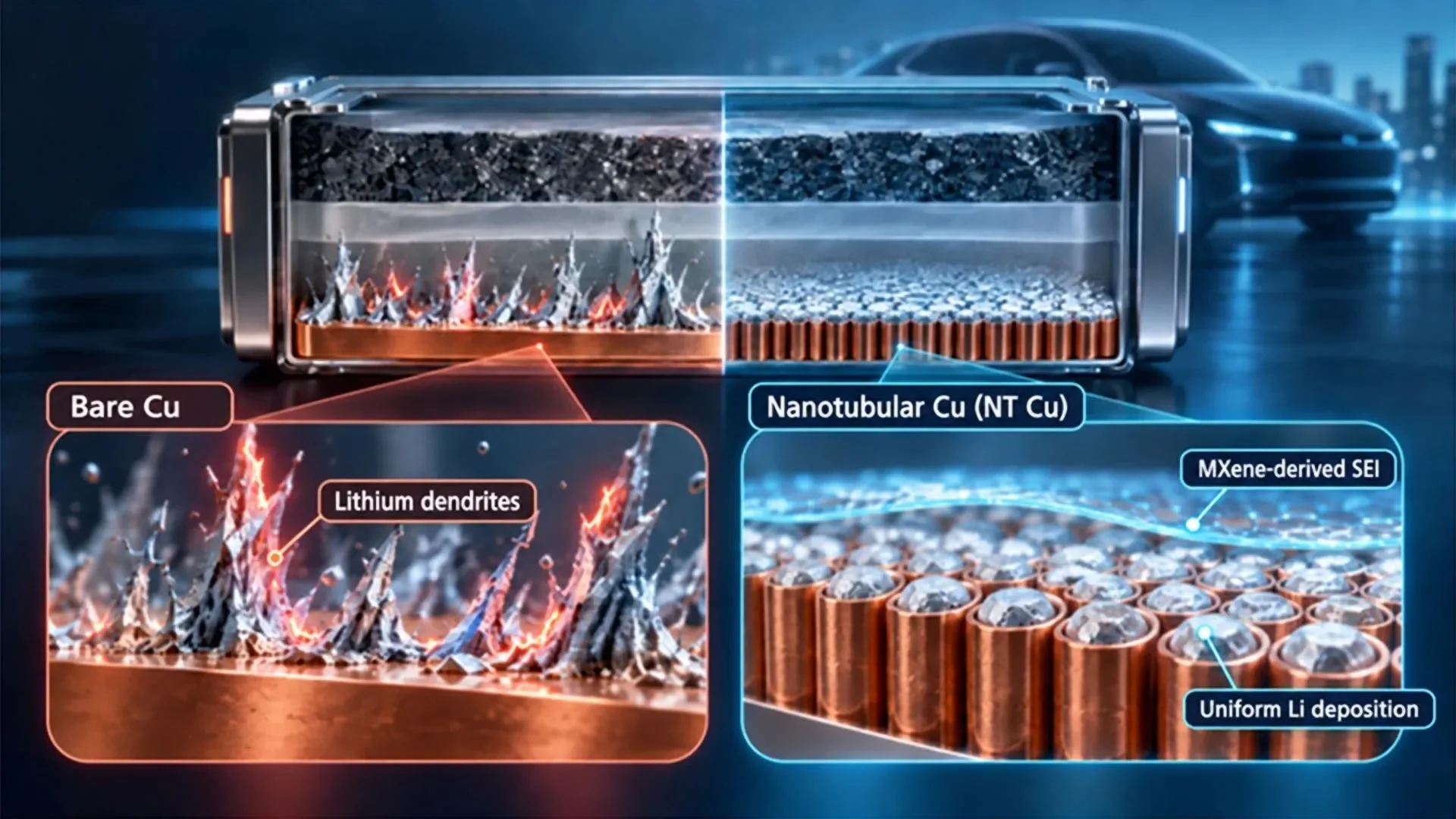
The crux of the invention lies in the inherent structural challenges faced by anode-free batteries. While these novel systems allow for lithium to be deposited directly onto a conductive layer—traditionally a copper foil—removing the need for conventional anode materials like graphite, they are plagued by one key issue: the formation of lithium dendrites during charge cycles. Dendrites, resembling sharp needles, can form when lithium ions concentrate irregularly, leading to compromised battery integrity, increased internal resistance, and, ultimately, shortened operational life.
Researchers including Professors Jinwoo Lee and Hee-Tae Jung spearheaded this innovative solution by integrating advanced fabrication techniques akin to those used in semiconductor device production. They introduced a meticulously engineered architecture of microscopic tubes on the copper foil substrate, enhancing lithium deposition properties. This novel micropatterning technique was facilitated through secondary sputtering lithography (SSL)—a process that employs a finely-tuned bombardment of particles to create intricate nanoscale structures.
The design of these tubes, each measuring approximately 300 nanometers in diameter and 150 nanometers in height, significantly augments the surface area available for lithium accumulation. Specifically, these structures expand the usable surface to nearly quadruple the area of a flat copper sheet. Such an increase fosters a more uniform lithium deposition, mitigating the risks associated with dendrite formation. By providing designated areas for lithium to settle, the tubes effectively prevent the configuration of damaging spikes, thereby enhancing electrode stability and lifespan without the burden of added materials.
But the innovation doesn’t end there. To further bolster the integrity and longevity of these batteries, the research team applied a deliberately thin coating of MXene—a two-dimensional conductive material—to the copper surface. At just 10 nanometers thick, this ultrathin layer lays the groundwork for a more comprehensive protective envelope to form. Instead of merely acting as a physical barrier, the MXene coating serves a dual purpose; it catalyzes the creation of a robust protective layer containing high concentrations of lithium fluoride (LiF) during battery operation. This layer not only guards against undesirable chemical reactions with the electrolyte but also plays a crucial role in suppressing dendrite growth.
The implications of this research are profound. As the KAIST team meticulously analyzed the formation of this protective layer using advanced imaging and mass spectrometry techniques, such as X-ray photoelectron spectroscopy (XPS) and transmission electron microscopy (TEM), they were able to confirm its uniform development across the MXene surface. The rich data produced during these investigations highlights the transformative potential of utilizing ultrafine fabrication methods to produce high-energy anode-free batteries that align with the growing demand for efficient, compact energy solutions in the EV market.
The prospect of lighter, smaller batteries with longer operational lifespans could facilitate a new generation of electric vehicles that are not only more environmentally friendly but also offer enhanced performance and passenger experience. As Professor Lee ardently reiterated, this research is a critical leap forward that could accelerate the commercial viability of anode-free battery technology, a movement that aligns with the overarching goal of creating compact energy storage systems for the electric mobility landscape of tomorrow.
With ongoing funding from the National Research Foundation of Korea and collaborative support from the Global Semiconductor Advanced Fab Utilization program, the KAIST team's findings herald an exciting era for battery technology, where the dream of efficient, high-capacity electric vehicles moves closer to fruition. The detailed findings of this study have been documented in the esteemed journal Advanced Functional Materials, paving the way for further exploration in the intricate interplay between materials science and energy storage innovation.