Field: Technology
SLAC scientists find conclusive proof of a mysterious third type of magnetism
Published | Technical Staff
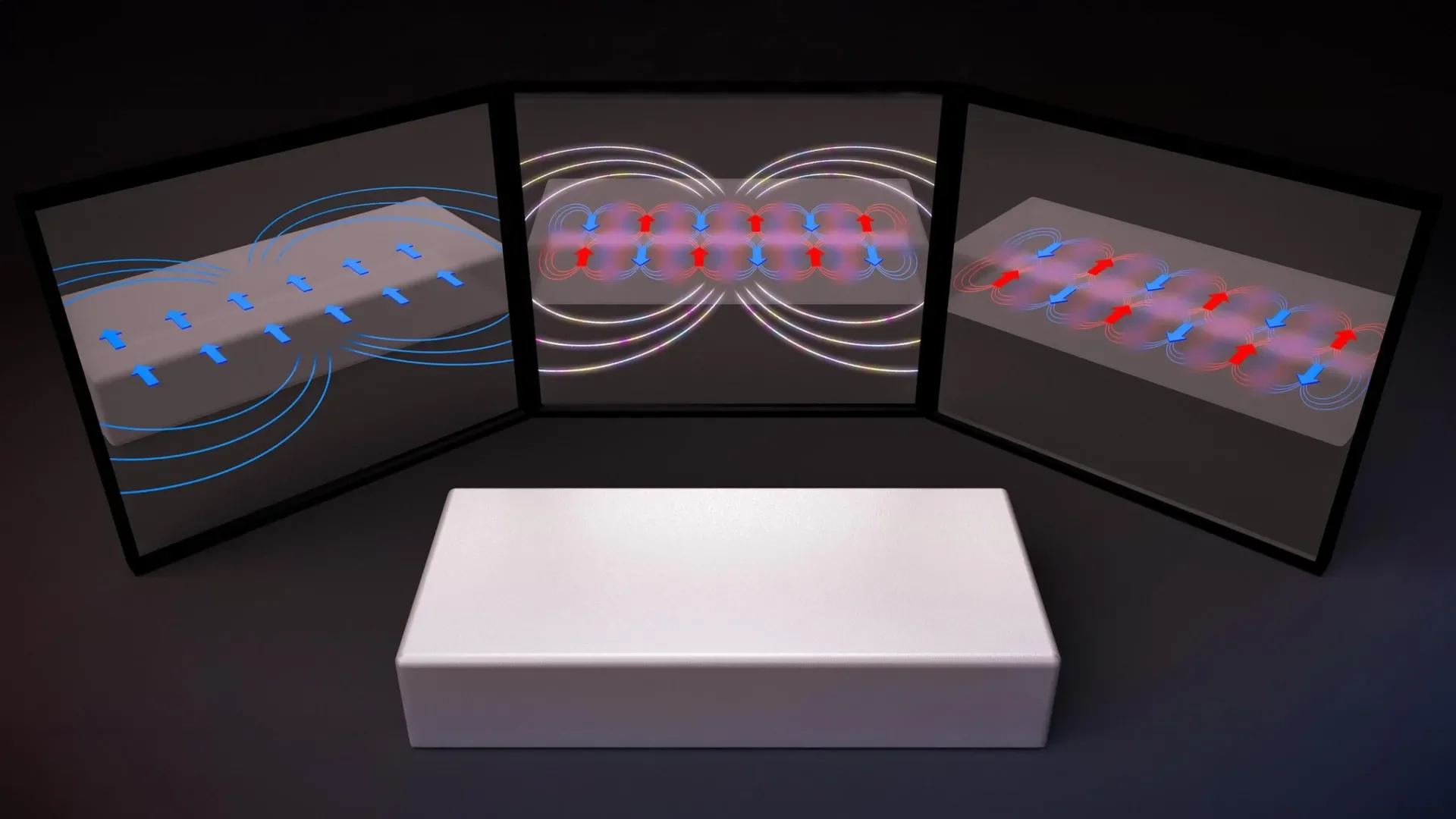
Visualization
In a groundbreaking discovery that challenges nearly a century of established magnetic theory, researchers from the SLAC National Accelerator Laboratory have identified a third magnetic phase, termed altermagnetism, adding a revolutionary dimension to our understanding of magnetic materials. Over the last few decades, physicists remained confined to a binary paradigm of magnetism, primarily divided into ferromagnetism and antiferromagnetism—a classification that now appears inadequate in light of newly emerging phenomena.
The team spearheaded by Daniel Jost, an associate scientist at SLAC and the Stanford Institute for Materials and Energy Sciences, presented their findings in a recent publication in the journal Science. At the core of their work lies manganese telluride (MnTe), a compound traditionally regarded as an antiferromagnet. However, Jost and his colleagues unveiled compelling evidence suggesting that its magnetic characteristics align more closely with the proposed definition of altermagnetism.
The intriguing nature of altermagnetism resides in its dual abilities to maintain stability while facilitating efficient information transport—issues pivotal for the next generation of electronic devices. Unlike ferromagnets, where all electron spins align uniformly (1/2, 1/2, 1/2 for spin-up or -1/2, -1/2, -1/2 for spin-down), and antiferromagnets, which feature the alternating spin arrangement (1/2, -1/2, 1/2, -1/2), altermagnets present a unique magnetic framework. This third type exhibits alternating spin orientations but does so within rotated crystal lattices. Such an arrangement engenders an asymmetry, creating chiral properties that distinguish altermagnets from their conventional counterparts—a crucial aspect demonstrated through various experimental methodologies.
To substantiate this assertion, the research team sought to identify a magnetic signature indicative of chirality within the MnTe structure. Chiral materials, akin to human hands whose mirror images cannot be aligned perfectly, reveal unique insights into the underlying magnetic order of a substance. Experimental observations previously hinted at a chiral behavior within MnTe, but definitive proof remained elusive.
Utilizing advanced techniques at the European Synchrotron Radiation Facility (ESRF) in France, the researchers employed circularly polarized X-rays—a technique that accentuates the magnetic chirality of materials. The ID32 beamline at ESRF allowed the scientists to finely tune the polarization of the X-rays, which rotate either left-handed or right-handed as they propagate through the material. By scrutinizing how MnTe scattered the two distinct forms of light, the researchers were able to extract the critical chiral feature—effectively revealing the material's inherent altermagnetic properties.
The experiments yielded significant results, showcasing a pronounced asymmetry in the scattering patterns, thus confirming the presence of chirality within the magnetic framework of manganese telluride. This evidence will not only enrich fundamental magnetic theory but lays the groundwork for the engineering of materials with superior properties—ripe for advancement in electronic applications. Such materials could usher in innovations in memory systems, quantum devices, and energy-efficient data centers, all of which depend on reliable and fast information transfer.
The discovery of altermagnetism is not merely an academic exercise but a potential catalyst for paradigm shifts in technology, prompting physicists to rethink materials science.
Reflection on the interplay of magnetic phenomena demonstrates how research trajectories evolve, revealing hitherto unexplored realms of magnetic behavior. As this study redefines the landscape of magnetism, the boundaries of potential applications expand, propelling us toward quicker, more efficient computational environments and inspiring future breakthroughs in quantum mechanics that rely on novel spins and magnetic properties. These advanced materials, stemming from altermagnetism, may very well devise a future where conventional computing methodologies transform into paradigms of unparalleled efficacy and capability.