Field: Technology
Scientists unravel a 192-year-old mystery hidden in a mangled silver coin
Published | Technical Staff
Visualization
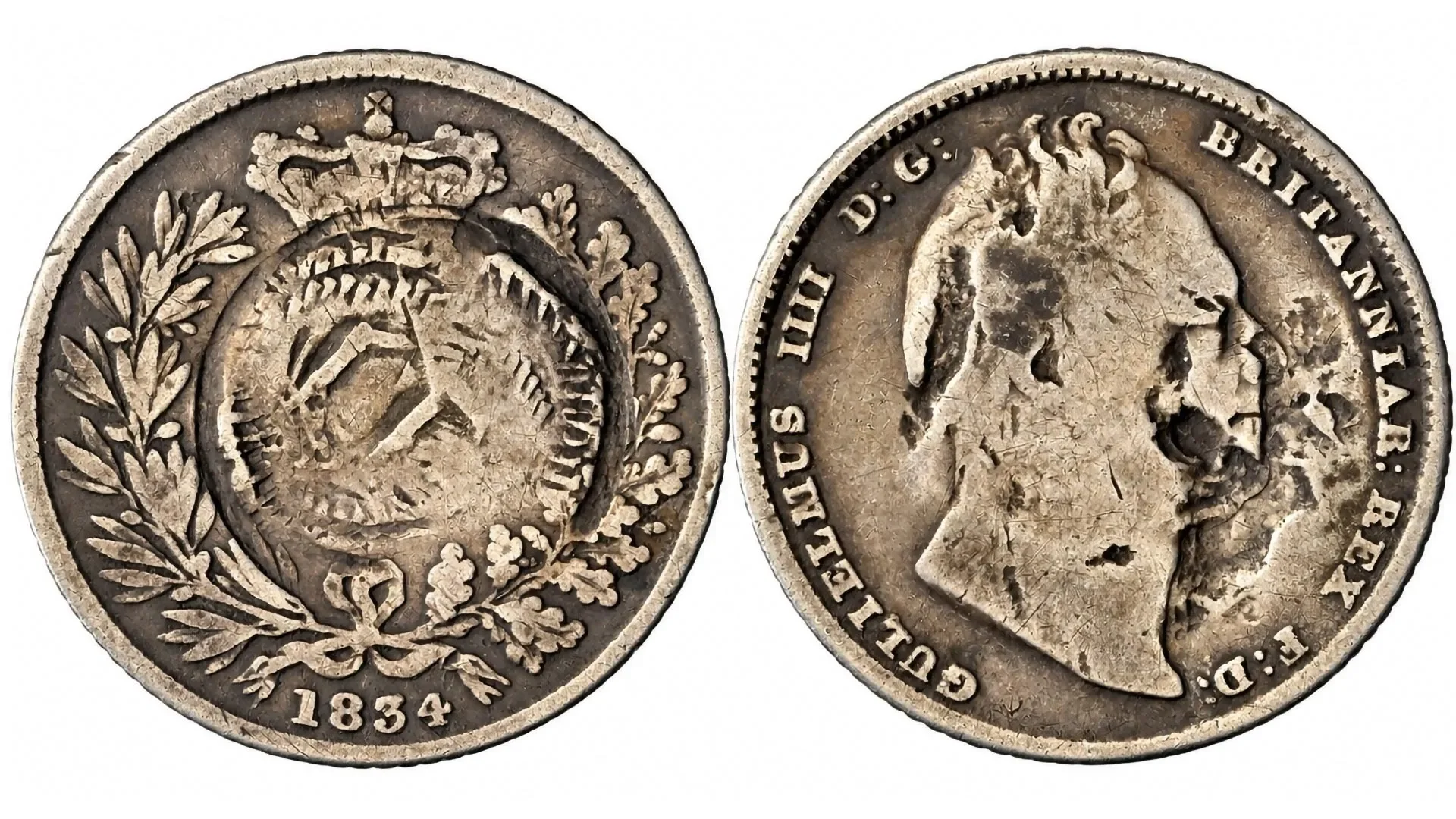
In an extraordinary instance of serendipitous discovery, researchers have turned a seemingly mundane 1834 British silver sixpence into an artifact of immense historical and technological significance. Unearthed at a car boot sale in Greater Manchester, England, this heavily distorted coin offers insights into an unusual minting anomaly that has persisted in obscurity for nearly two centuries. The findings, published in *npj Heritage Science*, reveal that advanced analytical techniques can illuminate the intricacies of 19th-century coin production and enhance our understanding of historical artifacts.
Initially purchased as part of a lot, the sixpence bears the regal likeness of King William IV but features an array of distressing deformations that sparked the interest of investigators. Rather than typical wear from circulation or damage from later impacts, the coin’s central surface shows signs of severe crushing, raising the fundamental question: What circumstances would lead a coin to sustain such extreme deformation during its time in the mint?
Investigators set out to answer this question through a comprehensive suite of analytical methodologies, incorporating powerful microscopy, chemical testing, and optical surface profilometry. Each of these approaches provided vital data, allowing the research team to piece together a plausible narrative regarding the coin's condition.
Microscopic examination revealed sharply defined depressions and elevated ridges across the severely deformed central region of the coin. Measurement indicated that across the affected area, heights varied dramatically, achieving a range of approximately 0.75 millimeters—a significant deformation for a metal coin of that period. The researchers concluded that the damage pattern was most consistent with a sequence of concentrated, high-pressure applications, likely occurring during the minting process when the coin was struck.
Intriguingly, the peripheral regions of the coin remained relatively intact, suggesting that whatever force had acted upon the coin had been fundamentally restricted to a localized area. This evidence contradicts explanations based solely on wear and corrosion—processes that typically smooth and surface-level material rather than create such pronounced distortions. A single, externally applied force does not adequately account for the juxtaposition of deep central damage with well-preserved edges. Therefore, the prevailing theory posited by the researchers is that the unusual deformation is an artifact of a striking anomaly during production at the mint.
Delving deeper, the investigative team employed scanning electron microscopy combined with energy-dispersive X-ray spectroscopy (SEM-EDX) to analyze the metallic composition of the coin. The coin was found to be primarily an alloy of silver and copper, a common concoction for coins of that era. However, in the severely distorted regions, the results revealed a greater concentration of copper and evidence of corrosion and contamination, particularly within the creased depressions. This chemical analysis underscored that while there had been surface-level changes due to environmental exposure, these observable features alone could not account for the depth and distribution of the physical distortions.
Optical surface profilometry provided a three-dimensional map of the coin's surface, allowing researchers to scrutinize the geometric intricacies of the distortions with unprecedented resolution. The resultant topographic maps exhibited complex features such as steep depressions and abrupt transitions in surface height, reinforcing the hypothesis that the coin had endured extreme localized compressive forces.
The historical context of the 1834 minting reveals a significant transformation in coin production, where steam-powered presses had begun to revolutionize the minting process. Traditionally, defective coins were identified during inspections and melted down—an important procedure given the incorporation of precious metals like silver into currency. Thus, if this deformed sixpence did emerge from the mint, it represents an exceptionally rare example of a manufacturing defect that managed to survive public circulation.
Establishing the precise timeline of deformation remains a lingering challenge, as the coin's history over nearly two centuries can obscure its origins. Consequently, the researchers adopted a multi-evidentiary approach, integrating findings from chemical composition, surface morphology, and the threedimensional geometry of the distortions. This robust methodology exemplifies a new frontier for discerning the narratives of historic metal objects, illuminating how structural and chemical signatures can distinguish between manufacturing defects and subsequent damage.
Adding another layer of sophistication, the investigation also examined the role of artificial intelligence in evaluating this historical puzzle. High-resolution imaging facilitated initial observations of surface features, leading the examination process to consider various hypotheses. Through the application of human-curated computational methods—specifically utilizing large language models (LLMs)—the researchers were able to process and categorize observations effectively, guiding the development of testable hypotheses.
The convergence of advanced imaging techniques, chemical analysis, and computational assistance not only sheds light on the enigmatic deformations of this silver sixpence but also outlines a systematic framework for future explorations into historic metal artifacts. This case exemplifies how the treasures of the past can be scientifically revived, revealing deeper narratives that inform our understanding of technological evolution and craftsmanship in historical contexts. The coin's journey from obscurity to scholarly attention encapsulates the remarkable blend of serendipity and scientific rigor, breathing new life into a 192-year-old mystery.