Field: Technology
Scientists recreate primordial matter from the dawn of the universe by colliding oxygen nuclei at near-light speeds
Published | Technical Staff
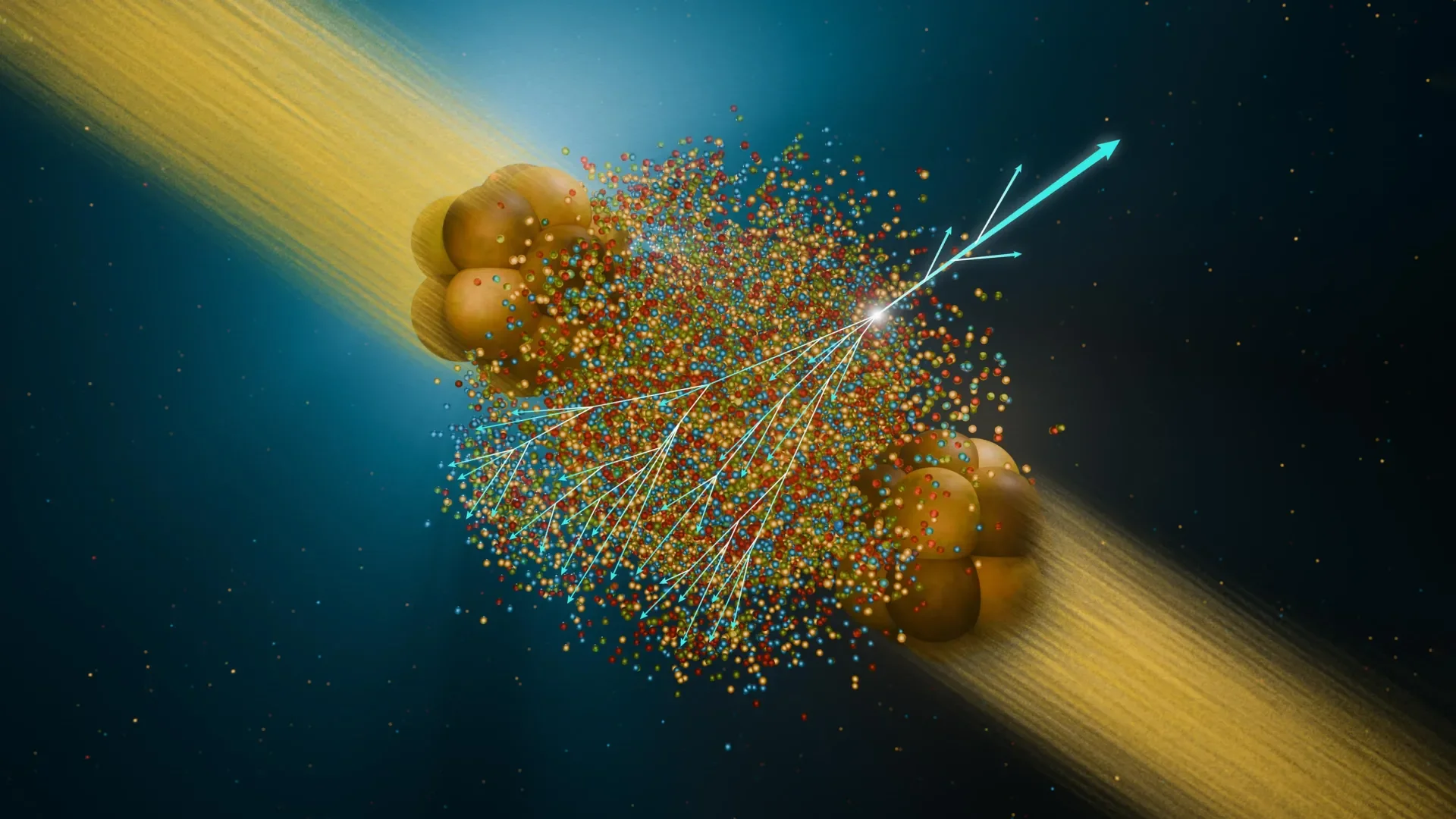
Visualization
In a groundbreaking endeavor, researchers at Brookhaven National Laboratory's Relativistic Heavy Ion Collider (RHIC) have successfully reconstituted a primordial state of matter akin to that which filled the universe shortly after the Big Bang. This remarkable feat was accomplished by colliding oxygen nuclei at velocities nearing the speed of light, unveiling new insights into quark-gluon plasma (QGP)—a densely packed state of matter theorized to have existed in the universe's infancy.
Typically, the production of QGP has relied on the high-energy collisions of larger atomic nuclei, such as gold nuclei, which contain 79 protons and 118 neutrons. The immense energies involved—and facilitated by Einstein's equation \(E=mc^2\)—result in the disaggregation of the nuclei, releasing constituent quarks and gluons. These subatomic particles, which are hypothesized to interact freely in the extreme conditions akin to those of the early universe, have eluded direct observation due to their fleeting existence, collapsing back into more familiar particles within an infinitesimal fraction of a second.
Significantly, the recent findings from the STAR experiment at RHIC suggest that conditions for creating this exotic matter can be achieved at much lower energies than previously documented. The researchers reported conclusive evidence of jet quenching—a phenomenon wherein high-velocity particle jets lose energy while traversing the dense medium of formed QGP. This effect, typically observable in the context of larger nuclei, was confirmed in the context of smaller collisions involving oxygen nuclei, which are composed of merely eight protons and eight neutrons.
Li Yi, a professor of physics at Shandong University and lead investigator on the STAR analysis, emphasized the findings' implications for our understanding of early-universe physics. The lower energy threshold identified by the experiment offers a critical contribution to the knowledge landscape regarding the conditions that facilitate the formation of quark-gluon plasma, pushing the boundaries of current theoretical frameworks.
"The QGP is believed to be the state of matter that encompassed the universe before protons and neutrons formed," Yi elaborated. "Understanding its characteristics is essential for deciphering the evolution of the universe's initial moments."
To elucidate the jet quenching phenomenon, scientists have relied on nuanced observations of particle behavior, particularly concerning jets created in the collisions. Jets are narrow sprays of energetic particles that emerge when a quark or gluon from one oxygen nucleus strikes a corresponding quark or gluon from another, resulting in pairs of particle jets, or "di-jets," that travel in opposite directions. Of particular interest are the paths taken by these jets within the QGP. Jets that propagate deeper into the dense plasma experience greater energy loss due to interactions with the abundant quarks and gluons, akin to the increased drag a bullet experiences as it traverses through water.
As colleagues have pointed out, studying the properties of quark-gluon plasma emerges as a powerful avenue for science to comprehend early universe conditions. The researchers utilized the STAR detector—a sophisticated instrument engineered to scrutinize the aftermath of these high-energy collisions—to extract relevant data. Their analysis demonstrated that particles escaping the quark-gluon plasma exhibited less energy than anticipated, corroborating the hypothesis that jet quenching had indeed occurred.
The implications of this research are twofold. First, it extends the known conditions requisite for the generation of QGP, thereby enriching the current models of high-energy nuclear physics. Second, the crossover findings from RHIC align with previous observations at the Large Hadron Collider (LHC), which also reported signs of collective motion and energy loss among particles, raising pivotal questions about the universality of these phenomena across distinct collision systems.
The STAR experiment's outcomes herald a new frontier for research into the early universe. After establishing signatures of QGP in the larger gold nucleus collisions, scientists grappled with a critical inquiry: can smaller collision systems similarly yield jet quenching, or perhaps alternative explanations might account for observed behaviors? This pursuit culminated in the focus on oxygen collisions, where researchers are now poised to investigate the limits of QGP production amid smaller systems.
Ultimately, these findings signify profound progress in pioneering our understanding of the fundamental constituents and interactions of matter under extreme conditions, challenging established paradigms and enabling a deeper comprehension of the universe as we unravel its earliest moments and gasped the ephemeral particles that once dominated the cosmos.