Field: Technology
Scientists Discover Theoretical Loophole Allowing Black Holes to Split Apart
Published | Technical Staff
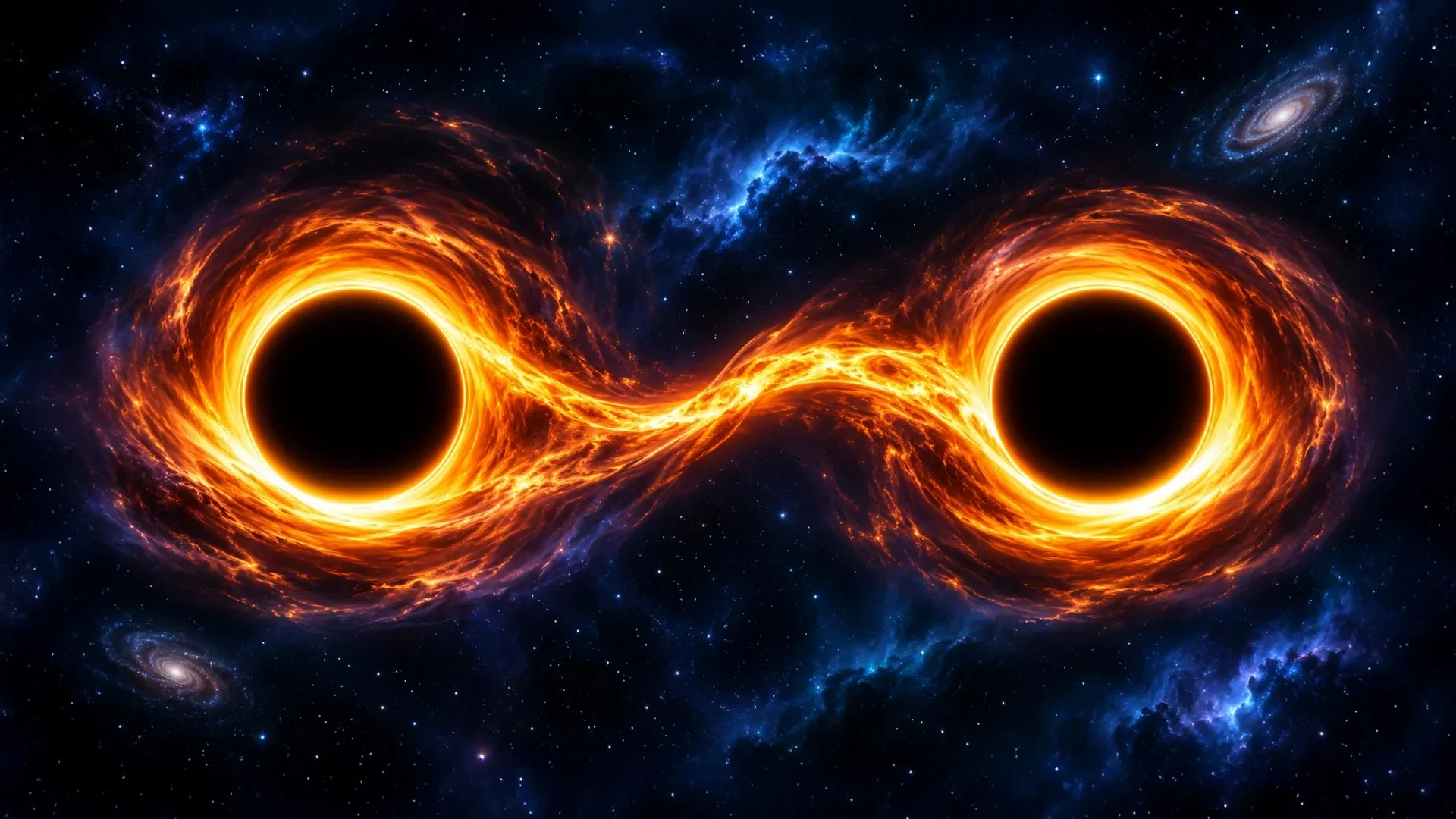
Visualization
In a groundbreaking theoretical study, physicists have unveiled a phenomenon that challenges the fundamental understanding of black hole dynamics: the possibility that an extremely rapidly spinning black hole could split into two smaller entities. This research paves the way for re-evaluating existing constraints governed by the laws of thermodynamics and potentially introducing a new era of exploration into black hole physics.
The study, published in Physical Review D under the title "When Black Holes Admit Pair-of-pants Topologies," investigates the paradoxical nature of black holes tending to merge rather than divide. Conventional wisdom dictates that ample thermodynamic considerations, primarily expressed through the lens of entropy, prevent this division. A black hole's entropy, a measure of the number of microscopic configurations that correspond to its macroscopic state, implies that splitting would yield an overall decrease in entropy—an act that is thermodynamically unfavorable.
Black holes are characterized by their event horizon, the boundary beyond which no information or matter can escape their gravitational grasp. The research led by Francesco Sannino from the University of Southern Denmark, in collaboration with Giacomo Cacciapaglia and other physicists, postulates that while traditional black holes resist splitting, those that spin at extreme velocities might bypass this limitation. Theoretical analyses indicate that an angular momentum sufficient to push black holes near their maximum rotation rate could create a transient “window,” where the thermodynamic restrictions are momentarily lifted.
The potential emergence of a "pair-of-pants topology" stems from the geometric evolution of the horizon. Initially singular, the horizon morphs into two distinct branches, akin to trouser legs, as the black hole theoretically bifurcates. Such an event would necessitate not only that the black hole has enough rotational energy but also that the offspring black holes could drift apart sufficiently to avoid reconvening—a challenge given the standard gravitational behavior of these entities, where proximity often invites fusion.
Moreover, the authors entertained the notion of alternate physics existing under extra-dimensional theories. In these frameworks, certain configurations of black holes could exhibit instability, providing an avenue for fragmentation that is thermodynamically favorable, particularly when there is a significant mass disparity between the fragments. Yet, while theoretical pathways open up fascinating discussions on black hole fragmentation, the study emphasizes that simply permitting an event is far from ensuring its occurrence; real physical conditions warrant further investigation.
Going forward, quantifying the probability of such splits remains a cornerstone of ongoing research. The implications for detecting such bifurcations are equally tantalizing. Sannino projects that primordial black holes, likely smaller and possibly less stable than their colossal astrophysical counterparts, might demonstrate a greater propensity for division. Future observations utilizing gamma-ray telescopes, including the Fermi Large Area Telescope, could unearth signatures of fragmentation through emitted high-energy radiation during hypothetical events where black holes disassemble.
In summary, the prospect of black holes splitting into two opens a thrilling new chapter in the exploration of gravitational phenomena. If substantiated, such occurrences could have profound implications for our understanding of gravity, quantum mechanics, and the very fabric of spacetime itself. As researchers continue to probe these enigmatic entities, one thing is certain: black holes are far from fully understood, and the cosmos still holds many secrets waiting to be revealed.