Field: Technology
Scientists discover that a clogged filter could revolutionize oil refining
Published | Technical Staff
Visualization
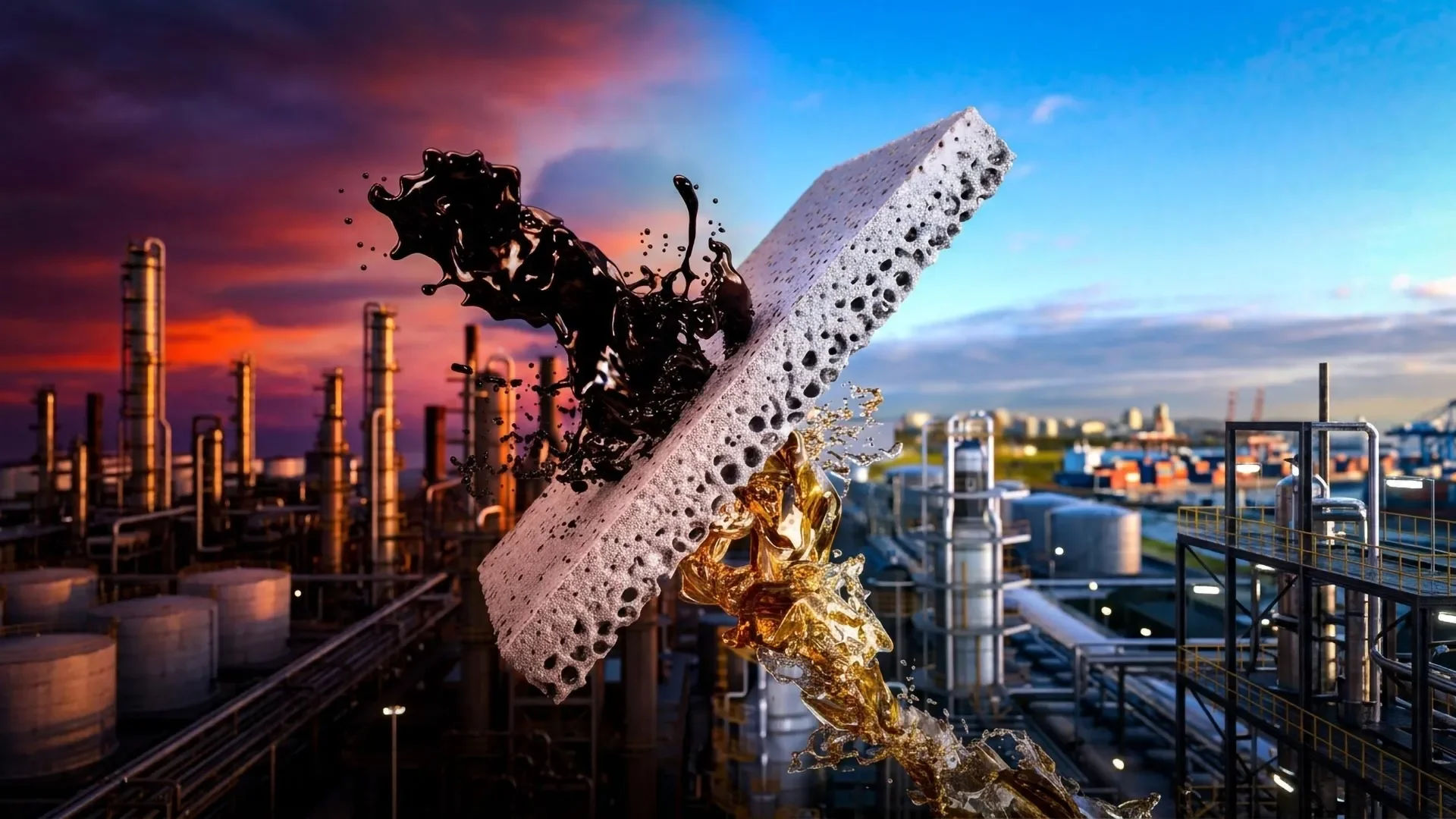
A groundbreaking breakthrough in oil refinery technology is poised to transform an industry notorious for its staggering energy consumption. A collaborative research effort spearheaded by Professor Dong-Yeun Koh at the Korea Advanced Institute of Science and Technology (KAIST), alongside Professor Ryan Lively’s group at Georgia Tech, has unveiled a remarkably simple membrane that separates crude oil at room temperature. By leveraging the crude oil itself to generate microscopic filtration channels, this innovation promises to reduce refining energy use significantly, along with lowering carbon emissions and operating costs.
Crude oil serves as a fundamental resource, transcending its use as a fuel for transportation to contribute as a primary feedstock for plastics, pharmaceuticals, and myriad everyday materials. As global demands escalate, the need for a more efficient refining process becomes increasingly urgent. Historically, crude oil refinement has relied heavily on distillation—an energy-intensive method that heats oil beyond 350 °C to vaporize fractions of it before cooling and condensing, a process that consumes around 1,100 terawatt-hours (TWh) of energy annually—a figure representative of the annual output of approximately 130 nuclear power plants.
The energy demands associated with traditional distillation methods are substantial, making it a leading driver of both greenhouse gas emissions and economic overhead in oil refining. In this light, the pursuit of alternative separation technologies, such as membranes, has garnered significant interest. Membrane-based methods promise a less energy-intensive approach, circumventing the extreme temperatures utilized in conventional distillation. However, earlier membrane innovations faced challenges primarily stemming from the assumption that effective separation necessitated specialized coating layers on the membranes, which are often cost prohibitive and prone to defects.
In a striking departure from conventional wisdom, the researchers at KAIST and Georgia Tech opted to employ a basic porous membrane structure made of polyacrylonitrile (PAN). This financially feasible and chemically robust polymer is already widely utilized in industrial filtration systems. What transpired during the flow of crude oil through this membrane defied expectations; heavier hydrocarbon molecules gradually accumulated along the membrane's inner walls, effectively reducing the size of the pores to create pathways measuring a mere 2 nanometers in width. This unexpected fouling phenomenon—which traditionally impedes filtration efficiency—ironically enhanced the membrane’s ability to separate lighter and heavier fractions of crude oil, with lighter fractions traversing the membrane with ease while their heavier counterparts were constrained.
The performance metrics achieved by this uncoated PAN membrane were astonishing. Not only did it yield permeation rates 23 times higher than its predecessors, but it also maintained stable operational efficacy over 28 consecutive days. Professor Lively emphasized the transformative potential of this technology, asserting its capacity to address one of the key bottlenecks in crude oil separation systems by markedly boosting productivity.
Projected simulations offer further insight into the transformative implications of integrating this membrane into existing refinery processes. It is estimated that energy consumption could decrease by approximately 31.6%, while carbon dioxide emissions may fall by 37.6%. Water cooling requirements could decrease by 20.7%, translating to an overall operational cost reduction of 36%. When considered at a national scale in Korea's refining and petrochemical sectors, such an implementation could prevent around 10 million tons of greenhouse gases annually—comparable to the emissions of approximately four million internal combustion engine vehicles.
Beyond the immediate applications within oil refining, the potential for this technology to revolutionize other industries looms large. The membrane's design could benefit the treatment of pyrolysis oil produced from recycling processes for waste plastics, the retrieval of solvents in battery production, purification of pharmaceutical compounds, and enhancements in biofuel generation.
This breakthrough invites exploration of the broader scientific principle underpinning it—the utilization of complex liquid mixtures to passively construct the necessary filtration pathways for effective separation. Such an approach dials into scalability and cost-effectiveness, offering an attractive alternative to traditional membrane technologies that hinge upon precision-engineered surface coatings.
In closing, this innovation heralds a paradigm shift not only in oil refining but potentially across multiple industries reliant on the separation of complex mixtures. As Professor Koh aptly pointed out, this study is a testament to the synergistic nature of research, revealing the profound impact of adaptability and creativity in scientific inquiry to address some of today's most pressing challenges in energy and environmental sustainability.