Field: Technology
Scientists discover a secret glow in toxic fire salamanders
Published | Technical Staff
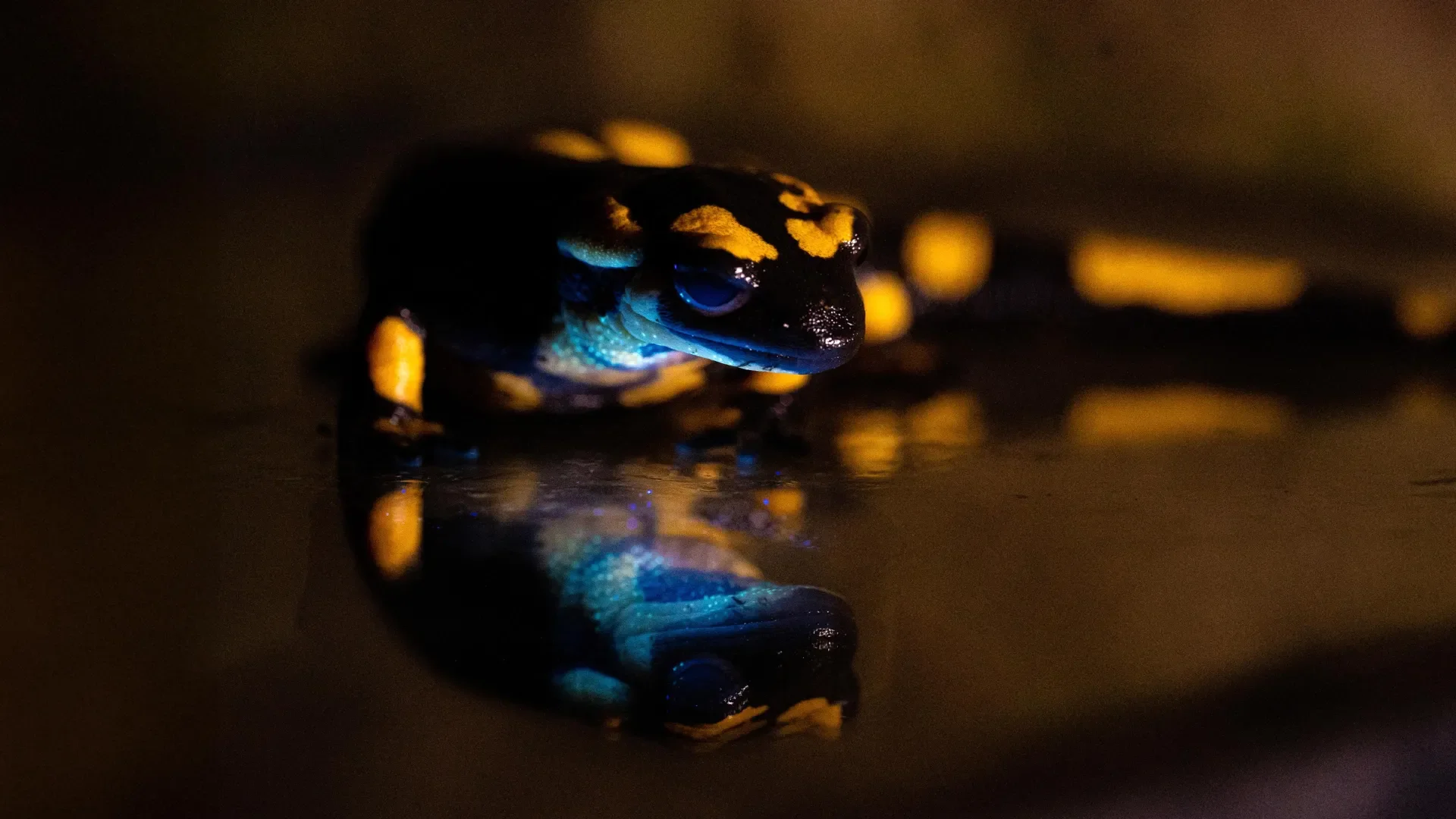
Visualization
In a remarkable illustration of nature's hidden complexities, a recent study from the Max Planck Institute for Chemical Ecology has unveiled an astonishing phenomenon in the fire salamander (Salamandra salamandra), a species emblematic of Europe's rich amphibian biodiversity. Under the lens of ultraviolet light, these striking black-and-yellow creatures exhibit a vivid biofluorescent glow, predominantly manifesting as green and cyan luminescence along their ventral side and lateral surfaces. This unexpected discovery not only challenges long-held perceptions of terrestrial biofluorescence but also sheds light on the possible communicative and defensive strategies of these enigmatic amphibians.
The implications of this finding stretch beyond mere curiosity; it raises critical questions about the roles of fluorescence in the behavioral ecology of fire salamanders, classified as "vulnerable" by the International Union for Conservation of Nature (IUCN) due to habitat destruction and fragmentation. A hallmark of the species' biology is its ability to secrete toxic substances, primarily comprised of steroidal alkaloids known as samandarines, which serve as a chemical deterrent against potential predators. The revelation that these skin secretions could also be fluorescent adds a layer of complexity to our understanding of their interactions within ecosystems.
Fluorescence, as defined biologically, involves the absorption of ultraviolet light by specific compounds present in the salamander's skin, which subsequently re-emit this energy as visible light. The detailed biosynthetic pathways leading to these compounds remain under investigation, but the researchers hypothesize that they could be novel molecules previously uncharacterized within the species. This discovery is a striking reminder of the biological treasures that await discovery, even in well-studied organisms. Bernat Burriel, lead author of the study, remarks, "It is fascinating that such a well-studied species still harbors unknown phenomena like this. It reminds us that even the most familiar organisms can hide secrets that are only revealed when they are observed with new tools."
The timing of fluorescence may play a crucial role in the salamanders' nocturnal habitats, where the interplay of moonlight and starlight generates an enriched spectrum of ultraviolet wavelengths. Under these natural luminescent conditions, the salamanders could employ this biofluorescent glow as a means of intra-species communication, helping to facilitate recognition among individuals or to enhance mate selection. Such a function would set a precedent for the broader understanding of fluorescence as a tool for communication in terrestrial ecosystems, traditionally assumed to be the purview of marine species.
Intertwining the concepts of aposematism—the use of warning coloration to signal toxicity—with fluorescence opens new avenues of inquiry. Given that the fire salamander's distinctive coloration already advertises its toxic nature, the fluorescence may serve as an auxiliary signal to increase visibility in low-light conditions, thereby fortifying its defensive strategy. Martin Kaltenpoth, a co-author of the study, posits that "fluorescence meets several criteria that suggest a communicative function," solidifying the notion that these bioindicators could be key to predator avoidance across varying sensory modalities within their environment.
The exact photophysical mechanisms underpinning the fluorescence of fire salamanders remain a tantalizing mystery, as researchers are currently engaged in the pursuit of identifying the chemical entity responsible for this intriguing phenomenon. Andrés Brunetti, another researcher involved in the study, expressed surprise at the lack of prior recognition of fluorescent compounds in salamander skin secretions, noting, "The presence of this fluorescent compound was surprising because salamander skin secretions have been studied chemically for decades."
The potential for this fluorescence to impact conservation efforts forms a critical narrative thread in the story of these amphibians. By gaining insights into the ecological and behavioral implications of their fluorescence, scientists could better inform conservation strategies aimed at preserving fire salamanders amid the threat of habitat loss. Collaboration among researchers, such as those from the Institute of Subtropical Biology and the Catalan Society of Herpetology, underscores the importance of interdisciplinary approaches in addressing biodiversity crises facing amphibian populations.
This groundbreaking revelation not only expands our biological curiosity about amphibians but also contributes meaningfully to the discourse on their conservation. By recognizing the multilayered defenses—chemical and visual—that these creatures possess, we can begin to appreciate the intricate dynamics of survival in a rapidly changing world. With a deeper understanding of how fluorescence might serve critical ecological functions, researchers and conservationists alike may be better equipped to safeguard the future of fire salamanders and their richly diverse habitats.