Field: Technology
Scientists discover a hidden oxygen reservoir deep inside Earth
Published | Technical Staff
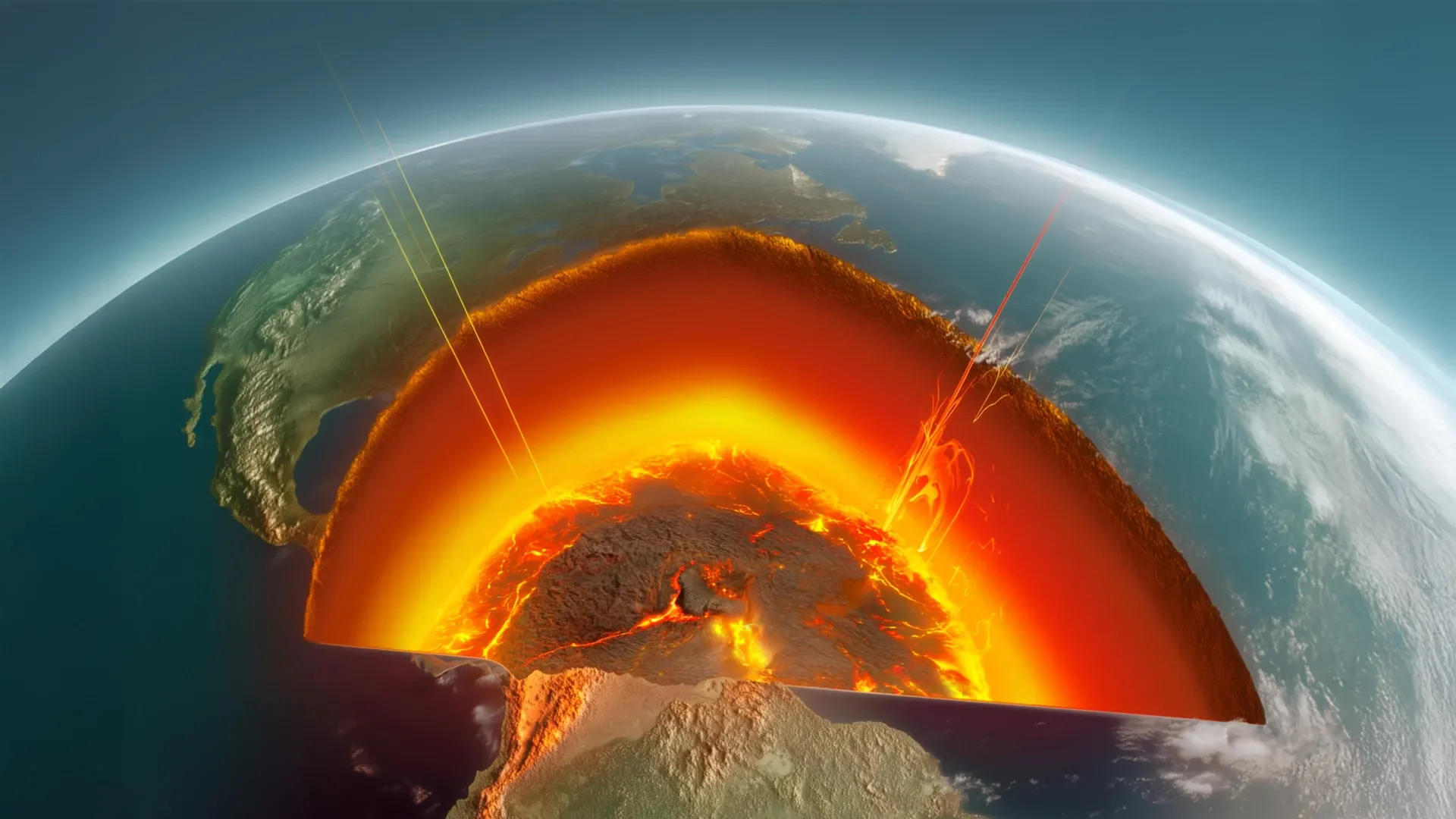
Visualization
The depths of our planet, long viewed as an area of inhospitable obscurity, have unveiled a stunning revelation regarding the elemental composition of Earth’s interior and its potential influence on the planet's atmospheric evolution. A team of researchers, spearheaded by Dr. Yanhao Lin and Dr. Ho-kwang Mao at the Center for High Pressure Science and Technology Advanced Research (HPSTAR), has unearthed compelling evidence suggesting that magma can indeed sequester significant quantities of oxygen—far beyond previously accepted paradigms. This breakthrough compels a reevaluation of the dynamics between Earth's geological processes and the genesis of its oxygen-rich atmosphere.
Traditionally, the geological community has operated under the assumption that the oxygen content of magma is limited and dictated by the presence and charge states of associated elements such as silicon, magnesium, and iron. Oxygen, while one of the most prolific elements comprising Earth's silicate mantle, has not been recognized as a separate volatile component capable of substantial absorption in molten rock. Through a combination of high-pressure experimental methodologies and sophisticated computer simulations, this research posits that we have likely underestimated magma's capacity for oxygen storage and release.
Utilizing an exceptionally fine-tuned apparatus to replicate the immense pressures and high temperatures characteristic of the Earth's depths, researchers focused on synthetic mid-ocean ridge basalt—a rock type endemic to divergent tectonic plate boundaries. By subjecting samples to pressures soaring up to 7 gigapascals—essentially 69,000 times the atmospheric pressure at Earth’s surface—and temperatures fluctuating between 1200°C and 1800°C, significant insights were gleaned regarding oxygen solubility in geological matrices.
The application of advanced piston-cylinder and cubic presses allowed the research team to maintain the requisite extreme environmental conditions while introducing platinum oxide (PtO2) to establish a deliberately oxygen-rich milieu. Upon rapidly cooling the molten material to engender glass, elemental analyses revealed that excess oxygen—defined as the amount of oxygen exceeding the stoichiometric demands of the other constituents—showcased compelling variability in storage potential relative to pressure conditions. At ambient pressure, samples exhibited negligible excess oxygen; however, once exposed to the maximum experimental pressure, they revealed excess oxygen constituting greater than 5% of the sample's overall weight—an impressive leap from the scant 0.2% to 0.5% observed in control samples devoid of platinum oxide.
Raman spectroscopy was employed to discern whether this additional oxygen existed merely as gaseous bubbles or had incorporated into the molecular framework of the glass structure. The absence of a specific gas signature in the glass signified that the excess oxygen effectively integrated into the material, hinting at an even broader capacity for oxygen dissolution than initially hypothesized.
To further scrutinize these phenomena on an atomic scale, the study incorporated deep neural network simulations devised by Prof. Haiyang Niu. These computational models—akin to ab initio simulations that delineate atomic behavior through quantum mechanics—revealed that oxygen could dissolve within the molten matrix until equilibrium was attained. The simulations demonstrated not only the kinetic potential for oxygen absorption but also illustrated a fascinating evolution in the species of oxygen bonds, highlighting the formation of peroxide-like linkages under elevated pressure.
This discovery leads to provocative implications concerning Earth's evolutionary narrative. Could primordial volcanic eruptions have functioned as a conduit for substantial oxygen migration from the depths of the Earth to its atmosphere? The researchers postulate that magma formed within the oxidized mantle regions had the potential to absorb considerable oxygen quantities, which would subsequently be expelled during ascent as pressure diminished. This mechanism might well account for the oxygenation processes that set the stage for complex life forms.
Ultimately, the implications of these findings stretch beyond our terrestrial confines, prompting inquiries into the atmospheric conditions that could prevail on extraterrestrial bodies with similar geochemical foundations. If oxygen presiding in deep planetary interiors serves as an overlooked reservoir, could similar processes enhance our understanding of habitability in the cosmos?
In summary, this research heralds a paradigm shift in our comprehension of magma's role within the Earth system. The newfound appreciation for oxygen as an independent entity in silicate melts opens avenues for future explorations, revitalizing discussions around planetary evolution and the origins of life both here and potentially on other worlds.