Field: Technology
Schrödinger’s Color Conundrum Solved: Geometry Reveals the Deep Structure of Human Color Perception
Published | Technical Staff
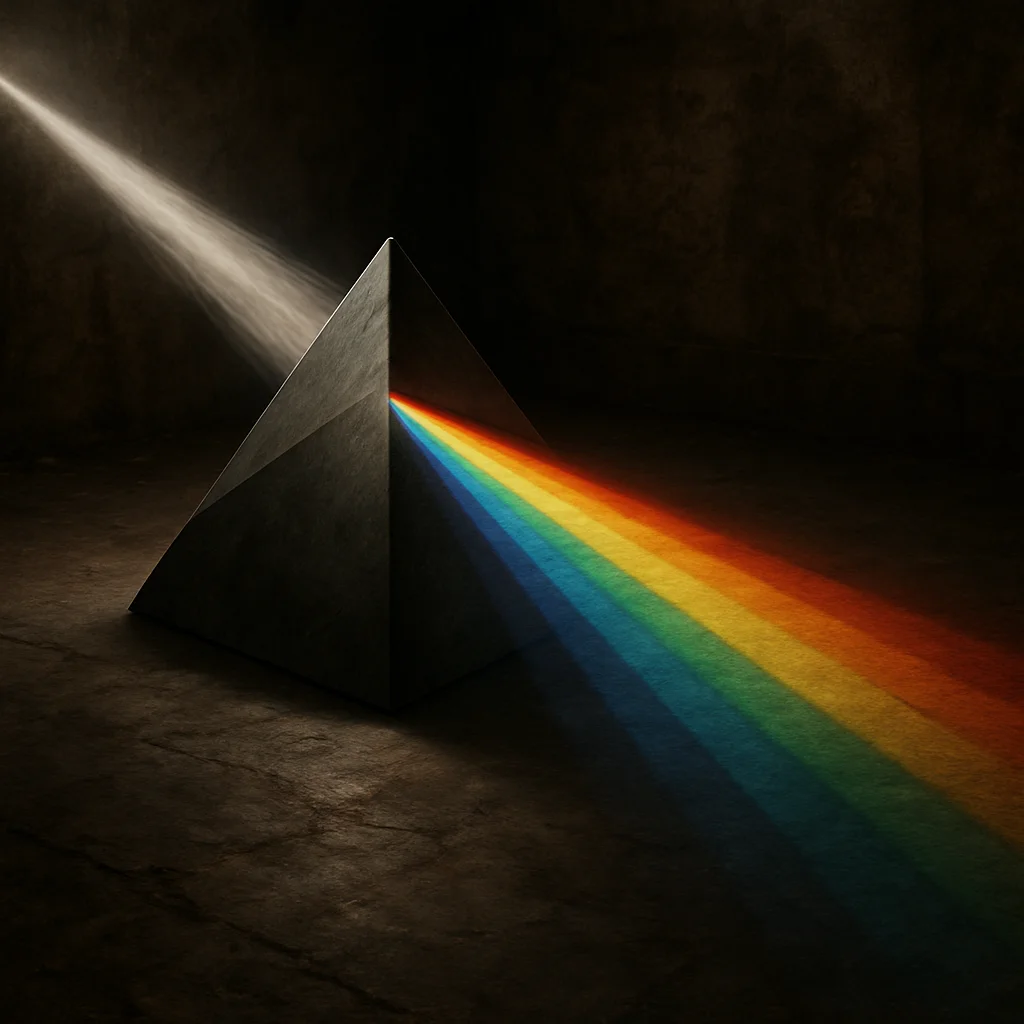
Visualization
A mathematical riddle at the core of color science, first articulated by Erwin Schrödinger in the 1920s, has finally been resolved with a geometric breakthrough that promises to transform both fundamental vision science and applied color technologies. The work, led by Roxana Bujack at Los Alamos National Laboratory, reveals that the perceptual qualities of hue, saturation, and lightness are not arbitrary constructs mediated by culture or language, but are instead intrinsically encoded in the mathematical fabric of color space itself.
Human color vision is subtended by three classes of cone photoreceptors, with peak sensitivities in the long (red), medium (green), and short (blue) wavelengths. This trichromacy constrains perceptual color space to three dimensions—a sturdy but infinitely varied arena within which the science of color difference has strived for mathematical rigor. Early in the 20th century, Schrödinger architected one of the most ambitious models, leveraging Bernhard Riemann’s revolutionary concept of curved spaces. In this Riemannian framework, Schrödinger defined the core perceptual axes—hue (an angular quality), saturation (the chromatic intensity), and lightness (relative luminance)—with the goal of embedding them within the geometry of color differences as subjectively experienced by human observers. The difference between any two colors is encoded as a metric, \( d(\vec{c}_1, \vec{c}_2) \), that should correspond to perceived dissimilarity.
Yet, for nearly a century, a critical flaw lingered: Schrödinger's model was incomplete in its formalization of the neutral axis—the trajectory of achromatic, or gray, colors from black to white that serves as the backbone for contextualizing hue and saturation. Without a precise mathematical definition of this axis, the entire coordinate system hovered in ambiguity. The neutral axis determines the reference from which the geometry of hue circles and saturation rings are constructed; its absence was an unspoken chasm in the mathematical formalism.
Bujack's team confronted this deficiency while developing algorithms for scientific visualization, domains in which color perception underpins the clarity and interpretability of complex data. Their breakthrough was to define the neutral axis solely via the geometry of the perceptual metric, independent of external assignments or cultural color naming. By examining the local curvature and geodesics—or shortest paths—within the perceptual color space, they formulated a procedure whereby the neutral axis arises naturally as the locus of points minimizing chromatic variation.
This approach required abandoning the comfortable strictures of Riemannian geometry in favor of a more nuanced, non-Riemannian manifold—a move that reflects the empirical reality that color differences are not strictly linear or symmetric in human perception. Utilizing the metric tensor \( g_{ij} \) obtained from color matching experiments and psychophysical scaling, the neutral axis was located by considering the set \(\mathcal{A} = \{ \vec{c} | \partial d(\vec{c}, \vec{n})/\partial \vec{c} = 0 \, \forall \vec{n} \in \mathcal{A}\} \), where \(\vec{n}\) traverses the achromatic scale.
Resolving the neutral axis gap permitted Bujack and colleagues to define hue, saturation, and lightness as intrinsic coordinates mathematically derivable from the structure of the color space metric itself. Further, their model corrected two outstanding perceptual effects neglected in Schrödinger's original framework. First, the Bezold-Brücke phenomenon—where colors shift in perceived hue when their intensity, or luminance, changes—was incorporated by recasting hue transitions as geodesics, or minimal paths, in the color space, replacing traditional straight-line (linear) interpolations. Here, the color difference \(\Delta d\) between points is not measured along Euclidean lines but along geodesic curves, which can be formally expressed by the solution to
\[
\frac{d^2x^i}{ds^2} + \Gamma^i_{jk} \frac{dx^j}{ds}\frac{dx^k}{ds} = 0,
\]
where \(\Gamma^i_{jk}\) are the Christoffel symbols of the non-Riemannian manifold.
Second, the perceptual law that large increments in color difference become less salient than equivalent increments near the neutral axis (the so-called law of diminishing returns) was incorporated by optimizing geodesic measurements in a curved (non-Riemannian) space, rather than through the linear scaling assumed in classical models.
The implications of this advance ripple far beyond theoretical psychophysics. Precision in modeling perceived color differences is essential in technologies ranging from digital photography to scientific visualization, surveillance, and robust visual communication. For example, more accurate metrics support optimal color mappings in high-dimensional data visualization—critical for national security and scientific discovery—where subtle color confusion can encode or obscure meaningful patterns.
Bujack’s team deployed their model at the 2026 Eurographics Conference on Visualization, building on prior groundwork published in the Proceedings of the National Academy of Sciences and providing a new mathematical standard for future color models. The project received backing from both Los Alamos National Laboratory’s Directed Research and Development program and the US National Nuclear Security Administration’s Advanced Simulation and Computing program, underlining its relevance to the most advanced computational needs.
By mathematically encoding the geometry of human color vision with newfound precision, this work not only fulfills Schrödinger’s century-old theoretical blueprint, but also equips scientists and engineers with a rigorously defined perceptual canvas. The result is both a resolution to a long-standing historical puzzle and a launchpad for innovation in fields where the subtlety of color perception holds the power to illuminate—or to conceal—the truths hidden within data.