Field: Technology
Rubin Observatory Uncovers Two Hidden Companions of the Milky Way, Hinting at Hundreds More
Published | Technical Staff
Visualization
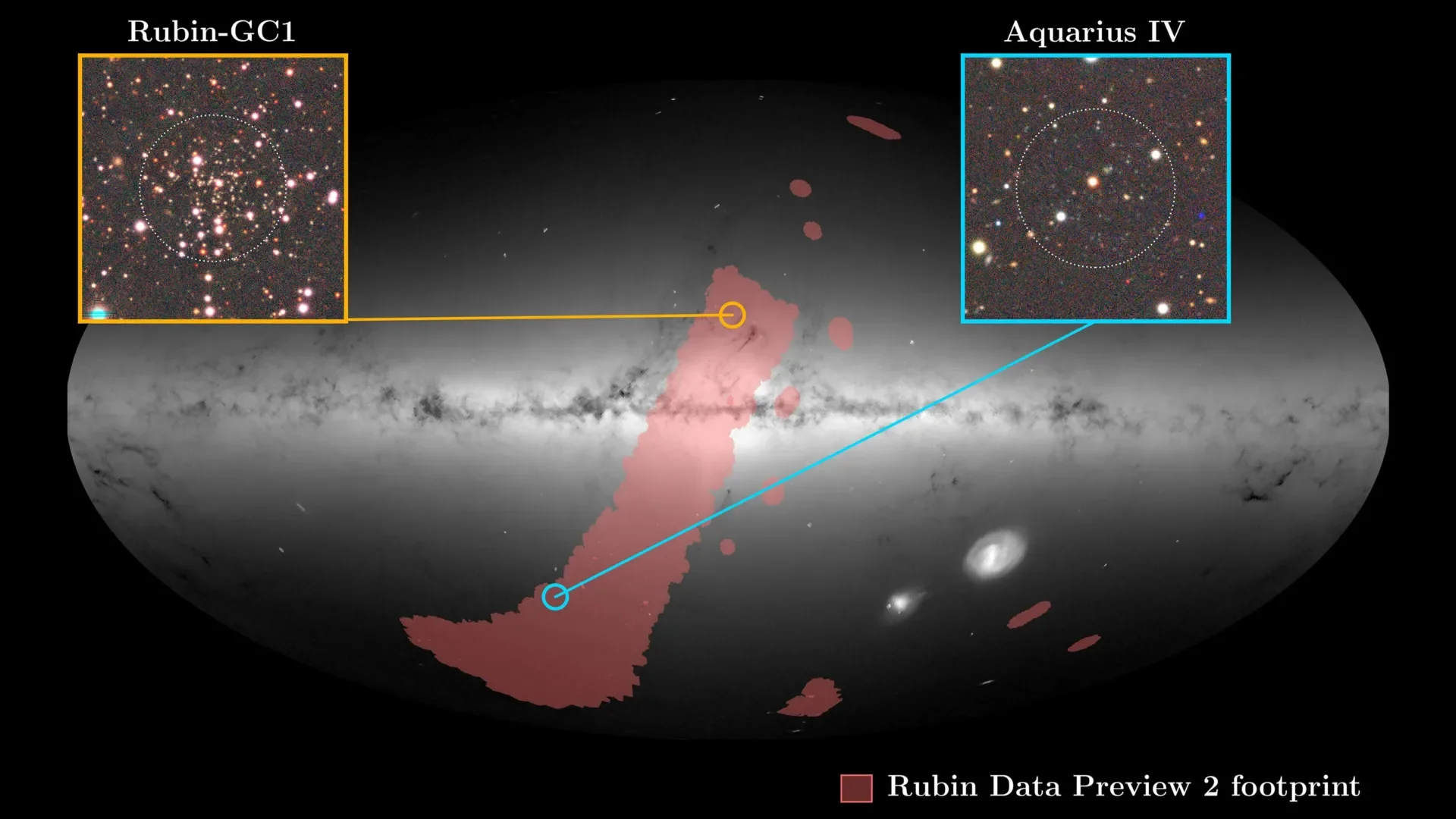
In an extraordinary milestone for astrophysics, the Vera C. Rubin Observatory has unveiled two previously uncharted companions of the Milky Way, utilizing preliminary observations that encompassed a mere 7% of the observable night sky. These revelations include Aquarius IV, a diminutive galaxy situated approximately 355,000 light-years from Earth, and Rubin-GC1, a star cluster enshrouded in cosmic dust that has masked its visibility from telescopes until now. The discoveries not only validate the observational prowess of the Rubin Observatory but also raise tantalizing prospects of unveiling numerous additional satellite galaxies lurking in the galactic periphery.
Nestled high atop Cerro Pachón in the Chilean Andes, the Vera C. Rubin Observatory is crafted for the meticulous exploration of deep-sky phenomena. Its robust observational capabilities were showcased in findings led by a team from Yale University, which reported their results in prominent academic journals. Notably, William Cerny, an astronomy graduate student at Yale and lead author of the Aquarius IV study, expressed enthusiasm about the discoveries: "What I find especially exciting is that these discoveries are just the beginning for Rubin." His excitement echoes within the scientific community, as researchers anticipate that the observatory's full-fledged survey, the ten-year Legacy Survey of Space and Time (LSST), could potentially yield an influx of such discoveries.
Currently, the Milky Way is estimated to host around 65 known satellite galaxies, yet projections suggest that hundreds more remain hidden, their existence obscured by various factors including cosmic dust and their intrinsically faint luminosity. The LSST aims to systematically map the extensive Milky Way halo, an encompassing region abundant with diverse astrophysical structures, including those elusive galaxies. Rubin employs its monumental 8.4-meter Simonyi Survey Telescope coupled with an innovative 3.2-gigapixel digital camera, the most sophisticated of its kind, allowing for unprecedented scalability in capturing celestial phenomena. This impressive instrumentation enables Rubin to generate a comprehensive time-lapse record of the Southern Hemisphere sky, one of the observatory's primary objectives.
The recent discoveries were derived from observations conducted from April 2025 to January 2026, utilizing data already in hand for preliminary analysis prior to the observatory's official launch. During these observations, astronomers effectively utilized advanced algorithms to discern faint signals within the dataset—Aquarius IV emerged as a tentative beacon, detectable only through refined methodologies rather than direct visual observation. Furthermore, Rubin-GC1, cloaked in the density of cosmic dust, showcases the challenges inherent in unveiling celestial objects obscured by interstellar material.
"This is an exciting future prospect for most of my career," stated Marla Geha, a professor of astronomy at Yale, who co-authored both studies. "It is remarkable this is now a reality." The collaborative effort behind this research spans multiple institutions, enriching the findings with diverse expertise from institutions like the University of Chicago, Dartmouth College, and numerous others stretching across the United States and Europe.
The significance of these findings transcends mere stellar cartography; they offer new data streams for investigating dark matter—an enigmatic substance constituting a substantial fraction of the universe's mass yet eluding direct observation. These faint galaxies, such as Aquarius IV, which possess an overwhelmingly dominant dark matter component relative to their stellar content, serve as critical laboratories for probing the dynamics and properties of dark matter. By examining the spatial distributions and motions of these ultra-faint objects using the laws of gravity, researchers aim to refine existing models and theories pertaining to the underlying structure of the cosmos.
Moreover, the positioning and interactions of satellite galaxies furnish insights into the evolutionary history of the Milky Way itself. As galaxies merge, they accumulate matter and exchange gravitational influences, revealing narratives of cosmic evolution that span billions of years. Through these spectral reveals, the story of how the Milky Way grew from a primordial collection of stars into the grand spiral we observe today becomes increasingly tangible.
The early triumphs achieved by the Rubin Observatory provide a compelling harbinger of the deeper cosmic tapestry that awaits discovery. Each newly uncovered satellite galaxy not only broadens our comprehension of galactic structures but also informs our understanding of dark matter, galaxy formation processes, and the fate of cosmic evolution itself. As the observatory embarks on its expansive ten-year journey, the stage is set for a renaissance in astronomical discovery, raising the intriguing question: which celestial companions remain in the shadows, waiting to be revealed?