Field: Technology
Revisiting Dark Energy: New Insights Suggest a Shift in Cosmological Constants
Published | Technical Staff
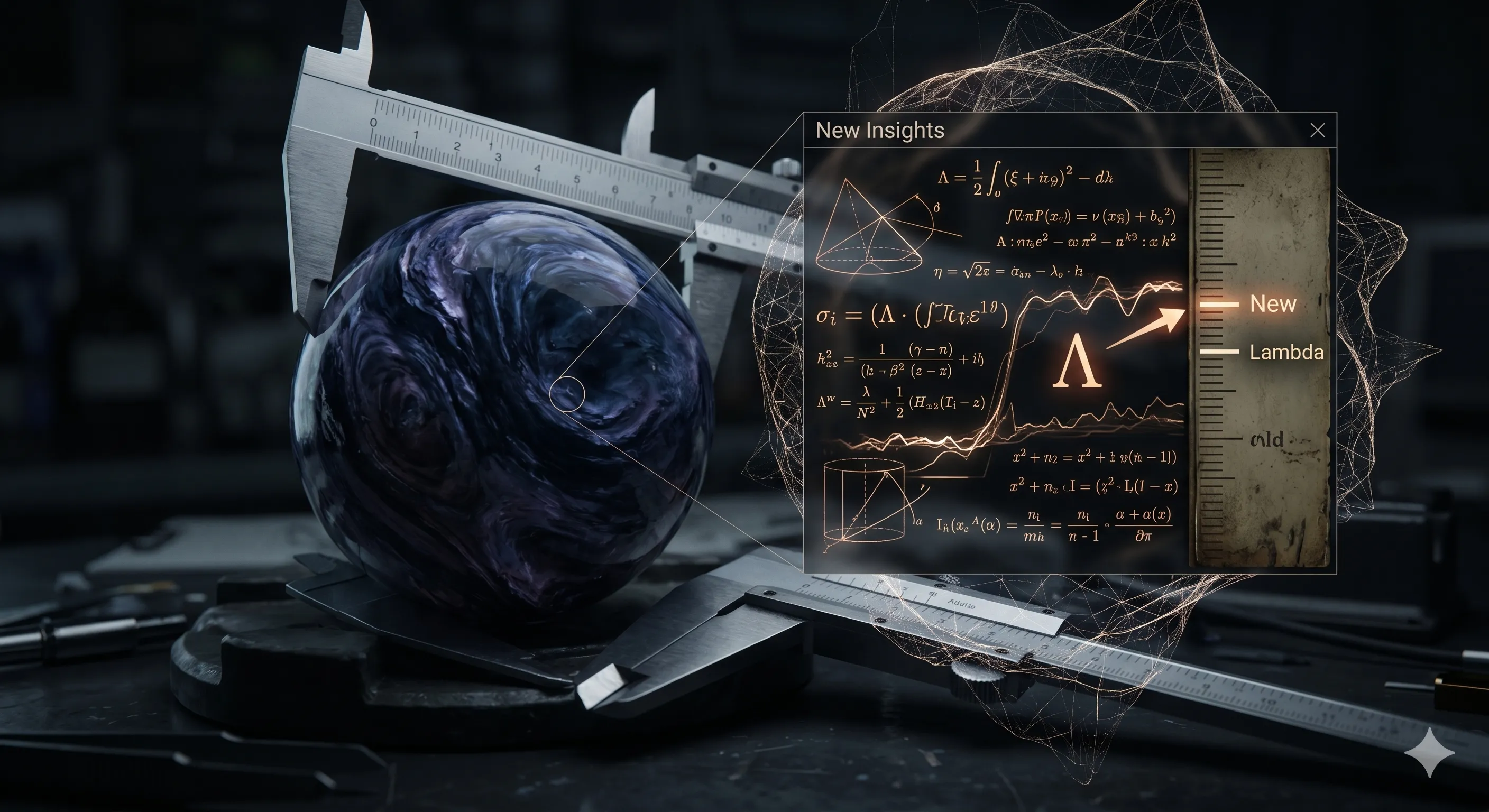
Visualization
A pivotal moment in cosmological research has emerged from the initial 13-month data release by the Dark Energy Spectroscopic Instrument (DESI) collaboration. This extensive dataset not only deepens our understanding of the universe's vast complexities but also brings to light a potentially revolutionary concept: the weakening influence of dark energy over time. This finding, if further substantiated, could reshape our understanding of cosmic expansion and challenge the core foundations of the ΛCDM model—the prevailing theoretical framework in cosmology that incorporates the cosmological constant (\(\Lambda\)) and cold dark matter (CDM).
DESI's sophisticated observational capabilities aim to dissect the dark sector of the universe with unparalleled precision. Among its goals is the refinement of the equation of state for dark energy, monitoring the gravitational pull that orchestrates the large-scale structure of the cosmos, and probing into the cosmic neutrino backgrounds and the early universe's inflationary phase. Through its advanced spectroscopic techniques, DESI examines the universe across a wide temporal spectrum, peering billions of years into the past.
The newly released data centers around the analysis of baryon acoustic oscillations (BAO) and the Lyman-α forest. Baryon acoustic oscillations serve as cosmic yardsticks measuring large-scale structures, while the Lyman-α forest, identified in distant quasars' spectra, reveals information about the intergalactic medium—both crucial for understanding the evolution and expansion of the universe. Moreover, supplementary data from ongoing analyses of the cosmic microwave background and type Ia supernovae provide a multifaceted view, integrating DESI's findings into a broader cosmological context.
The intrigue of DESI's first data release lies in its implications for dark energy. Conventionally thought to act as a cosmological constant—a static, unchanging force driving the accelerated expansion of the universe—the new analyses hint at a dynamic character. Evidence pointing to a varying dark energy equation of state suggests a diminishing influence on cosmic expansion. This observation sharply contrasts with the traditionally held view postulated since dark energy's discovery in 1998, pivoting the scientific dialogue towards alternate cosmological scenarios that might foreseeably include phenomena akin to a 'Big Crunch' or a stabilized universe.
Quantitatively, these observations derived from data release have revealed shifts with a statistical significance of 4.2 sigma, underscoring a strong but not conclusive indication of this varying cosmic component. In scientific terms, this level of certainty is provocative, meriting closer scrutiny but stopping short of the rigorous 5 sigma level required to denote a definitive discovery in physics.
This discovery fuels a broader scientific debate surrounding the reliability and completeness of the ΛCDM model. Recent corroborative studies, such as those employing the Atacama Cosmology Telescope, highlight a consensus in the early universe's behavior that aligns with ΛCDM predictions, emphasizing an enduring tension in cosmological studies. While DESI's findings may not immediately overturn established paradigms, they introduce a compelling narrative in the quest for a unified understanding of cosmic history.
Further exploration and subsequent data releases from DESI will be critical in affirming these initial findings. Meanwhile, the cosmological community is poised on the brink of potentially transformative insights that could redefine fundamental concepts of physics and our understanding of the universe’s ultimate fate.
In conclusion, the journey of unravelling the universe’s most enigmatic forces continues with renewed vigor, propelled by technological advancements and interdisciplinary collaboration. As we stand at the cusp of potentially revising long-held cosmological theories, the role of instruments like DESI becomes ever more crucial in illuminating the dark corners of our universe.