Field: Technology
Reframing the Life and Death of the Honeybee Superorganism
Published | Technical Staff
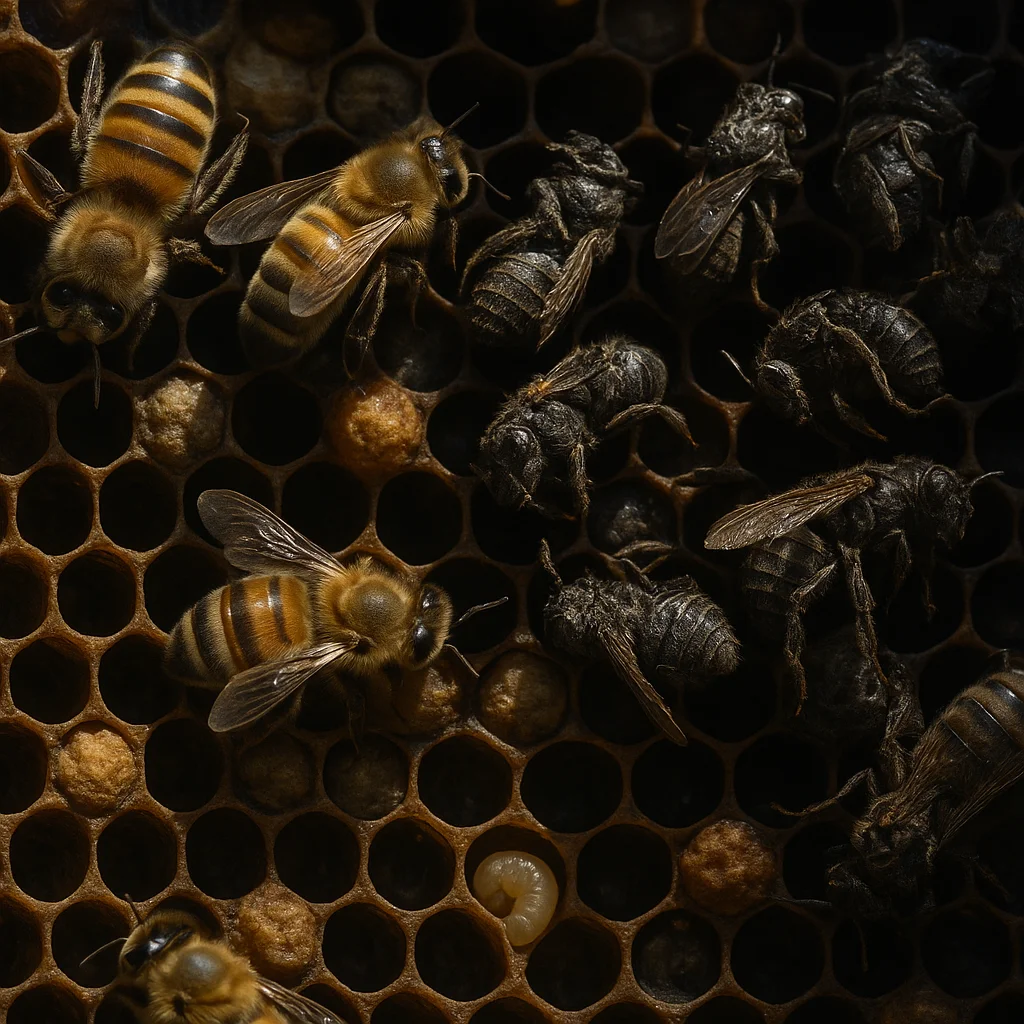
Visualization
The nature of biological individuality within Apis mellifera societies has long been an intellectual battleground. Seminal 20th-century concepts classified the honeybee colony as a superorganism—an integrated unit whose workers resemble somatic cells, the queen as reproductive tissue, and the collective behavior as emergent life. Yet a new review by Dr. Hannes Bonhoff (Lund University) and Dr. Heikki Helanterä (University of Oulu), published in Insectes Sociaux, proposes a radical reevaluation: what apiarists and biologists often interpret as enduring, potentially immortal colonies are, upon genetic scrutiny, ephemeral lineages of mortal superorganisms, each with discrete lifespans and developmental trajectories.
This contention arises at the intersection of classical entomology and modern evolutionary biology. The earlier paradigm, influentially championed by E.O. Wilson in “The Insect Societies” (1971), posited that a new queen emerged as part of a perennial organism; thus, as long as queen-replacement persisted, so did the colony’s cohesive identity. Bonhoff and Helanterä instead privilege the genetic distinctiveness imparted by each queen and her mating events with multiple drones. By their reasoning, replacement of a queen—since mating yields a new composite genotype—constitutes the birth of an entirely new biological individual, not the rejuvenation of the old. The defining genotype shift, not continuity of nest or workers, demarcates one superorganism from another.
As a result, a so-called “colony” is better conceptualized as an ephemeral phase in a genealogical sequence—a superorganismal lineage analogized to descent in multicellular animals. Just as organismal death and reproduction delimit generations in mammals, so too does the generational turnover of colonies: each is born, matures, ages inexorably, and, subject to senescence, ultimately ends. Using the lexicon of developmental biology, the authors map the colony’s ontogeny to that of an individual vertebrate, highlighting a progression from an incipient propagule (analogous to embryo), through differentiation (juvenile), to productive maturity (adult), and culminating in reproductive senescence. The inevitable attrition of maternal workers, analogous to organismal aging, limits the superorganismal lifespan to several years—contradicting the notion of immortality.
Central to this new framework is a critical dissection of swarming, traditionally regarded as the reproductive event—the colony’s means of giving rise to offspring. Yet Bonhoff and Helanterä argue that the prime swarm, which typically includes the old queen and a swath of workers, represents not offspring dispersal but the departure of the parent—the equivalent of an old organism abandoning its habitat. Only in subsequent afterswarms, bearing young unmated queens (virgin gynes), does true reproductive division happen: these propagate genetically novel colonies, paralleling the production of gametes and zygotes in animal reproduction.
The analogy is made explicit by drawing comparisons to polychaete annelids, where atoke forms (non-reproductive worms) bud off epitokes—specialized, sexually mature segments. Epitokes carry out sexual reproduction and, following gamete release, die, while the atoke persists in a temporarily immature state, available for another reproductive cycle. In honeybee colonies, the prime swarm—bereft of reproductive capacity after dispersal—mirrors the atoke; afterswarms and the residual portion of the superorganism at the natal nest, now carrying new queen lineages, function as the true propagules.
This perspective allows for a radical reimagining of reproductive roles within the colony using the conventions of cell biology: drones become “sperm bees,” virgin queens “egg bees,” the active queen a “stem bee,” and workers “somatic bees”—each with specialized deployments in the colony’s developmental and reproductive cycles. The gestation of a new colony within the mother’s body—fed, protected, and “milked” by workers producing nutritive secretions—invokes mammalian placentation in its biological intimacy. Eventually, somatic attrition claims the maternal workers, and the emerging daughter superorganism becomes fully independent—a kind of social live birth.
These nuances have essential implications for both the interpretation of field studies and apicultural practice. For instance, ecological studies measuring nest-site occupancy often interpret multiyear persistence as evidence for colony longevity, without discriminating between successive, genetically distinct superorganisms occupying the same cavity. This critical oversight may have far-reaching consequences for understanding colony robustness, host–parasite dynamics (for example, in the case of Varroa destructor mite infestations), and the evolutionary ecology of eusocial insects.
Modern beekeeping, with its emphasis on perpetual youth and productivity, unwittingly conflicts with these evolutionary dynamics. The common practice of “requeening”—systematic replacement of aging queens with unrelated, young queens to boost brood or pollination—thus operates not as rejuvenation but as forced euthanasia and replacement at the superorganismal level. The original genetic identity of the colony is extinguished, and a gestation cycle for a new superorganism is abruptly initiated. As Bonhoff and Helanterä underscore, this practice, while economically expedient, runs counter to the organismal rhythms and natural life histories intrinsic to Apis mellifera.
Such a paradigm shift compels a reconsideration of the biological integrity and continuity attributed to bee colonies. The implications reach beyond taxonomy and systematics, challenging the assumptions underpinning conservation efforts, agricultural management, and even the philosophical definition of “individuality” in the living world. The conceptual frame of honeybee colonies as mortal, generational superorganisms—rather than immortal collectives—illuminates the evolutionary logic beneath the surface bustle of the hive.