Field: Technology
Rare Duck-Billed Dinosaur Illuminates Cretaceous Island Evolution in Romania's Hațeg Basin
Published | Technical Staff
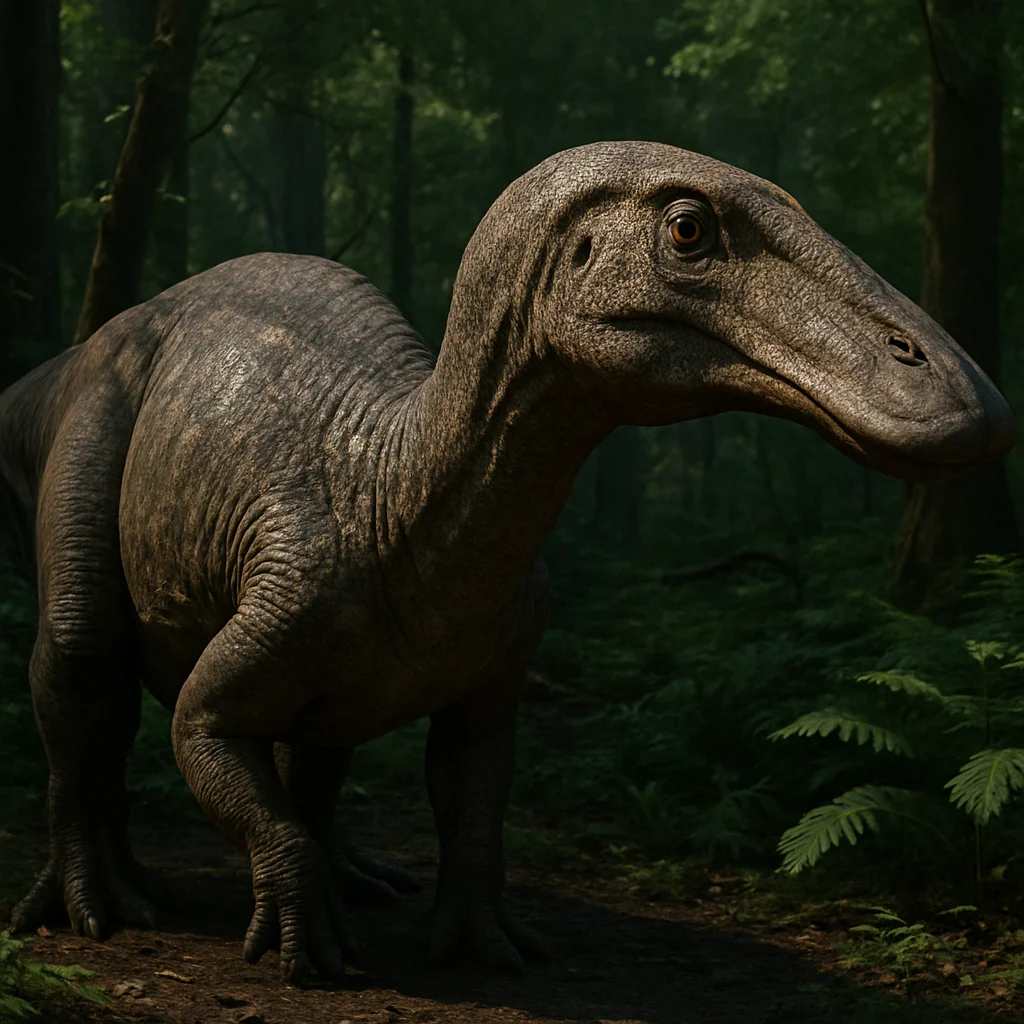
Visualization
Beneath the rolling hills of Romania’s Carpathians, within the legendary Hațeg Basin, paleontologists have unearthed the remains of a new genus and species of hadrosauroid dinosaur—Kryptohadros kallaiae—shedding long-awaited light on the dynamics of insular dinosaur evolution during the terminal Cretaceous. The incomplete skeleton, discovered at the Fântânele-3 site near the village of Vălioara, is embedded within the continental sediments of the Densuș-Ciula Formation and dates to the early Maastrichtian age, approximately 70 million years ago, during a period marked by dramatic continental fragmentation and the emergence of the so-called European Archipelago.
Hațeg’s paleofauna has confounded paleontologists for decades, not only for its abundance of insular dwarfs, but also for the enigmatic scarcity of complete articulated remains, especially among the hadrosauroids. The newly described specimen of Kryptohadros kallaiae comprises partial cranial elements, rib fragments, caudal vertebrae, and a section of the hindlimb. Although incomplete, the diagnostic nature of the preserved skull—distinguished by autapomorphic configurations in the maxilla and dentary—enabled taxonomic distinction from the region’s historically established Telmatosaurus transsylvanicus. For over a century, isolated fossils presumed to represent Telmatosaurus have filtered through European collections; now, this fossil demonstrates that at least two sympatric hadrosauroids coexisted on this Late Cretaceous island.
Morphological comparison reveals that while Kryptohadros kallaiae shares considerable cranial similarity with Telmatosaurus—a reflection of their recent common ancestry—critical differences in the shape and articulation of specific skull elements demarcate it as a separate evolutionary entity. Subtle but consistent variances in the triturating surface of the maxilla, as well as the geometry of the jugal and quadratojugal contacts, provided definitive anatomical evidence. These distinctions are further corroborated through a robust phylogenetic analysis, wherein a matrix of 309 morphological characters across 56 ornithischian taxa was scored and subjected to maximum parsimony and Bayesian inference. The resulting cladogram positions Kryptohadros, Telmatosaurus, and the contemporaneous Tethyshadros insularis from Italy within a newly circumscribed clade—Telmatosauridae—characterized by their endemic evolutionary trajectory, adaptive to the confined, resource-limited insular ecosystems of late Mesozoic southeastern Europe.
The paleobiogeographic implications of this finding extend beyond taxonomic novelty. The Telmatosauridae, as resolved by Magyar et al., represent a relictual lineage persisting from an earlier wave of hadrosauroid dispersal events from Asia into the evolving Euroamerican landmasses during the Albian–Campanian interval (ca. 113–72 Ma). The analyses propose that, in addition to Telmatosauridae, no fewer than six transcontinental dispersal episodes shaped the European hadrosauroid fauna, as inferred by the mosaic distribution of derived morphological traits. These waves likely capitalized on transient land bridges formed by fluctuating sea levels and tectonic uplift. Notably, however, the absence of certain, later-arising hadrosauroid clades in southeastern European deposits underscores a hypothesis that subsequent migrations from Asia into western European landmasses circumvented these islands, perhaps due to shifting marine barriers during the Maastrichtian.
Kryptohadros kallaiae, described in the *Journal of Systematic Palaeontology*, therefore provides a crucial calibration point for reconstructing Cretaceous biogeographic patterns and offers a rare window into the adaptive radiations that occurred in paleoisland settings. The discovery compels a revised view of the Hațeg assemblage as a locus of parallel evolutionary trajectories, rather than a dominion of a single, monotypic hadrosauroid genus. This reinforces the notion that Mesozoic insular environments, far from being evolutionary cul-de-sacs, fostered their own unique mosaics of dinosaurian diversity, shaped by geographic isolation, limited resources, and dynamic migration corridors—a scenario now embodied by the subtle yet diagnostic anatomy of Kryptohadros kallaiae.