Field: Technology
Quantum Superpositions Transcend the Familiar: Oxford Team Crafts Unprecedented ‘Cat’ States in Trapped Ions
Published | Technical Staff
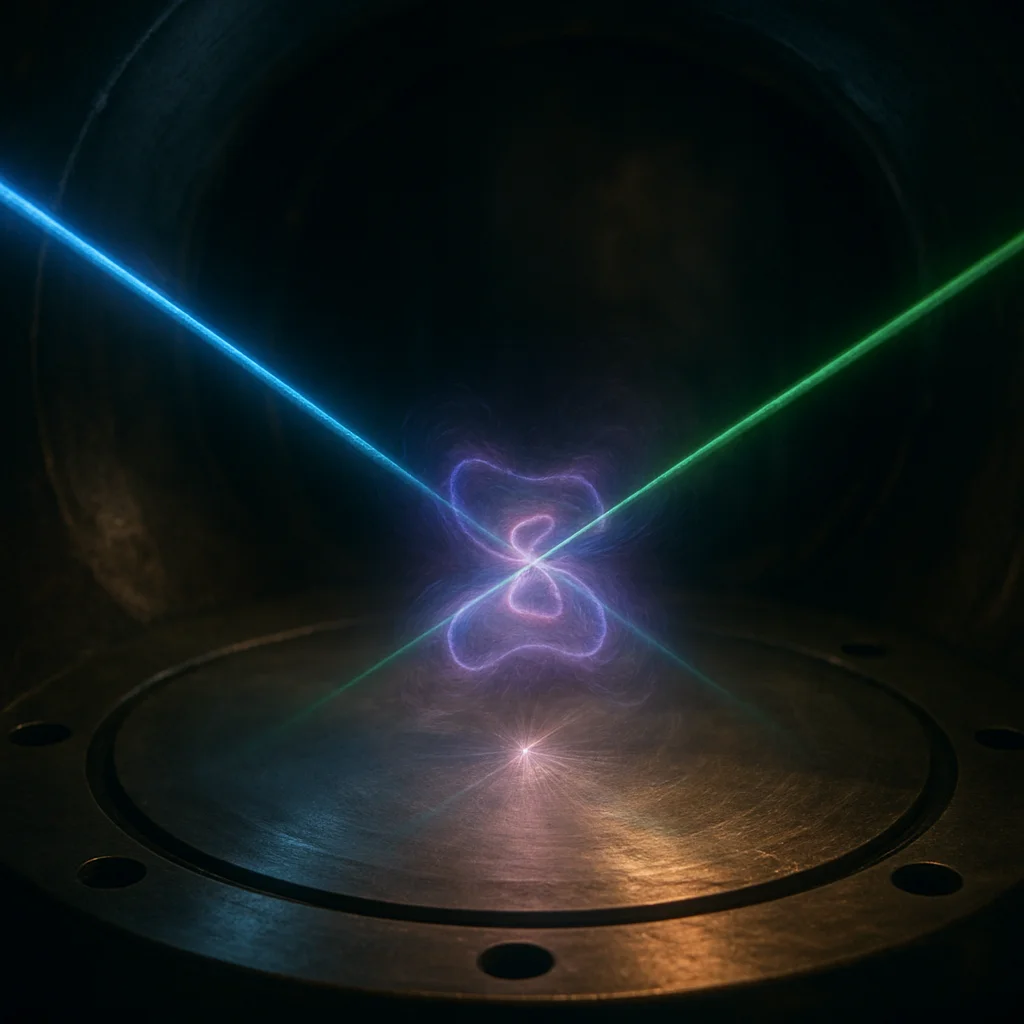
Visualization
Quantum superposition—an idea so counterintuitive that Erwin Schrödinger resorted to the metaphor of a feline suspended between life and death—has moved from the pages of paradox to the cutting edge of quantum technology. Yet after decades of experiment, even the most sophisticated laboratory demonstrations of cat-like states hewed to a familiar script—coherent states, simple wave packets displaced along the phase space of a quantum harmonic oscillator. Now, researchers at the University of Oxford have engineered quantum superpositions whose individual components are themselves profoundly nonclassical, a leap that pushes the quantum ‘menagerie’ far beyond its previously known boundaries and points toward next-generation quantum computation.
To understand the extent of this breakthrough, it is important to revisit the conventional landscape. Quantum harmonic oscillators—spanning trapped ions, vibrational modes in molecules, and quantized fields of light—have long provided a fertile ground for studying macroscopic quantum effects. The canonical “cat states,” usually constructed as superpositions of two spatially separated coherent states |α⟩ and |−α⟩, can be written in the form (|α⟩ + |−α⟩)/√2. Coherent states, eigenstates of the annihilation operator â, are distinguished for their minimum-uncertainty properties: ΔxΔp = ℏ/2, closely mimicking classical motion in phase space. Other implementations, notably Fock (number) states and Gottesman-Kitaev-Preskill (GKP) grid states, push further into the quantum domain, but the underlying ingredients have remained mathematically “tame.”
What had eluded physicists was experimental realization of superpositions crafted from components such as squeezed states—states in which quantum uncertainty is deliberately redistributed, allowing the variance in one quadrature (e.g., position or momentum) to shrink below the standard quantum limit, at the expense of inflated uncertainty in the conjugate quadrature. For a squeezed vacuum state |ξ⟩ = S(ξ)|0⟩ (where S(ξ) is the squeezing operator), Δx and Δp become unequal, breaking the symmetry of classical uncertainty.
Saner et al. have, for the first time, experimentally synthesized a “sibling” family of cat states whose constituents span an arbitrary set of nonclassical motional states. Using a solitary trapped ion—the very platform that bridges the dichotomy between discrete (spin) and continuous (motion) quantum systems—the Oxford group forged hybrid spin-oscillator states and employed measurement-based state engineering at an unprecedented level.
Their methodology exploits the ion’s dual nature. The internal (electronic) state behaves as a two-level qubit, while the motional degree of freedom acts as a quantum harmonic oscillator—its quantum state expressible as a weighted sum of Fock states, |ψ⟩ = Σ_n c_n|n⟩. By orchestrating entangling operations between the spin and motion—realized via state-dependent forces or sideband transitions—the researchers prepared the joint state
|Ψ⟩ = α|↑⟩ |ϕ_↑⟩ + β|↓⟩ |ϕ_↓⟩,
where |ϕ_↑⟩ and |ϕ_↓⟩ can be tailored nonclassical motional states (e.g., squeezed, rotated, or otherwise engineered wave packets). A carefully timed mid-circuit measurement of the spin (projecting onto, say, |↑⟩) collapses the motional state into the desired superposition—an instance of measurement-based quantum state preparation.
Crucially, the Oxford team achieved programmable control over the properties of these superpositions. By varying the amplitude, orientation, and phase-space displacement of the motional components, they sculpted an entire zoo of new “cat” siblings—some constructed from states with non-Gaussian statistics and others with rotationally asymmetric phase-space distributions. This versatility was underpinned by precise manipulation of laser fields and trapping potentials, allowing the researchers to fine-tune the Hamiltonian parameters in their system.
Verification of these exotic quantum states required the full quantum state tomography of the ion’s motion. Employing techniques such as motional sideband spectroscopy and reconstruction of the Wigner function—a quasi-probability distribution defined as
W(x, p) = (1/πℏ) ∫ dy ⟨x − y|ρ|x + y⟩ e^{2ipy/ℏ},
they revealed strikingly nonclassical features: negative regions in the Wigner function and interference fringes, both hallmarks of genuine quantum coherence not reproducible by simple mixtures of classical states. Wigner negativity, in particular, provides an unambiguous criterion for nonclassicality, as no probabilistic interpretation exists when W(x, p) < 0.
The implications for quantum technologies are profound. Macroscopic superpositions involving nonclassical ingredients could offer enhanced resilience to certain types of decoherence or enable fault-tolerant encoding of quantum information within continuous variables. The ability to program arbitrary superpositional states paves the way for quantum error correction schemes and may ultimately usher in more robust quantum processors.
The Oxford group’s collaboration with theoretical physicists now continues, aiming to quantify the “quantumness” of these states and plumb new foundational questions—such as the role of non-Gaussianity in quantum computation and metrology, and the boundaries between quantum and classical realms.
“We believe we’re still scratching the surface,” remarks Dr. Raghavendra Srinivas, observing that each step reveals unforeseen complexity and opportunity. As the quantum cats of theory multiply and diversify, their laboratory incarnations may soon outpace even the boldest thought experiments of early quantum mechanics—heralding a new era for both fundamental physics and the coming wave of quantum information science.