Field: Technology
Polarized Radio Waves Reveal the Magnetic Secrets of a Gamma-Ray Burst
Published | Technical Staff
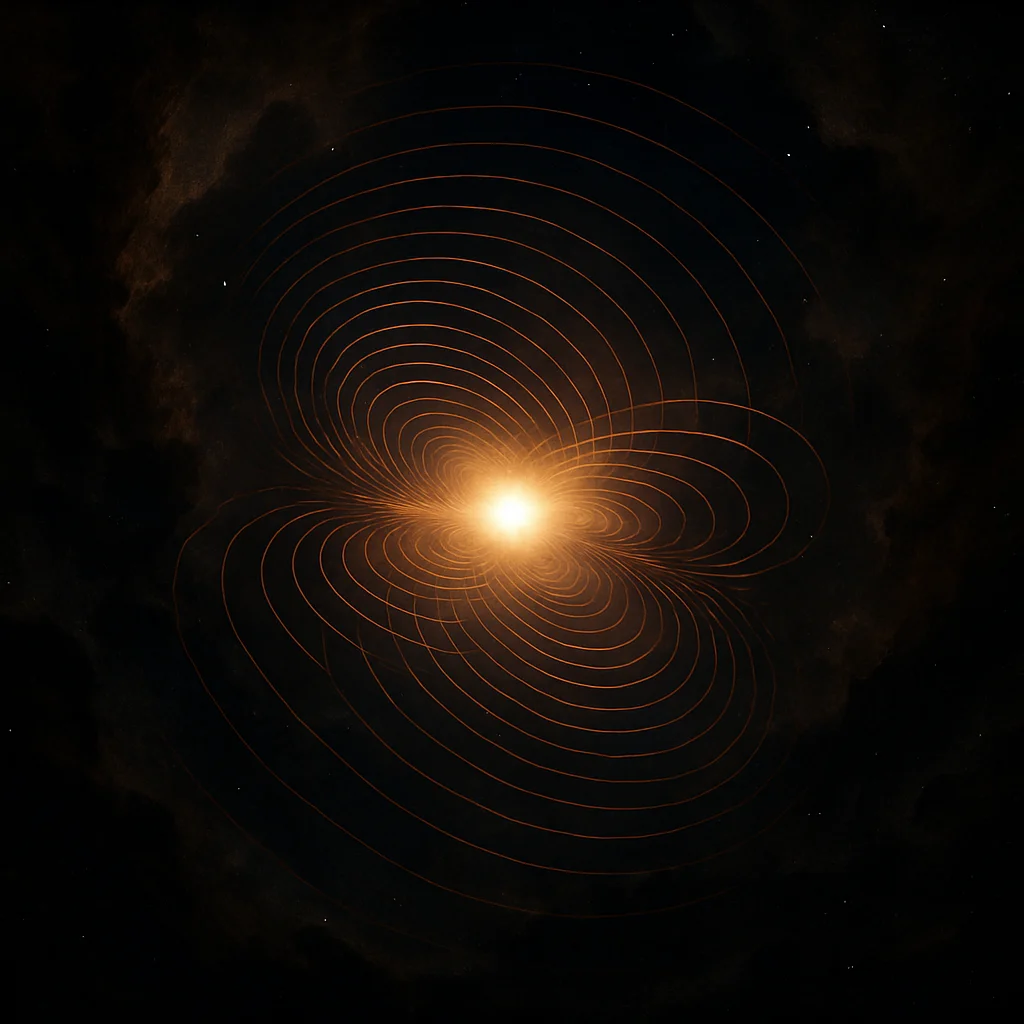
Visualization
In a historic breakthrough, an international collaboration of astronomers utilizing the National Science Foundation’s Karl G. Jansky Very Large Array (VLA) has, for the first time, detected polarized radio emission and its Faraday rotation signature in the afterglow of a gamma-ray burst (GRB). This observational coup provides an unparalleled window into the magnetic field environment enveloping one of the universe’s most violent and energetic phenomena.
Gamma-ray bursts are electromagnetic beacons of cosmic catastrophe—brief, ferocious flashes that unleash in a few seconds as much energy as our Sun will radiate over its entire ten-billion-year life span. The consensus model posits that these events result from massive stars collapsing to form black holes, igniting relativistic jets that punch through the stellar envelope, forging outward at velocities near the speed of light. As the jets interact with their surroundings, they generate a rapidly fading afterglow across the electromagnetic spectrum, including radio wavelengths. However, despite decades of theoretical inference, direct probes of the magnetic substrata associated with these GRB jets have remained frustratingly out of reach—until now.
The target of this transformative study was GRB 260310A, a relatively proximate event in cosmological terms, whose luminous radio afterglow offered astronomers a rare and fertile observational opportunity. Dr. Tanmoy Laskar (University of Utah) and colleagues trained the VLA on the cooling embers of the explosion, revealing that the radio waves were not just faint echoes of the blast, but carried with them the unmistakable imprint of polarization—oscillations of the electromagnetic field in a preferred orientation, evocative of the way sunlight reflected off water is filtered by polarized sunglasses.
More revealing still, the polarization angle of the detected radio waves exhibited a wavelength-dependent rotation: a clear signature of Faraday rotation, a physical effect in which the plane of polarization is twisted as electromagnetic waves traverse a magnetized plasma. In such a medium, the induced angle of rotation, Δθ, is given by the relation:
Δθ = RM × λ²,
where λ is the observational wavelength and RM, the rotation measure, encodes the net line-of-sight integral of the electron density weighted by the magnetic field component parallel to the wave propagation:
RM = (e³ / 2πm_e²c⁴) ∫ n_e B_∥ dl.
Here, e is the elementary charge, m_e the electron mass, c the speed of light, n_e the electron density, B_∥ the parallel component of the magnetic field, and the integral is taken along the path traversed by the radio waves. The magnitude and sign of RM provide direct, quantitative insight into both the strength and topology of the intervening magnetic field.
The detection of significant Faraday rotation in GRB 260310A’s afterglow thus functioned as a cosmic magnetometer, revealing a path-length-averaged magnetic field that dwarfs what could plausibly be generated by the Milky Way or the extragalactic medium. Instead, the observations point to an intensely magnetized, compact environment surrounding the progenitor star—specifically, a dense HII region (a bubble of ionized hydrogen gas) likely sculpted by the extreme ultraviolet radiation and powerful winds of the massive star prior to its explosion. Such regions are magnetized plasma domains where Faraday rotation effects are amplified, especially at radio wavelengths, and their detection provides direct empirical support for the long-held theoretical prediction that GRBs are born in the death throes of the universe’s most massive stars.
This measurement was made possible by exploiting the VLA’s sensitivity in the centimeter band, a region previously unattainable for polarization analyses of GRB afterglows, which had been the domain of facilities such as ALMA observing at millimeter and sub-millimeter wavelengths. As Collin Christy (University of Arizona) explained, earlier efforts were hamstrung by the rapid fading of afterglow light at shorter wavelengths; the VLA’s range enabled the team not only to detect afterglows over longer timescales but to measure Faraday rotation directly for the first time in a GRB setting.
The implications are profound. These observations validate the utility of polarized radio afterglow measurements as a probe of magnetic field evolution in real time. As Dr. Kate Denham Alexander (University of Arizona) notes, continuous monitoring with state-of-the-art radio telescopes like the VLA could permit astronomers to track the temporal decay and spatial realignment of magnetic structures as the shock wave ploughs through its environment—affording unparalleled empirical tests of relativistic jet models, mechanisms for jet collimation and energy transport, and the ultimate dissipation of magnetic energy in extreme astrophysical settings.
Each new gamma-ray burst observed with these tools will further unravel the story encoded in their polarization, enabling systematic mapping of magnetic geometries and, perhaps, distinguishing between progenitor star types and their circumstellar environs. As understanding deepens, the universe itself becomes a laboratory for exploring the fundamental physics of matter, energy, and magnetism under conditions unattainable on Earth. Thus, in decoding the magnetic fingerprints left in the afterglows of its most luminous detonations, astronomers have inaugurated a new era in the study of both GRBs and the cosmic environments that shepherd them into existence.