Field: Technology
Physicists Unveil the True Carrier of Proton Identity: The Baryon Junction
Published | Technical Staff
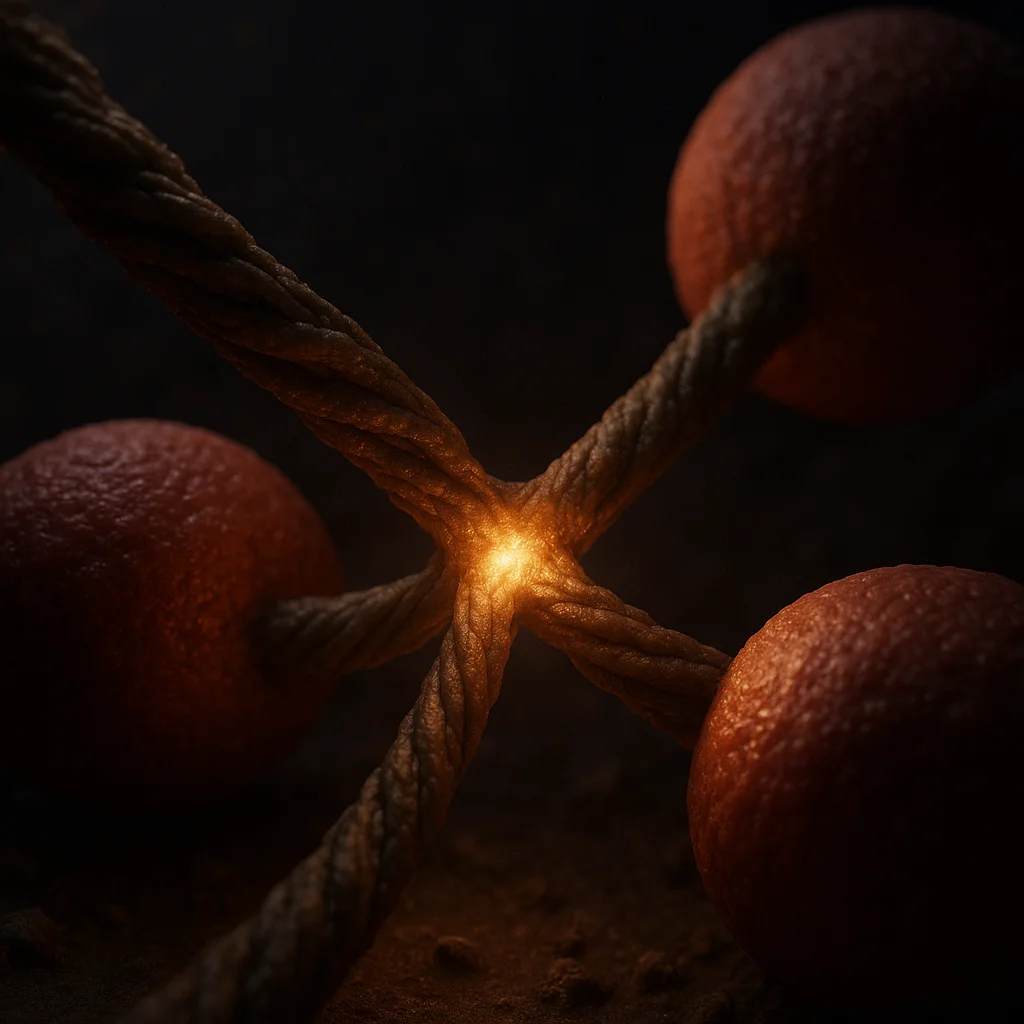
Visualization
The character of ordinary matter hinges on a cryptic quantum number: the baryon number, a tally critical to distinguishing matter from antimatter throughout cosmic history. For decades, the proton—a cornerstone of atomic nuclei—has been regarded as the paradigm for baryon number conservation, presumed to partition this identifier equally among its three valence quarks. Yet, recent breakthroughs from the STAR Collaboration at the Relativistic Heavy Ion Collider (RHIC) advocate for a revisionist view: the proton’s baryon number is not simply a reflection of its quark census, but is instead an emergent property of a dynamic gluonic structure, the so-called baryon junction.
The textbook paradigm conceives the proton as a system of three constituent quarks, each with a baryon number of ⅓, tightly confined within a femtometer-scale hadron by the exchange of massless gluons, the mediators of the strong force. Quantum Chromodynamics (QCD)—the gauge field theory governing strong interactions—features the SU(3) color symmetry, which, in perturbative regimes, allows for tractable predictions about quark-gluon interactions inside hadrons. However, the nonperturbative vacuum, where quark confinement and hadronization dominate, admits more enigmatic structures. Among these is the baryon junction: a topologically nontrivial, Y-shaped gluonic configuration hypothesized to orchestrate the convergence of color fields from three quarks.
To adjudicate between the orthodox quark-centric model and the junction hypothesis, STAR physicists exploited RHIC's unique capability to engineer collisions across a spectrum of systems: relativistic heavy ions, gold nuclei, and photons. These collisions probe the plasticity of baryon number under extreme conditions by tracking how it propagates through swathes of nuclear matter and the quark-gluon plasma. The critical observable is how baryon number—initially localized in the projectile nucleons—reappears among the myriad secondary particles after the kinetic violence of a collision.
Central to the experimental analysis is the rapidity distribution of net baryons, \( N_B(y) - N_{\overline{B}}(y) \), across final states. If the baryon number were strictly tied to the valence quarks, one anticipates limited migration of net baryon number away from the original nuclei, corresponding to fragmentation predominantly near beam rapidity. In contrast, gluonic mechanism—especially those rooted in baryon junctions—predict more delocalized transport, enabling the quantum number to manifest further from the region of initial nucleon overlap, i.e., towards midrapidity.
Interrogating data collected by the STAR detector suite, the collaboration scrutinized collision events, employing advanced tracking algorithms and particle identification techniques. They reconstructed net proton and baryon yields as a function of rapidity from the spatial and energetic signatures left in the time projection chamber and other subsystems. Statistical treatments and comparisons with hadronic transport models and event generators, incorporating or excluding baryon junction dynamics, undergirded the analysis.
Their findings reveal a transport pattern of baryon number at odds with expectations for quark-constrained propagation. Instead, the experimental data are congruent with the baryon junction paradigm: baryon number traverses greater distances from the collision epicenter than models with only quark-driven mechanisms would allow. Underlying this is the QCD insight that gluons, while themselves electrically neutral and without baryon number, can forge collective configurations, such as the Y-shaped junction, capable of encapsulating and migrating the identity of baryonic matter.
Professor Zhangbu Xu, a leading physicist in the consortium, emphasizes the paradigm shift: "Our results suggest that the baryon number is not simply carried by individual quarks. Instead, it is more favorably carried and transported by gluons, the particles that hold quarks together, when arranged in this special configuration." Dr. Rongrong Ma further notes the implications: this reconceptualization of the source of baryon number demands a deeper understanding of matter’s underlying architecture and recontextualizes one of the earliest conserved quantum numbers since baryogenesis.
The consequences are profound, stretching from a more nuanced appreciation of QCD vacuum topology to potential relevance in the primordial matter-antimatter asymmetry carved in the infant universe. The investigation, published in _Science_ (STAR Collaboration, 2026; doi: 10.1126/science.ads5962), delivers not only empirical substantiation for the theorized baryon junctions but also spotlights the ever-evolving complexity of the proton, decades after its purportedly fundamental structure was thought to be well-settled.
In sum, the proton’s baryon number—once the exclusive province of its quark constituency—now emerges as a property encoded in the deep structure of confining gluonic fields. The baryon junction thus becomes not only a theoretical curiosity but a real participator in the identity and persistence of matter itself.
The textbook paradigm conceives the proton as a system of three constituent quarks, each with a baryon number of ⅓, tightly confined within a femtometer-scale hadron by the exchange of massless gluons, the mediators of the strong force. Quantum Chromodynamics (QCD)—the gauge field theory governing strong interactions—features the SU(3) color symmetry, which, in perturbative regimes, allows for tractable predictions about quark-gluon interactions inside hadrons. However, the nonperturbative vacuum, where quark confinement and hadronization dominate, admits more enigmatic structures. Among these is the baryon junction: a topologically nontrivial, Y-shaped gluonic configuration hypothesized to orchestrate the convergence of color fields from three quarks.
To adjudicate between the orthodox quark-centric model and the junction hypothesis, STAR physicists exploited RHIC's unique capability to engineer collisions across a spectrum of systems: relativistic heavy ions, gold nuclei, and photons. These collisions probe the plasticity of baryon number under extreme conditions by tracking how it propagates through swathes of nuclear matter and the quark-gluon plasma. The critical observable is how baryon number—initially localized in the projectile nucleons—reappears among the myriad secondary particles after the kinetic violence of a collision.
Central to the experimental analysis is the rapidity distribution of net baryons, \( N_B(y) - N_{\overline{B}}(y) \), across final states. If the baryon number were strictly tied to the valence quarks, one anticipates limited migration of net baryon number away from the original nuclei, corresponding to fragmentation predominantly near beam rapidity. In contrast, gluonic mechanism—especially those rooted in baryon junctions—predict more delocalized transport, enabling the quantum number to manifest further from the region of initial nucleon overlap, i.e., towards midrapidity.
Interrogating data collected by the STAR detector suite, the collaboration scrutinized collision events, employing advanced tracking algorithms and particle identification techniques. They reconstructed net proton and baryon yields as a function of rapidity from the spatial and energetic signatures left in the time projection chamber and other subsystems. Statistical treatments and comparisons with hadronic transport models and event generators, incorporating or excluding baryon junction dynamics, undergirded the analysis.
Their findings reveal a transport pattern of baryon number at odds with expectations for quark-constrained propagation. Instead, the experimental data are congruent with the baryon junction paradigm: baryon number traverses greater distances from the collision epicenter than models with only quark-driven mechanisms would allow. Underlying this is the QCD insight that gluons, while themselves electrically neutral and without baryon number, can forge collective configurations, such as the Y-shaped junction, capable of encapsulating and migrating the identity of baryonic matter.
Professor Zhangbu Xu, a leading physicist in the consortium, emphasizes the paradigm shift: "Our results suggest that the baryon number is not simply carried by individual quarks. Instead, it is more favorably carried and transported by gluons, the particles that hold quarks together, when arranged in this special configuration." Dr. Rongrong Ma further notes the implications: this reconceptualization of the source of baryon number demands a deeper understanding of matter’s underlying architecture and recontextualizes one of the earliest conserved quantum numbers since baryogenesis.
The consequences are profound, stretching from a more nuanced appreciation of QCD vacuum topology to potential relevance in the primordial matter-antimatter asymmetry carved in the infant universe. The investigation, published in _Science_ (STAR Collaboration, 2026; doi: 10.1126/science.ads5962), delivers not only empirical substantiation for the theorized baryon junctions but also spotlights the ever-evolving complexity of the proton, decades after its purportedly fundamental structure was thought to be well-settled.
In sum, the proton’s baryon number—once the exclusive province of its quark constituency—now emerges as a property encoded in the deep structure of confining gluonic fields. The baryon junction thus becomes not only a theoretical curiosity but a real participator in the identity and persistence of matter itself.