Field: Technology
Physicists at CERN Complete the Doubly Charmed Baryon Family with the Discovery of Ω<sub>cc</sub><sup>+</sup>
Published | Technical Staff
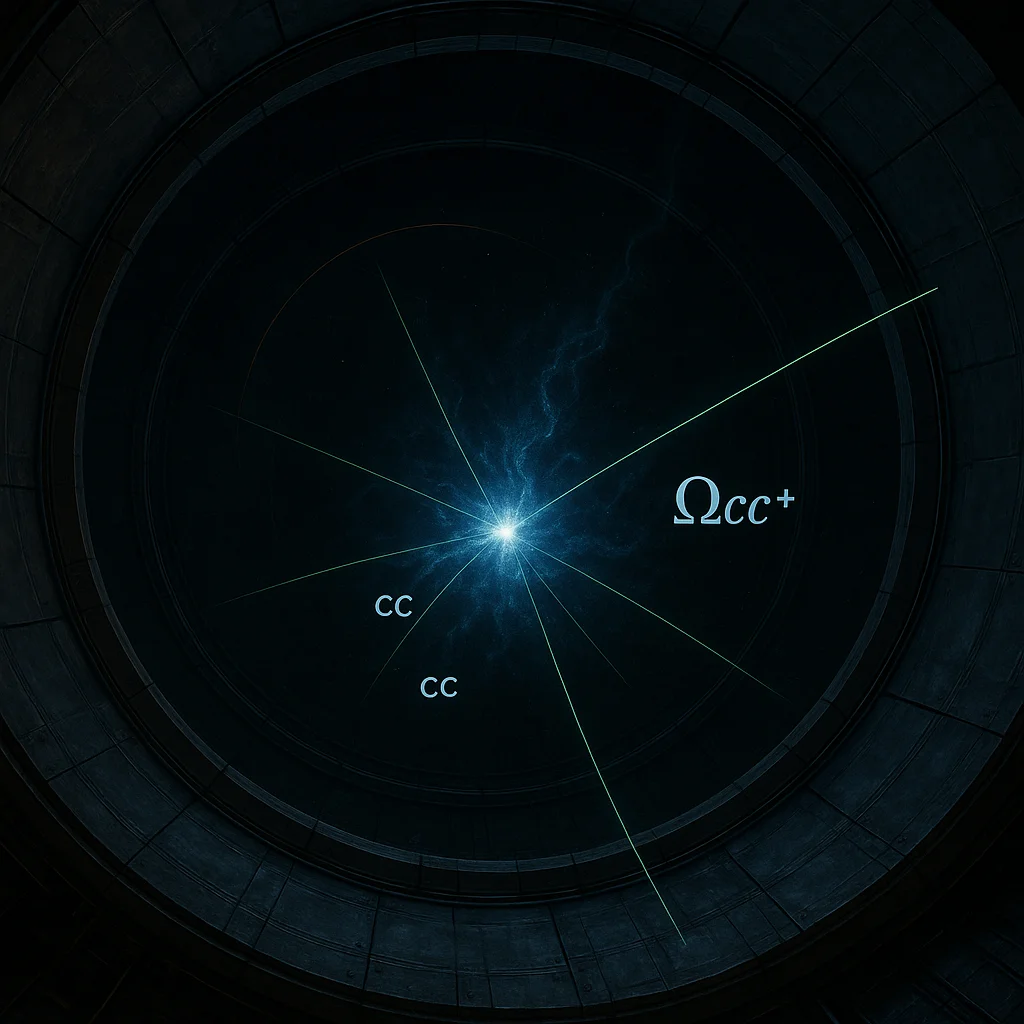
Visualization
Nearly six decades after theoretical physicists first mapped the arcane terrain of quark interactions, researchers at CERN have realized a profound objective: the unambiguous detection of the Ωcc+ baryon, a particle composed of two charm quarks (c) and a strange quark (s), finalizing the triad of doubly charmed baryons. This accomplishment, delivered by the LHCb Collaboration exploiting the uniquely sensitive apparatus at the Large Hadron Collider (LHC), marks the conclusion of a major chapter in the ongoing effort to catalog the Standard Model’s baryonic portfolio.
At the foundation of visible matter, quarks exist in six flavors—up (u), down (d), strange (s), charm (c), bottom (b), and top (t)—which combine into mesons (quark-antiquark pairs) or baryons (three-quark combinations) via color confinement imposed by quantum chromodynamics (QCD). The discovery of the Ωcc+ means the full cohort of baryons containing two charm quarks, and either an up, down, or strange quark, is now experimentally confirmed.
The historical trajectory began in the 1960s, following the elucidation of the quark model. Gell-Mann and Zweig’s Eightfold Way and subsequent advances in SU(3) flavor symmetries provided a model for how quarks could assemble to form composite particles. These theoretical constructs found empirical substantiation with milestones such as the 1964 observation of the Ω− baryon (sss) and the seminal “November Revolution” of 1974, which unveiled the charm quark, necessitating a broadening of baryon classification to accommodate new configurations.
Despite robust theoretical predictions, the doubly charmed baryons remained elusive, a consequence of both their formidable mass and ephemeral lifespans. Theoretical masses for doubly charmed baryons such as Ξcc++ (ccu), Ξcc+ (ccd), and Ωcc+ (ccs) were predicted, with QCD calculations placing the Ωcc+ mass proximate to 3,700–3,800 MeV/c2. However, prior accelerator energies and detector sensitivities fell short of the requirements for production and detection.
The LHCb experiment has progressively filled this gap. In 2017, the Ξcc++ was identified through its distinct decay signature; the Ξcc+ followed in early 2024. Now, the Ωcc+ has been reconstructed from proton–proton collisions at record luminosities, an achievement heavily indebted to LHCb’s upgraded vertex detector, which provides sub-millimeter resolution.
The experimental methodology exploited the Ωcc+’s weak decay channel. Producing in high-energy pp collisions, these baryons traverse a mere fraction of a millimeter before decaying, yet survive long enough to yield measurable flight paths. Utilizing advanced tracking algorithms, physicists reconstructed decay chains—typified by subsequent transformations into more stable baryons and mesons—which converge to form a vertex distinct from the initial collision. The appearance of a resonance at a mass roughly four times that of the proton (proton mass ≈ 938 MeV/c2), together with kinematic and topological consistency, allowed identification of the Ωcc+ with high significance.
The uniqueness of these doubly charmed baryons resides not merely in novelty, but in their potential as laboratories of QCD in the regime of disparate mass hierarchies. The competition between the large charm quark mass (≈ 1.27 GeV/c2) and the lighter up, down, or strange quarks, modulates the interplay of the strong and weak forces, offering rare empirical leverage to probe the mechanisms by which QCD binds color-charged constituents. Especially, the interplay of both heavy-quark symmetry and light-quark effects within a single hadron system sharpens theoretical predictions about confinement and hadronization.
Dr. Paula Collins, incoming deputy spokesperson of the LHCb Collaboration, described the moment as one of “beautiful historical significance.” Out of 85 composite particles completed at the LHC to date, the trifecta of doubly charmed baryons—unique in their longevity and decay observability—represent a critical testbed for the Standard Model. Their successful detection underscores not only the maturity of experimental techniques at the energy frontier but also the enduring predictive strength of theoretical physics in the subatomic realm.
As data collection continues and analyses sharpen, these particles will not only serve as validation points for existing models but will guide theory towards possible physics beyond the present paradigm, continuing the tradition of interplay between prediction and discovery that has driven particle physics for generations.