Field: Technology
Paleontologists Uncover Revolutionary Insights into European Tapejarid Pterosaur Diversity
Published | Technical Staff
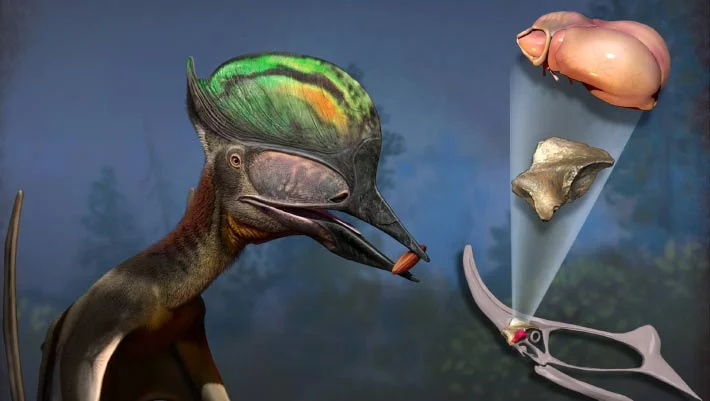
Visualization
A significant paleontological breakthrough emerges from the historical archives of the Sedgwick Museum of Earth Sciences in Cambridge, England, with the identification of a new genus and species of tapejarid pterosaur, named Hintighernia edingerae. This groundbreaking discovery, originating from a specimen first described in 1870, suggests that the evolutionary history of tapejarids stretches far beyond their well-known associations with the Cretaceous strata of Brazil.
Traditionally conceived as endemic to South America, particularly in the Aptian-Albian deposits typified by the type species Tapejara wellnhoferi from the Romualdo Formation, the tapejarids have intrigued paleontologists due to their distinctive morphological features, including short, downturned snouts and prominent cranial crests. Rubi Pêgas and collaborators from the Universidade Federal do ABC assert that these pterosaurs, members of the Cretaceous clade Tapejaridae, may exhibit ecologically distinct adaptations, with indications of an omnivorous or potentially herbivorous/frugivorous diet.
The rediscovered specimen of Hintighernia edingerae, dated to approximately 105 to 100 million years ago during the Cretaceous, originates from the Cambridge Greensand Member, a segment of the West Melbury Marly Chalk Formation, which has proven adept at yielding an extensive collection of over 2,000 pterosaur fossils. In a significant revision of taxonomic attributions, the researchers contend that the original specimen should no longer be classified as Ornithostoma sedgwicki but rather re-evaluated within the context of chaoyangopterid diversity.
Employing micro-CT scanning technology, the team achieved an intricate digital reconstruction of the pterosaur's braincase, yielding an endocast that closely resembles that of Tapejara wellnhoferi. These neuroanatomical similarities imply a noteworthy evolutionary relationship, although the authors admonish that further phylogenetic investigations of pterosaur cranial neuroanatomy are merited to substantiate these connections.
In their comprehensive assessment of ancillary pterosaur specimens from the Cambridge Greensand, the researchers identified a fragmentary snout tip that could potentially be integrated within the new genus H. edingerae, while distinguishing additional elements such as neck vertebrae and an upper arm bone as indicative of broader tapejarid affiliation. Moreover, distinct elongated neck vertebrae alongside jaw fragments suggest the presence of at least one additional azhdarchoid species cohabiting the region during the Cretaceous.
Upon synthesizing their findings, the researchers delineate at least three azhdarchoid taxa within the Cambridge Greensand deposits. By advancing the hypothesis that Europe may have been a crucible for early tapejarid diversification, they posit that it served as a crucial nexus for the radiation of sinopterines in eastern Asia and tapejarines in South America. This assertion aligns with biogeographic models that consider the Eurogondwana hypothesis, suggesting potential dispersal pathways through North Africa.
The implications of this discovery extend further than merely broadening our geographical understanding of the Tapejaridae family; they illuminate the evolutionary tapestry of pterosaurs and provoke a reassessment of established paleontological paradigms. As Pêgas and colleagues conclude, Europe appears to have occupied a pivotal role in the early evolutionary narrative of this group, establishing itself as a hotspot of tapejarid diversity during the Cretaceous period. This emerging understanding of pterosaur evolutionary pathways exemplifies the dynamic nature of paleontological research, continually reshaping our comprehension of prehistoric life on Earth.