Field: Technology
Paleontologists Reconstruct Cretaceous Bird in Remarkable Detail
Published | Technical Staff
Visualization
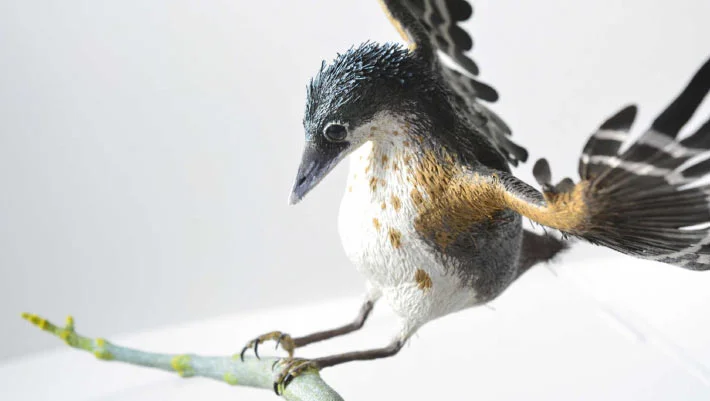
In a groundbreaking advancement for paleontological visualization, researchers have meticulously reconstructed the small enantiornithine bird, Concornis lacustris, facilitating a vivid representation of an organism that coexisted with dinosaurs over 100 million years ago. This intricate life-size model reflects not only the fossilized anatomy of the species but also incorporates advanced digital modeling techniques, traditional sculptural craftsmanship, and meticulous attention to detail.
Concornis lacustris, a member of the Enantiornithes lineage—a group of birds that reached their zenith during the Cretaceous period and succumbed during the mass extinction event that obliterated non-avian dinosaurs—flourished within the lush habitats of what is now Europe approximately 125 million years ago. The holotype specimen, uncovered in Las Hoyas, Cuenca, Spain, has long served as a pivotal source of anatomical data. The original description of the fossil in 1992 heralded a new era of understanding the evolution of small Mesozoic birds, according to Dr. Víctor Peco from Universidad Complutense de Madrid and Dr. Sergio Nebreda, who is affiliated with multiple esteemed institutions, including Johns Hopkins University.
The recent endeavor culminated in the first three-dimensional reconstruction of Concornis lacustris, initiated in a manner reminiscent of anatomical and paleoart practices. The process began with a careful analysis of the skeletal remains and progressed through multiple layers of modeling, from musculature to integumentary details. Utilizing the software Blender, the researchers synthesized a digital representation informed by a combination of published illustrations and photographs of the fossil. Given the incompleteness of the original skull and sections of the skeletal framework, the team drew from other early bird fossils, including a remarkably preserved skull from Brazil and another fragmentary skull derived from the same Las Hoyas site.
Following the digital assembly, the model underwent transformation into a tangible form using 3D printing technology. Constructed from plastic, the model received a layer of sculpted epoxy putty before being meticulously painted with oil to achieve realistic anatomical representation. Impressive detail was rendered through fine plastic filaments, which represent downy plumage, while individual wing feathers were printed separately, a nod to the specificity required in reconstructing avian anatomy.
The feather morphology, including counts and shapes, was derived from studies of pertinent fossil specimens unearthed in both China and Spain, as well as comparisons with a contemporary avian species, the wallcreeper (Tichodroma muraria), known for its respective flight dynamics and environmental adaptations. The resultant model boasts a wingspan of approximately 30 centimeters and a body length of around 13 centimeters, depicting the bird in a poised landing position on a branch of Frenelopsis, a conifer abundant in the Las Hoyas ecosystem.
Despite the absence of pigmentation in the holotype specimen, the reconstruction employed closely related fossils as a reference to infer coloration. The artists rendered the model with a dark brown back and wings featuring banded flight feathers, complemented by a pale undersurface and an iridescent blue-green sheen adorning the head—elements that enhance the authenticity of the representation.
This synthesis of osteological, myological, and integumentary data reflects a sophisticated methodological approach that harmonizes digital innovation and traditional artistry. As the researchers elaborated, the integration of these diverse facets not only optimizes the reconstruction process but also facilitates rigorous scientific scrutiny, yielding an anatomically consistent portrayal of Concornis lacustris.
Published in the journal Earth History and Biodiversity on September 26, this work not only provides a glimpse into the vibrant life of the Cretaceous period but also serves as a valuable outreach resource, enhancing public engagement with paleontological science through the captivating medium of paleoart. Through this confluence of science and art, the narrative of Concornis lacustris emerges not merely as a tale of fossils but as a visceral connection to the avian life that once took flight in prehistoric skies.