Field: Technology
Paleoindian Specialization Redefined: Ice Age Megafauna Hunters Shaped Early American Societies
Published | Technical Staff
Visualization
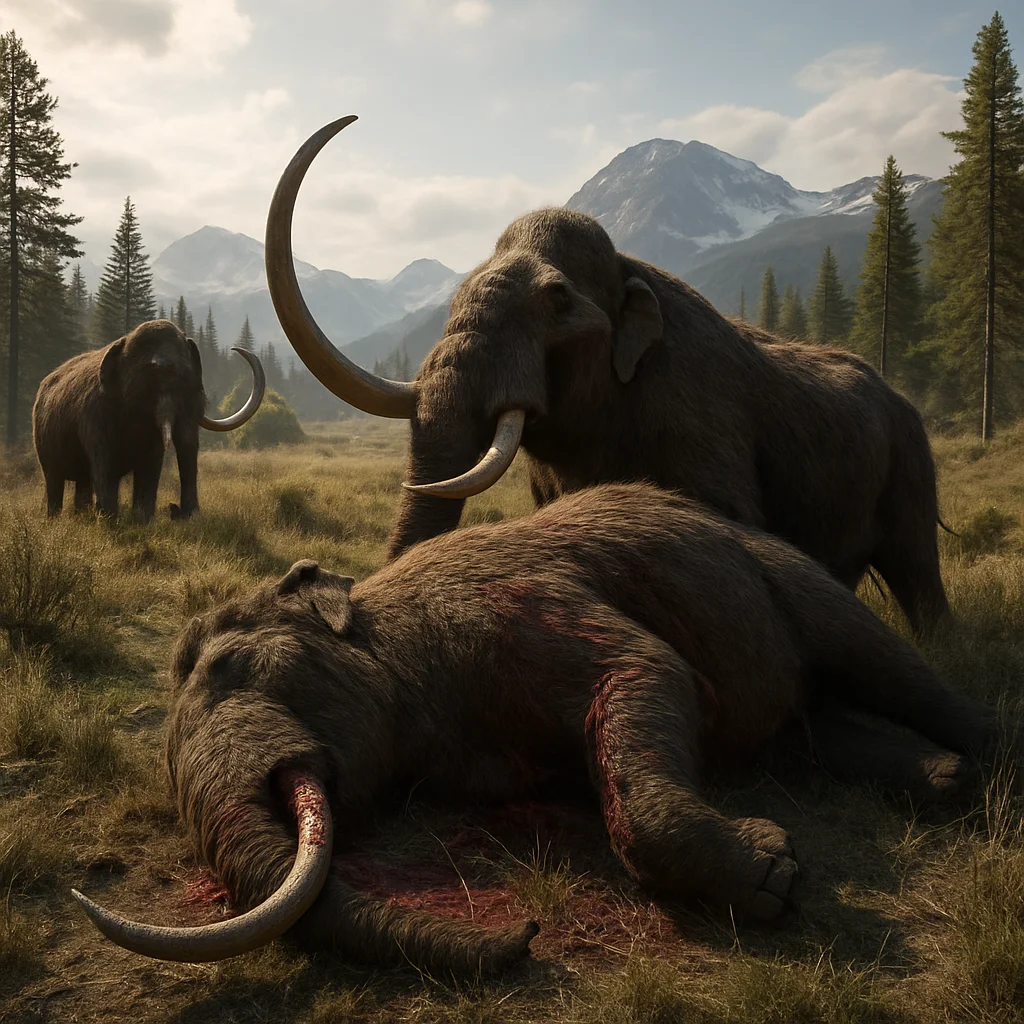
For decades, the dietary strategies of Paleoindians—the first widespread human populations to traverse the Ice Age Americas—have been a crucible for debate among archaeologists and paleoecologists. Were these early peoples ecological generalists, opportunistically gleaning whatever their environments might yield, or did they enact a more exacting, high-risk approach, centering their existence around the pursuit of the largest terrestrial animals to stride the Pleistocene landscape? A sweeping new analysis led by researchers at the University of Alaska Fairbanks, published in "Science Advances," has now presented robust evidence favoring the latter hypothesis: the Americas’ first continent-spanning human cultures were not broad-spectrum foragers, but hyper-specialized megafaunal predators—warriors against mammoths, gomphotheres, giant ground sloths, and other Ice Age titans.
Spanning 50 archaeological sites distributed across three geographically and temporally distinct Paleoindian societies—Eastern Beringia (ancient Alaska, 14,000–13,300 cal BP), the Clovis culture of North America (13,400–12,800 cal BP), and South America’s Fishtail Projectile Point tradition (12,900–11,600 cal BP)—the research team undertook a systematic quantification of faunal remains. Their analyses drew from three key indices: species abundance (the tally of recovered remains per species), minimum number of individuals (a conservative estimator of how many animals are represented at a site), and edible biomass (a calculation that reconciles body size and meat/fat yield). These metrics, applied across disparate ecologies and separated by vast distances, revealed a convergent signal: in every case, megafauna accounted for a staggering 83–88% of the estimated caloric intake from animal sources.
This dominance is more than a simple reflection of availability. As lead author Ben Potter asserts, the true test of specialization is not simply the number of particular animal bones at archaeological sites—it is their prevalence relative to expected natural frequencies. If dietary generalization had been prevalent, ubiquitous small prey such as rabbits or rodents would be prominently featured in archaeological assemblages, mirroring their ecological abundance. Instead, the pattern is inverted: remains from now-rare or extinct megafauna utterly dominate the record, while small game, despite being globally abundant during the Late Pleistocene, is practically absent, making up only a negligible fraction of dietary contributions.
The phenomenon is dramatically illustrated by the case of the Anzick-1 child of Clovis Montana. Stable isotope analysis of this remarkable burial demonstrated that approximately 96% of the individual’s protein originated in megafaunal sources—with mammoth predominating. Such chemical signatures strongly reinforce faunal evidence, establishing a direct nutritional reliance on the largest mammals available.
Further, the associated Paleoindian material culture corroborates this subsistence focus. Across the Americas, archaeologists recover an extraordinary uniformity of technologically sophisticated toolkits optimized for the hunting and butchering of very large animals. Eponymous fluted projectile points—Clovis, Fishtail, and their variants—demonstrate engineering optimal for penetrating thick hides and withstanding the kinetic demands of massive quarry. Butchering implements abound, yet implements for plant processing (such as grinding stones) and fishing gear are conspicuously rare or entirely absent. This technological homogeneity is geographically striking. From the mammoth steppes of Beringia through North American grasslands and down into the subtropical realms of southern South America, the consistency of toolkit form and function underscores a highly mobile, single-prey-focused behavioral paradigm.
Such megafaunal specialization may also illuminate the remarkable rapidity of human expansion across the Western Hemisphere—a dispersal without precedent in the archaeological record. When foraging groups encounter unfamiliar ecosystems, adaptation typically requires generations of observation and experimentation to identify, process, and exploit a diverse array of local floral and faunal resources. For Pleistocene hunter-gatherers attuned to following migratory megaherbivores such as mammoths, this learning curve might be bypassed; knowledge of one wide-ranging prey species and its habits could be ported across contiguous and diverse landscapes. As Prof. Mat Wooller aptly notes, the extensive ranges of such animals meant the pursuit of a single species could facilitate population movements on a continental scale, untethered from the slow ecological acculturation typical of more generalized foragers.
The ramifications of this specialized predation reverberate beyond anthropology, extending into the sphere of extinction dynamics. The extinction chronologies outlined by Potter’s team trace an unmistakable pattern of arrival, overlap, and terminal decline of megafaunal taxa—first in Beringia (~13,300 cal BP), thence through North America (~12,800 cal BP for mammoths, Columbian mammoths, horses), and concluding in South America (by ~11,600 cal BP for ground sloths and gomphotheres). Notably, these timings often closely follow or coincide with the evidence for human presence, lending compelling circumstantial weight to the anthropogenic overkill hypothesis. Large-bodied herbivores, with slow reproductive rates and wide birth intervals—traits encapsulated in their net reproductive rate, R₀, being near unity for population stability—are uniquely vulnerable to even modest increases in adult mortality inflicted by technologically adept predators. Coupled with Pleistocene deglaciation and habitat contraction, such sustained predation pressure could irrecoverably tip population dynamics into decline.
The findings also challenge cognitive narratives regarding early human adaptability. Far from being generalized tinkerers, clad in adaptive flexibility, the first Americas-wide human societies appear as ultraniche specialists—relentless, coherent in customs and armament, and defined by their relationship to the largest lifeforms of their epoch. The ecological cost, as ever, was profound: as the great herds fell, so too, in time, did the culture built to pursue them.
This research, therefore, marks a critical inflection in Paleoindian studies—realigning our view of the hemisphere’s earliest cultural architects as bold experimenters in ecological specialization, whose success and ultimate consequences were written into the bone and isotope record of the megafauna they so skillfully hunted, and, perhaps inadvertently, erased.