Field: Technology
Oxford scientists unveil the blueprint-less assembly of viruses through molecular self-organization
Published | Technical Staff
Visualization
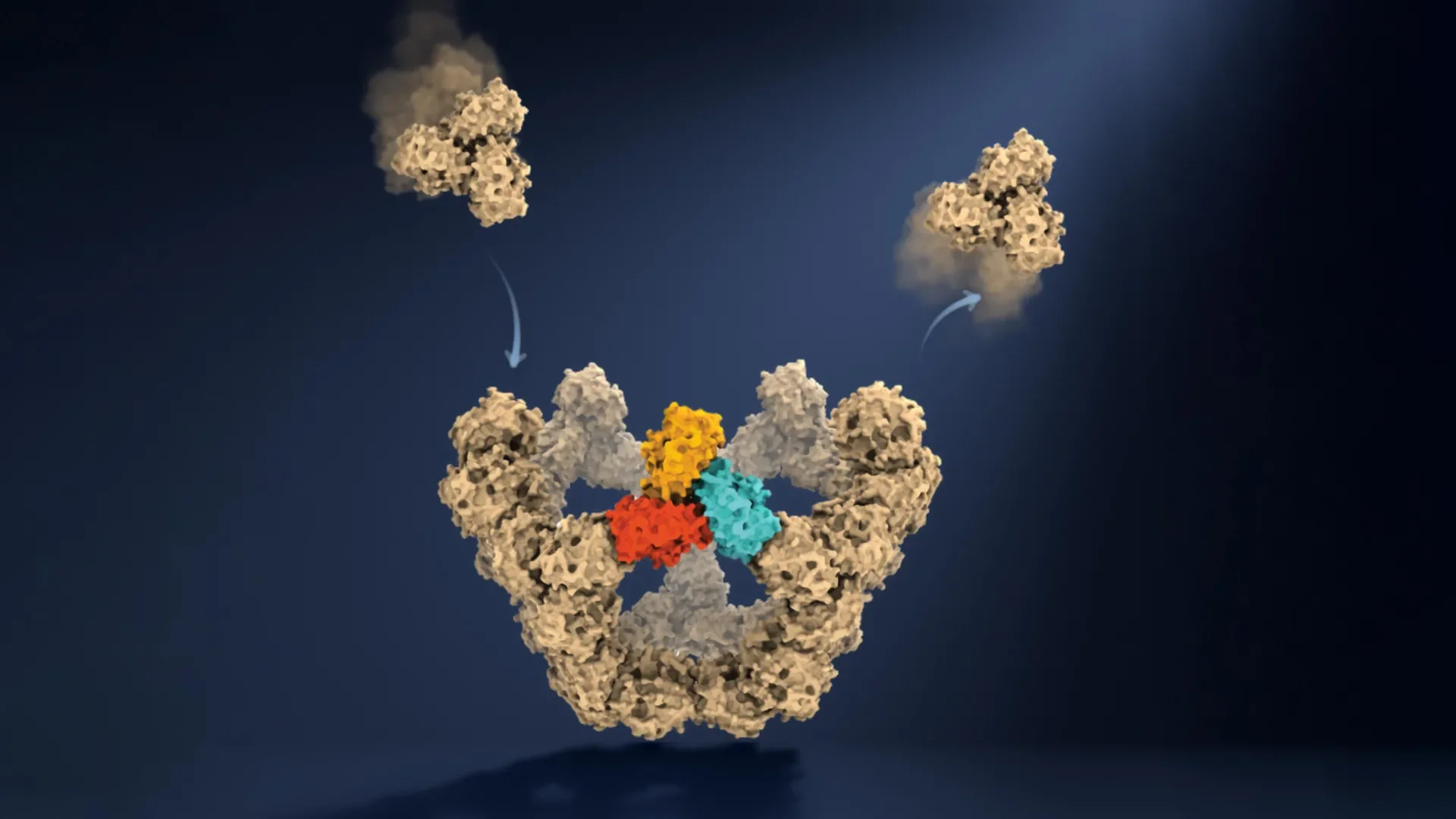
In a groundbreaking experiment, researchers at the University of Oxford have achieved an unprecedented observation of virus-like particles assembling through a trial-and-error mechanism, a feat that elucidates the underlying simplicity of complex biological structures. Published in a recent issue of *Nature*, this study captures the intricate self-building processes of these particles, demonstrating how they utilize molecular interactions to construct their protein shells—without the guidance of a preconceived blueprint.
At the core of a virus's structure lies the capsid, an organized protein shell that encapsulates and protects its genetic material. These shells can be comprised of a vast array of protein components, sometimes numbering in the hundreds or thousands, depending on the specific virus. The assembly of such intricate structures has long perplexed scientists, particularly due to the fleeting nature of intermediate states during the construction process. Traditional techniques have generally confined research to isolated examination of starting and finished products, thus neglecting the transient moments that reveal the assembly's dynamics.
To surmount these challenges, the Oxford team turned to an engineered virus-like particle fitted with precisely 60 protein units. Employing a cutting-edge mass photometry technique, which quantifies the mass of individual molecules by analyzing the patterns in scattered light, the researchers developed a framework that allowed them to observe and film the particle’s assembly in real-time. This innovative approach not only provided insight into how proteins progressively attach, but also enabled the investigation of the specific interactions involved in their self-assembly.
Dr. Roi Asor, co-lead author of the study and affiliated with both the Department of Chemistry and the Kavli Institute for Nanoscience Discovery, conveyed the complexity of the construction challenge faced by a virus. He stated, “A virus has to solve an extraordinary construction problem. Its components somehow have to find the right arrangement among a huge number of possibilities, without a blueprint or machinery directing the process.” The result of this investigation elucidates a molecular maze where only certain pathways lead to successful assembly. Initially, as proteins begin connecting, they form transient, weak associations that can easily dissociate if an optimal arrangement eludes them. This characteristic flexibility affords the molecules countless opportunities to reconfigure until they establish stable, closed structures.
A pivotal finding emerged from the observation of a specific assembly milestone: the formation of a closed pentagonal ring composed of five larger protein units. This closed structure represents the first significant degree of stability in the overall assembly. Once established, the addition of subsequent protein components occurs with accelerated efficiency, as each newly formed intermediate does not require the assembly of excessive new protein units for further progress. The interlocking of these proteins acts as reinforced scaffolding, anchoring the building blocks in place, which streamlines their collective growth and fosters an environment conducive to the assembly's completion.
The research introduces a quantifiable model of assembly that redefines the nucleation phase—the critical initial stage where proteins begin to connect. Here, the difficulty typically lies in the vast array of potential configurations that could arise. The findings indicate that the presence of weak interactions during early-stage connections provides proteins the latitude to “fail” without catastrophic consequences, thereby transforming inefficacious attempts into learning experiences that can inform future configurations. This architectural flexibility significantly enhances the reliability of assembly by transitioning from a disorderly exploration of possibilities to a directed approach via stable intermediate forms.
The ramifications of these insights extend well beyond viral architecture. Through an enhanced understanding of molecular interactions dictating self-assembly, future antiviral strategies may derive from targeted disruptions aimed at impeding the assembly processes of viral capsids. This could yield not only advanced therapeutic interventions but also lay the groundwork for innovative vaccine constructs utilizing engineered virus-like particles. Dr. Jack Tan, a co-author of the study associating with the MRC Weatherall Institute of Molecular Medicine, recognized the potential for these findings to influence the design of versatile antiviral agents and sophisticated vaccine platforms.
In the grand scheme, the principles unveiled here resonate across biological systems. Self-assembly is not limited to viruses, permeating the fabric of cellular life—from the intricate architecture of cytoskeletal frameworks to the formation of cellular compartments and multi-protein complexes. By providing unprecedented visualization and tracking methodologies, the Oxford team has opened a portal into the nuanced world of molecular construction, thus offering tantalizing prospects for future research that investigates the emergence of complexity from elemental interactions. This research not only illuminates the enigmatic capabilities of viral assembly but also underscores the fundamental sophistication inherent in biological systems, promising profound implications for the fields of nanoscience and biomedical innovation.