Field: Technology
New Species of Iguanodontian Dinosaur Discovered in England
Published | Technical Staff
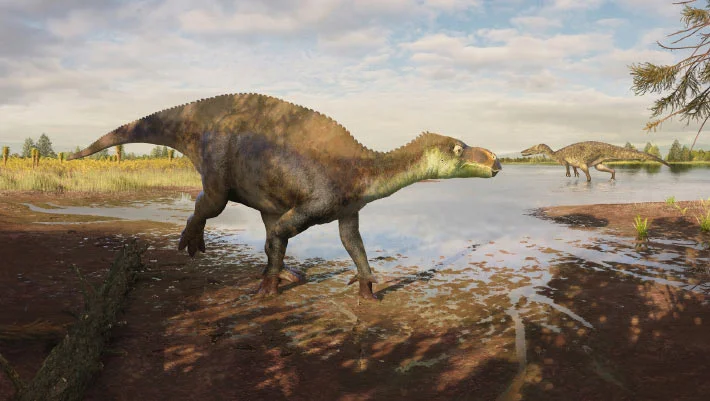
Visualization
The rich tapestry of prehistoric life has woven a new thread as paleontologists unveil a previously unknown genus and species of iguanodontian dinosaur, Paludohadros proudlovii, following the analysis of a partial skeleton unearthed in a Surrey brickworks back in 2001. This significant finding emerges from the stratified layers of the Weald Clay Formation, a geological landscape that narrates the stories of creatures that roamed the Earth approximately 125 million years ago during the Early Cretaceous period.
This discovery marks a pivotal addition to the evolutionary narrative of the Iguanodontia, a clade recognized as one of the earliest identified groups of dinosaurs, rooted deep within the ornithischian lineage. Lead author Ricardo Sacamoto, a dedicated Ph.D. student at the Natural History Museum in London and the University of São Paulo, elaborates on the Iguanodontia's historical significance. This group was first and formally defined in 2021 to include early representatives such as Dryosaurus altus, Iguanodon bernissartensis, Rhabdodon priscus, and Tenontosaurus tilletti. Not only does this add depth to our understanding of dinosaurs spanning from the Middle Jurassic to the Late Cretaceous, but it also challenges previously held beliefs about their diversity during the Jurassic era.
Paludohadros proudlovii, based on available fossil material, has been reconstructed to measure around 5 meters (16 feet) in length with an estimated mass ranging from 1.5 to 2 tons—size comparable to a modern rhinoceros. Importantly, the skeletal evidence suggests an individual specimen that was likely a juvenile and, if it survived, could have potentially grown to reach double its size. Sacamoto reflects on his initial encounter with the fossil, recalling the thrill of recognition when he discerned its distinctive features pointing to a new species. “Paludohadros proudlovii is the first species I’ve ever named, and I’m honored to have been able to work on it.”
Geological proximity also enriches the context of this finding. The skeleton of Paludohadros proudlovii was located a mere 100 meters from that of Baryonyx walkeri, a sizable theropod known for its piscivorous diet, although recent evidence suggests Baryonyx had a more opportunistic feeding strategy. Intriguingly, remains discovered within Baryonyx's dental structure included a juvenile iguanodontian, potentially indicating that these two species coexisted in a complex ecological web. As Professor Susannah Maidment, a prominent paleontologist and senior author of the associated study, postulates, these interactions might highlight instances of predation or scavenging among these ancient reptiles.
In a world where habitats underwent significant changes, the swampy lowlands of Early Cretaceous England served as a flourishing ground for diverse ecosystems, where iguanodontians grazed on the lush flora, navigating their dome-headed bodies through dense vegetation. The multitude of adaptations that these herbivorous dinosaurs developed, such as robust thumb spikes—evolutionary adaptations for defense or foraging—exemplify the remarkable evolutionary experimentation that characterized the time.
The research team's findings, substantiated in the Journal of Systematic Palaeontology, invite further inquiries into not just Paludohadros proudlovii, but the broader environmental and ecological interactions that shaped the world of these extraordinary animals. As our understanding of ancient life continues to evolve, the uncovering of Paludohadros proudlovii metaphorically bridges the past to the present, inviting both scientific inquiry and public fascination with the world that existed long before humankind.