Field: Technology
Needle-Toothed Apex: A New Jurassic Thalattosuchian Redefines Crocodylomorph Evolution in Gondwana
Published | Technical Staff
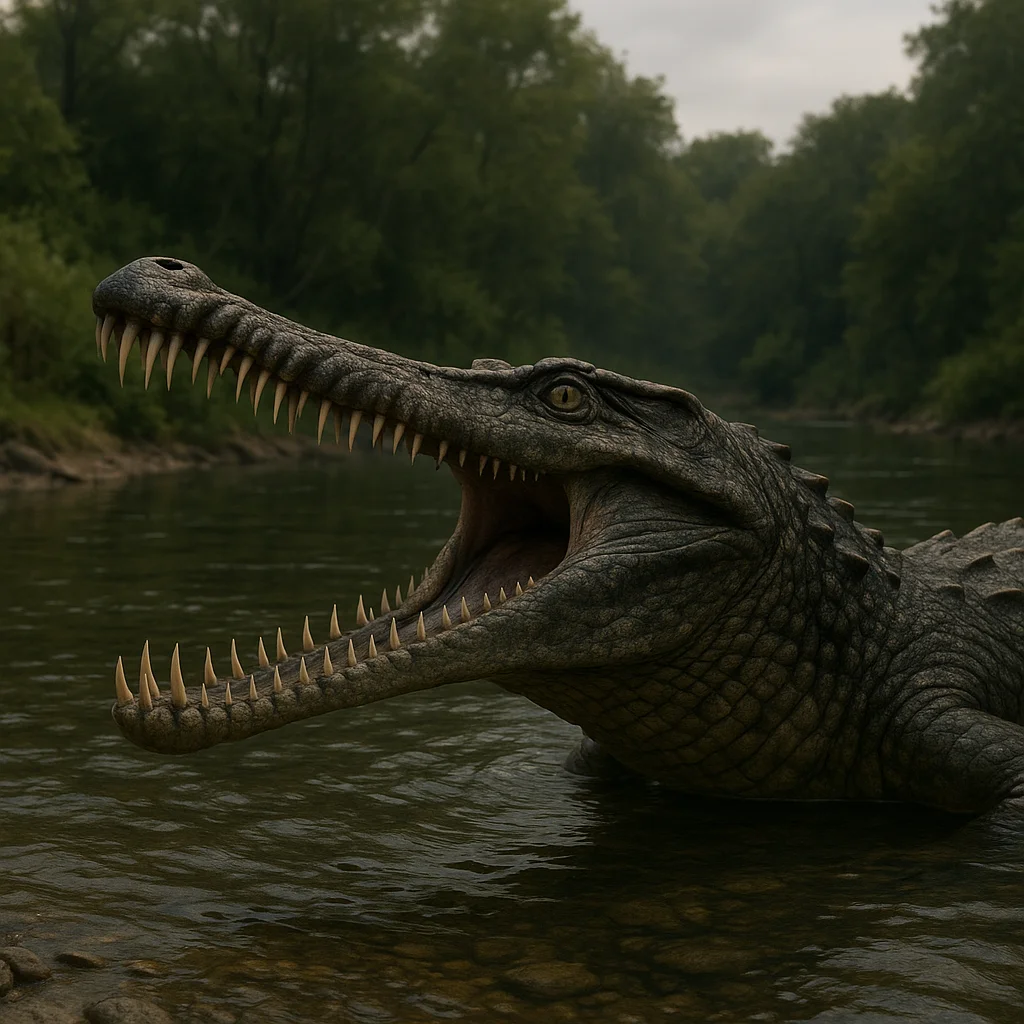
Visualization
Emerging from the crimson mudstones of eastern Morocco’s Talsint-Anoual formation, a newly identified genus and species of teleosaurid thalattosuchian, Ctenosuchus tenuidens, is reshaping our understanding of Jurassic crocodylomorph diversity and adaptation. The fossils, collected from Middle Jurassic strata dating to approximately 165 million years ago, reveal a predator whose oral armature is unlike any previously described within Crocodylomorpha—exhibiting extremely narrow, needle-like teeth, arrayed in an astonishingly dense configuration along an elongated rostrum.
The recovered material comprises two partial specimens acquired through commercial collectors, corroborated with geo-referenced photographic evidence of their provenance. The local sedimentology—red mudstone beds superimposing extensive marine limestones and shales spanning Early to Late Jurassic epochs—suggests episodic terrestrial and lacustrine environments within the broader Mesozoic paleolandscape of the region.
Thalattosuchia, the broader clade to which Ctenosuchus belongs, is renowned for morphotypes that frequently parallel the hydrodynamic streamlining of marine reptiles. Members of this group span a vast paleogeographic range (~97 degrees latitude), though their fossil record remains Eurocentric, with notable exceptions in Gondwanan deposits. Ctenosuchus tenuidens, however, disrupts this narrative; it is not only the first teleosauroid recorded from Gondwana’s freshwater systems, but also the second Jurassic teleosaur from Morocco, following Machimosaurus sp.
The dentition of Ctenosuchus tenuidens sets it uniquely apart. Each maxillary tooth measures roughly an order of magnitude taller than wide—a slenderness index of 10:1—while inter-dental spacing is a mere 2.3 mm. For context, the extant Indian gharial (Gavialis gangeticus), famed for its piscine diet and narrow snout, possesses teeth in its upper jaw separated by approximately 15 mm. Reconstructing the entire jaw margin, researchers estimate a count exceeding 35 teeth per side, vastly surpassing ratios seen in modern crocodylians and hinting at a highly specialized feeding ecology.
This morphology invokes comparisons to the sieving apparatus of certain filter-feeding vertebrates but likely facilitated predation on small, soft-bodied organisms—principally diminutive fish, crustacea, and aquatic invertebrates. While speculative, the possibility of rudimentary filter feeding is acknowledged, paralleling some convergent structures observed in Jurassic pterosaurs. Nonetheless, such functionality in a crocodylomorph archosaur would mark an extraordinary case of trophic innovation within the clade.
The cladistic analysis situates Ctenosuchus tenuidens securely within Teleosauridae, sibling to Seldsienean megistorhynchus and nested within the Aeolodontini. This placement refines our resolution of Thalattosuchia’s phylogeny and highlights a remarkable case of ecological partitioning. The discovery of such a uniquely adapted teleosaurid in a Gondwanan freshwater context not only extends the known ecological plasticity of the group, but also suggests that teleosauroids, while traditionally viewed as coastal or marine-adapted, could radiate into non-marine niches with marked anatomical innovation.
Published in the Journal of Vertebrate Paleontology, this research underscores the imperative of systematic exploration in underrepresented paleoenvironments and calls for reexamination of thalattosuchian distributional dynamics. Ctenosuchus tenuidens stands as a testament to evolutionary experimentation within Crocodylomorpha—its needle columns of teeth, densely packed and exquisitely tailored for a diet of the minute and elusive, offering a window onto Jurassic freshwater ecosystems as yet only partially glimpsed in the fossil record.