Field: Technology
Necks Evolved for Movement, Not Head Mobility, in Early Land Animals
Published | Technical Staff
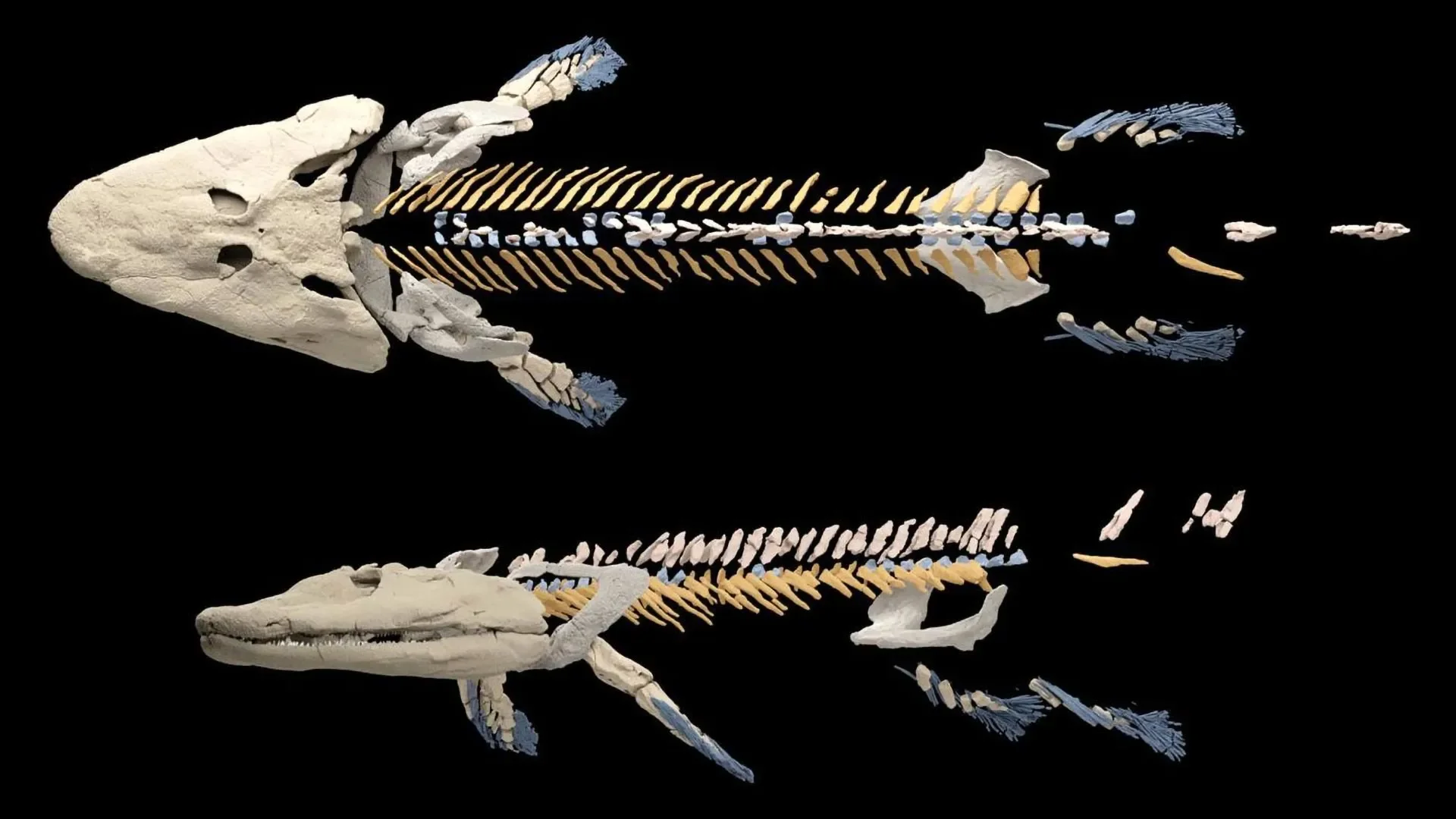
Visualization
In a groundbreaking re-evaluation of the evolutionary adaptations accompanying the transition from aquatic to terrestrial life, recent research from Penn State reveals that the first animals to venture onto land nearly 380 million years ago, contrary to long-held beliefs, possessed remarkably stiff necks. This pivotal study alters the understanding of how neck structures originated, suggesting that they did not primarily evolve to enhance the range of head movement as previously hypothesized. Instead, neck development may have arisen from a broader context of skeletal changes that facilitated the use of front limbs for locomotion.
The research gathered an international team of scientists who synthesized new fossil evidence with innovative experiments on extant species and advanced computer modeling of ancient anatomical structures. Their findings, published in the esteemed journal *Nature*, underscore a significant paradigm shift in our understanding of one of Earth's most critical evolutionary transitions—the emergence of the first land-dwelling vertebrates.
Tom Stewart, an assistant professor of biology at Penn State and a key contributor to the research, elaborated on this juncture in evolutionary history. This era coincided with the formation of early terrestrial ecosystems, a time when the planet itself underwent radical transformations that set the stage for the evolution of complex life forms. Unraveling the mechanisms behind our own lineage's adaptation from an aquatically dominated existence to one marked by land-based exploration is crucial. Notably, many anatomical alterations evident in pioneers of terrestrial life remain visible in contemporary vertebrate anatomy.
For decades, the accepted narrative posited that necks had evolved to enhance the mobility of the head, providing early tetrapods—the ancestors of all four-limbed vertebrates—with the ability to scan their environment more effectively. The prevailing theory was simple: as early vertebrates adapted to a land-dwelling lifestyle, the capability to turn their heads without realigning their entire bodies would confer significant survival advantages—locating prey, identifying threats, and exploring the new world became more manageable tasks.
However, the challenge lay in deciphering the biomechanics of these ancient animals. Soft tissue, which constituted a vital component of the vertebral column, rarely persisted through time to be fossilized, leaving a substantial gap in understanding the functional dynamics of these early neck structures. Stewart noted this limitation, suggesting that researchers often turned to modern analogs, like birds, which inform our comprehension of extinct organisms' mobility.
The Devonian Period, approximately 420 to 360 million years ago, yielded some of the requisite fossils that illustrate this evolutionary transition. Fossils from this period exhibit a unique combination of aquatic fish traits and adaptations conducive to terrestrial life. Some species developed robust fins capable of supporting their bodies out of water, while others began to display a distinct morphological separation between the head and shoulders, indicating the inception of what we now recognize as necks.
Among the pivotal fossils is Tiktaalik roseae, a landmark discovery first described in 2006. Found on Ellesmere Island in Nunavut, Canada, Tiktaalik serves as a critical link in the evolutionary chain, showcasing the anatomical shifts occurring in vertebrates on the brink of life on land. For decades, it has been assumed that the separation of the head from the shoulders resulted in enhanced head mobility, driving the evolution of the tetrapod body plan.
The research team, in pursuit of confirming the proposed hypothesis regarding neck evolution, looked to contemporary sturgeons for insights into these ancient aquatic vertebrates. Sturgeons, often referred to as living fossils due to their retention of various primitive features, offered a valuable model because their spinal structures include a notochord—a flexible, rod-like structure that supported early vertebrate forms.
To investigate the mechanics of the notochord, researchers measured its stiffness and other mechanical properties in modern sturgeon, translating those measurements into models that represented fossilized species like Tiktaalik. By incorporating these biomechanical insights into anatomical reconstructions of early tetrapods, the team could simulate potential neck movements.
The results were unequivocal. Evidence suggested that even with a clear delineation between the head and shoulders, the structure of the vertebral column, conditioned by the notochord, offered considerably limited mobility. Thus, the necks of the earliest terrestrial vertebrates were not the flexible structures they were once thought to be. Instead, they were markedly stiff, underscoring a new understanding of their anatomical function during a critical transition in the evolution of life.
As the research unfolds, it becomes increasingly clear that while modern tetrapods have ultimately evolved a greater degree of neck flexibility, the earliest adaptations were likely part of a complex suite of anatomical changes enabling the first terrestrial forays. These findings not only challenge long-held beliefs about the roles of necks in vertebrate evolution but also pave the way for further inquiries into how anatomy has shaped the evolutionary narrative across the epochs.