Field: Technology
Nearly 3,000 Exploding Stars Challenge Our Understanding of the Universe
Published | Technical Staff
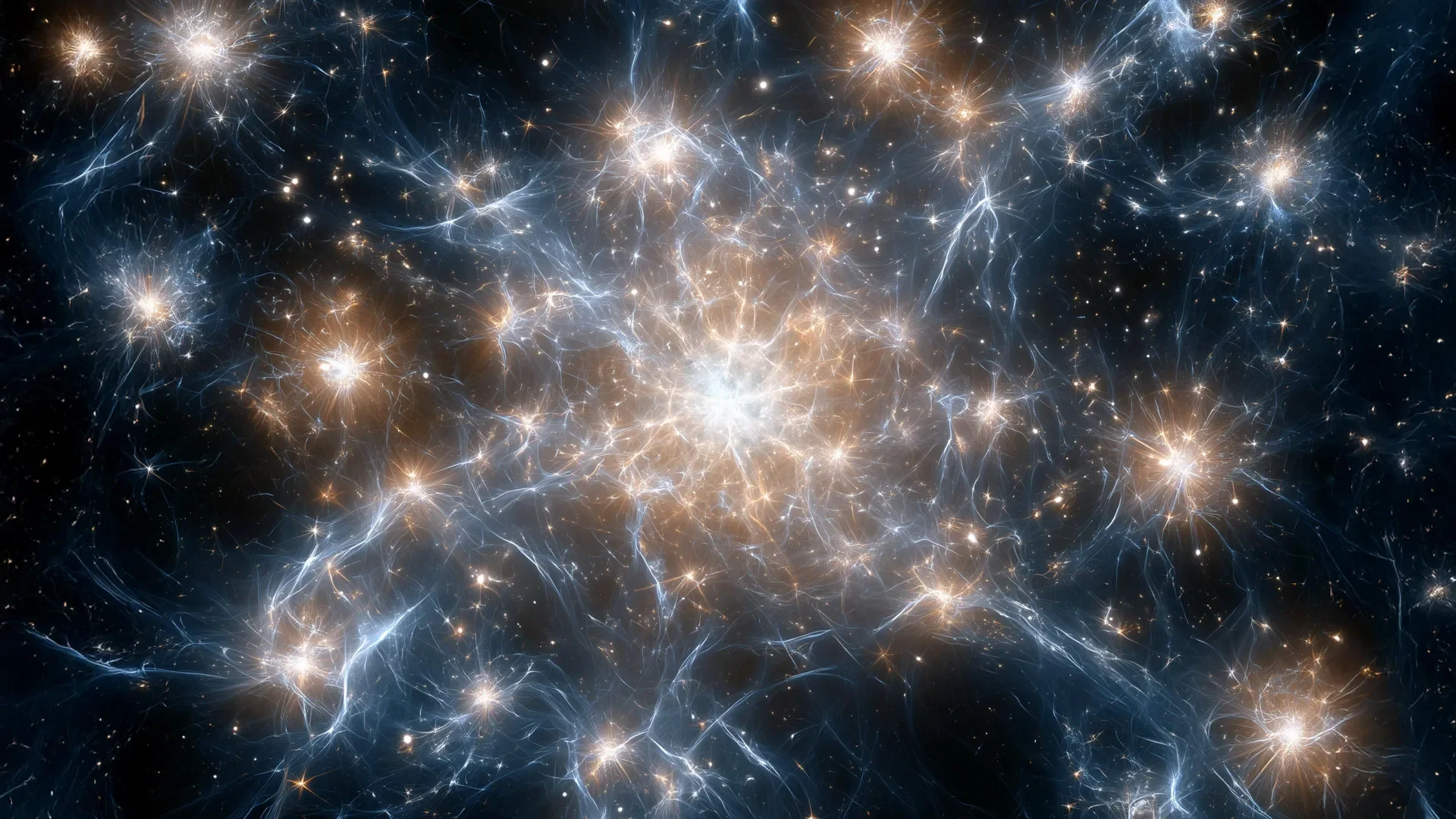
Visualization
In a groundbreaking study led by the University of Queensland’s School of Mathematics and Physics, cosmologists have compiled a formidable database of 2,884 Type Ia supernovae, which has led to compelling evidence suggesting that dark energy—a pivotal component in our understanding of cosmic expansion—may not be the fixed, immutable force long assumed. This revelation marks a significant departure from a cornerstone of modern cosmology and opens the door to profound implications regarding the universe's evolution.
Type Ia supernovae occur when a white dwarf in a binary star system accrues enough mass from its companion, eventually leading to a thermonuclear explosion. These luminous events have historically served as standard candles in astrological measurements due to their consistent intrinsic brightness. By embracing this consistency, astronomers can calculate the distances to these exploding stars, thereby tracing the history of the universe's expansion through Hubble's law, given by \(v = H_0 \cdot d\), where \(v\) is the recession velocity, \(H_0\) is the Hubble constant, and \(d\) is the distance.
Researcher Ryan Camilleri, a PhD candidate involved in the project, articulates that this extensive compilation, the largest of its kind to date, synthesizes several decades' worth of astronomical observations into a cohesive dataset. The team meticulously revisited historical records, applying refined analytical techniques that accommodate a growing comprehension of supernova behavior. This iterative process is crucial, as previous models may not have accurately depicted the phenomena due to various distortions affecting luminosity measurements, such as interstellar dust attenuation and gravitational lensing effects, which can skew data and lead to misleading conclusions.
It’s important to note that this latest dataset incorporates not just prior supernova observations but also integrates data from other significant astronomical efforts, including relic light from the Big Bang and comprehensive galaxy distribution maps. The result is a nuanced understanding of cosmic expansion that deviates from the traditional framework positing dark energy as a constant force throughout cosmic history. In Professor Tamara Davis’ analysis, the findings resonate eerily with independent observational data gathered from the Dark Energy Spectroscopic Instrument (DESI)—another challenging metric suggesting a possible variability in dark energy over time.
The implications of such a discovery are staggering. Should dark energy indeed exhibit temporal variability, the cosmological constant that has wielded influence over our understanding of cosmic mechanics would need reevaluation. The congruence of findings from different studies suggesting time-variant dark energy constitutes a compelling argument for the scientific community to probe deeper into this phenomenon. This inquiry extends beyond mere academic interest; it might hold the key to harmonizing two fundamental, yet disparate, theories in physics: gravity, elucidated by General Relativity, and the quantum mechanics governing the subatomic realm.
As researchers advance into unexplored territory, the Dark Energy Bedrock All-Sky Supernova program (DEBASS) is set to further enrich this evolving corpus of knowledge by identifying a wider array of supernovae—especially those occurring within closer cosmic vicinities. Such studies will enable scientists to scrutinize the expansion of the Universe from a new vantage point, determining whether the apparent shifts in dark energy are persistent or merely ephemeral anomalies.
The collaborative essence of this research echoes through various institutions globally, encompassing the contributions of countless astronomers and researchers who have delved into the intricacies of supernovae—from the Dark Energy Survey to the Supernova Legacy Survey, and beyond. Collectively, these projects have underscored the imperative of integrating multi-faceted observational frameworks to enhance the robustness of cosmological models.
As these revelations unfold, the broader astrophysical community hangs on the precipice of redefined cosmic understanding, inviting further explorations into the very fabric of the universe. The enigma of dark energy—whether it bends or remains fixed—will not only concentrate the minds of theoretical physicists but may also pioneer new pathways toward a unified theory that bridges the realms of gravitation and quantum mechanics, fundamentally reshaping our grasp of existence itself.