Field: Technology
Nearby Dwarf Galaxies are Missing Most of Their Oxygen, Hubble Data Show
Published | Technical Staff
Visualization
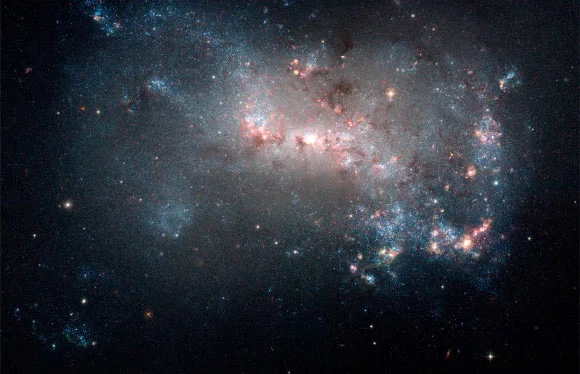
In an enlightening exploration of galactic evolution, recent observations from the NASA/ESA Hubble Space Telescope have unveiled a striking phenomenon: gas-rich dwarf galaxies retain only a fraction—approximately 11% on average—of the oxygen produced by their stellar populations. This revelation emerges from a meticulous census conducted as part of the Galaxies Losing Oxygen via Winds (GLOW) project, which scrutinized 37 dwarf galaxies within a vicinity of around 19.5 million light-years from our planet, each possessing stellar masses ranging from 3 million to 3 billion solar masses.
Oxygen, predominantly synthesized in stellar interiors through nucleosynthesis during stellar evolution and explosive supernova events, is typically expected to contribute significantly to a galaxy's baryonic matter. Dr. Grace Telford, an astronomer at the University of Utah, articulated the paradox that while oxygen was once concentrated within these galaxies, evidence suggests it has largely been expelled into the vast intergalactic medium. The mechanisms driving this ejection appear to be the energetic outflows propelled by massive stars and subsequent supernova explosions, which impart kinetic energy sufficient to disrupt the gravitational bindings of galactic gas.
Utilizing Hubble's observations, the research team meticulously reconstructed the star formation histories of the analyzed dwarf galaxies. By quantifying the oxygen content across various galactic components—gas, stars, and dust—they discovered a retention rate varying from 4% to 25%. Intriguingly, nearly all of the retained oxygen exists in gaseous form, suggesting a substantial portion has traversed beyond the galactic confines, potentially enriching the surrounding circumgalactic medium.
The investigation also delineated a significant correlation between the proximity to massive neighboring galaxies and oxygen retention. Dwarfs situated more than 3.3 million light-years away from substantial galactic influences exhibited a consistent retention of less than 15% of their oxygen. In stark contrast, those encircled by denser environments displayed greater variability, indicating potential mechanisms for oxygen recycling or accretion of metal-enriched gas from neighboring massive systems. This nuanced interplay raises fundamental questions: Is the elusive oxygen encapsulated in the circumgalactic medium, or has it completely escaped the gravitational clutches of these dwarfs?
Previous ultraviolet assessments of ionized oxygen have accounted for a mere 1-7% of total oxygen production in these galaxies, yet when corrected for other ionization states, the GLOW project estimates that halos surrounding these dwarfs could capture up to 35% of this vital element, positing that a considerable fraction may have dissipated beyond the galaxies’ gravitational confines.
To provide context for their findings, the astronomers engaged with three cosmological simulations which affirmed the mass-metallicity relationship prevalent in galaxy formation theories. However, these simulations predicted greater metal retention in dwarf galaxies than the empirical data suggested. A refined galaxy-evolution model proposed by the researchers indicates that smaller galaxies tend to jettison larger amounts of mass, that the outflows carry gas that is approximately double the metallicity of the interstellar medium, and highlights a suppression of gas accretion by roughly 40%.
Dr. Kristen McQuinn, the GLOW principal investigator and mission head at NASA’s Nancy Grace Roman Space Telescope, emphasized the significance of oxygen as a tracer of galactic enrichment processes: “Oxygen is one of the primary elements formed by stars. Understanding its lifecycle—how much is generated, retained, and disseminated—illuminates the broader narrative of galaxy evolution and the enrichment processes affecting the intergalactic medium.”
The rigorous examination of oxygen dispersal within these dwarf galaxies not only challenges existing paradigms but also enriches our comprehension of cosmic chemical evolution, offering profound insights into the formative stages of the universe as galaxies engage in ceaseless cycles of birth, death, and rebirth in the grand tapestry of cosmic history. The outcomes of this pivotal research are detailed in the Astrophysical Journal, marking a significant stride in our understanding of galactic dynamics and elemental distribution in the cosmos.